
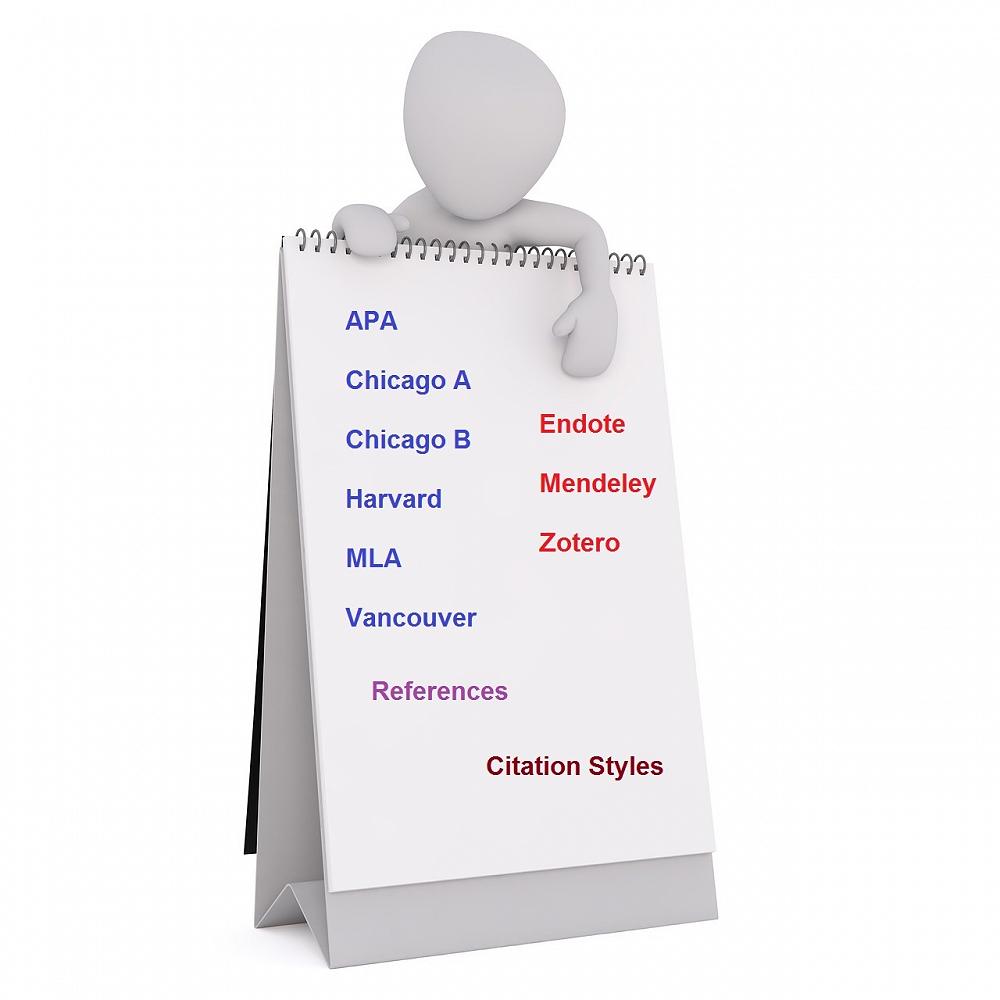
References, Citations Styles, and Reference Management Software
Referencing is part of a policy of Academic Integrity that the University of Otago adheres to.
What is referencing?
Referencing/citing is basically a process of indicating the sources of information you used to inform your assignments / research. The general rule is that if you are writing about a concept, theory or idea that is not your own or is informed by the work of another, you should reference/cite it.
Note: The terms cite and reference (or citing and referencing) are often used interchangeably.
There are two steps to the process of referencing:
Adding a citation in the body of the assignment/research at the point where you have drawn on the ideas, or even included a direct quote, from another source.
To provide a list of those citations/references (called, a Reference list), with all the publication details necessary to find it (if possible) if the reader felt inclined.
Note: Some referencing styles use a bibliography instead of a reference list. A reference list only includes works cited/referenced in the assignment. A bibliography includes all works consulted for the assignment, cited in the document or not.
Citation / Referencing Styles
There are a variety of ways to format the citations / references, and these are often referred to as citation styles or referencing styles. The style you use is dictated by the Academic department you are studying through and the style they use. The style is usually specified in the course outline of your papers or by your supervisor.
The Library has developed an online a Referencing Styles guide [otago.libguides.com/managingreferences]. The guide provides links to referencing manuals in the Library collection, referencing/citation style websites or blogs, pdf guides and interactive tutorials developed by various educational institutions. The following styles are covered:
ACS (American Chemical Society)
APA (American Psychological Association)
Chicago A
Chicago B
CSE (Council of Science Editors)
Harvard
MLA (Modern Language Association), and
Vancouver
If you get stuck on an aspect of referencing, you are welcome to contact your Subject Librarian: otago.libguides.com/liaison
Reference Management Software – EndNote
If you are undertaking a large research project or are likely to use the same references repeatedly in your course work, you might consider using some reference management software.
This software can retrieve and store the publication details of your chosen sources of information (e.g., books, articles, websites, theses, etc.) and sometimes the publication itself (e.g. a pdf of the article). The publication details can then be generated into a reference list, in a wide variety of styles.
Most reference management software offers a ‘cite while you write’ option so you can insert citations into the body of your work as you write or add them later.
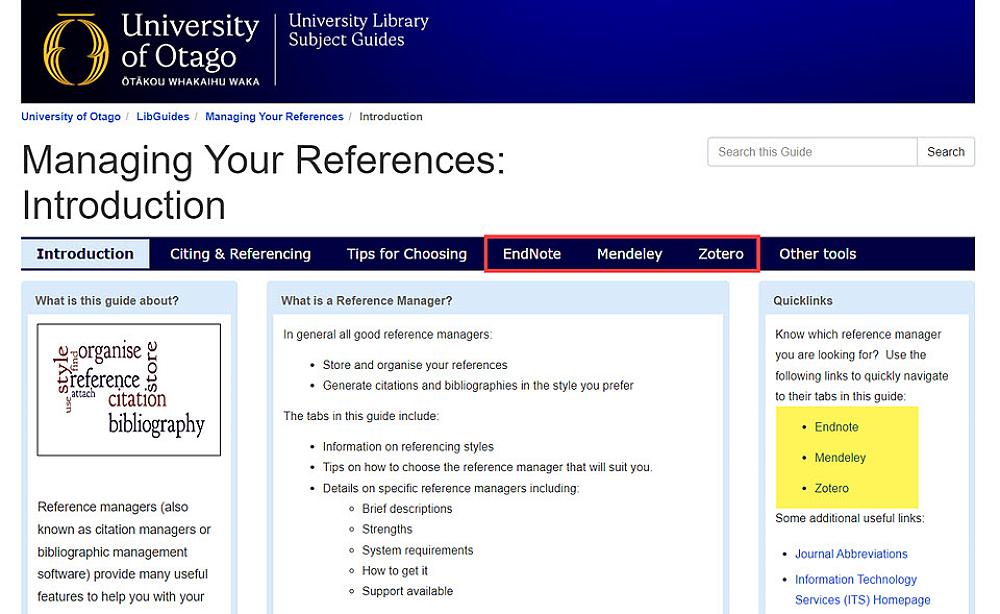
The three most commonly used reference management tools at the University of Otago are: Zotero, Mendeley and EndNote.
Mendeley and Zotero are open source. This means they are freely available to download and install, and the maintenance and updates to the software is open and collaborative. Both options have their own websites and training videos and more information is available on the Managing References guide: otago.libguides.com/managingreferences.
EndNote is not open source, but the University provides fully subsidised access to this product for students. Just fill out this online request form: https://ask.otago.ac.nz/software-request-student-form/
Clarivate provides a range of support for EndNote, including online chat and videos. The following link directs you to information, guides and videos that have been helpful to EndNote users at the University of Otago. Some of these resources have been created by ITS and the Library but are no longer being updated.
EndNote resources on the Library Services Guide for Postgraduates: [https://otago.libguides.com/pgworkshop/EndNote]