
Ethical Use of AI at Papanui High School
Artificial Intelligence (AI) is becoming an increasingly common tool in education, offering students new ways to enhance their learning. However, at Papanui High School, we emphasise the importance of using AI ethically and responsibly.
What is AI?
AI, or artificial intelligence, refers to computer programmes that can generate text, images, and even music. Popular examples include ChatGPT and DALL-E. While these tools can be helpful, they do not "think" or "understand" like humans do. Instead, they predict responses based on vast amounts of data.
Using AI Responsibly
AI can be a valuable learning aid when used correctly. Students can use it to:
✔ Generate practice questions
✔ Summarise or explain difficult concepts
✔ Create study plans
However, using AI to complete assignments or assessments is a form of plagiarism and will result in serious consequences, including losing grades and parental notification. AI-generated work does not accurately reflect a student’s ability and learning.
The Role of Critical Thinking
Since AI can sometimes provide incorrect or misleading information, students must apply their critical thinking and literacy skills to evaluate its output. AI should complement learning, not replace it.
Guidelines for Ethical AI Use
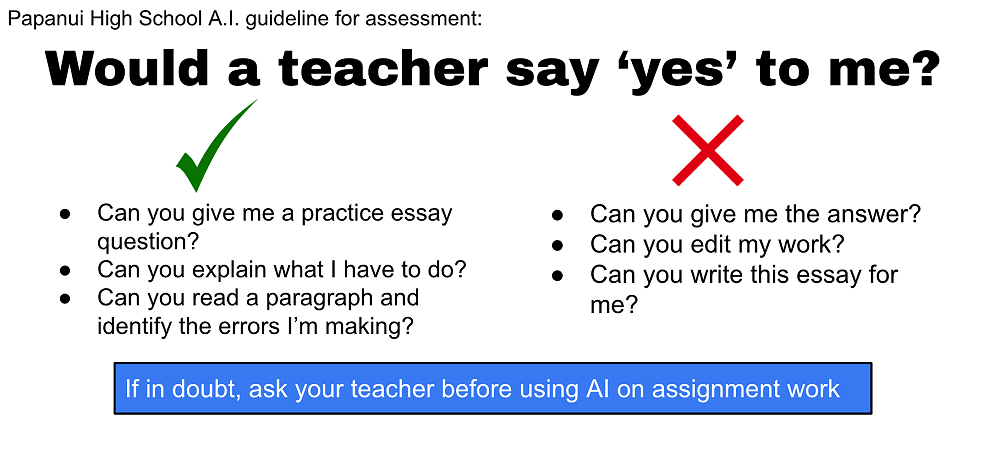
At Papanui High School, we encourage students to ask themselves: "Would a teacher say yes to me?"
✔ Acceptable: Using AI to clarify instructions or generate practice questions
✖ Unacceptable: Using AI to write an essay or complete an assessment
If in doubt, students should check with their teachers before using AI for schoolwork.
By understanding how to use AI responsibly, students can develop the skills they need for success while maintaining academic integrity.
Mike Smith
Lead Teacher - Digital Tools