
A Recipe for Selective Eating
Taking a positive, pressure free, food experiences approach can be helpful for navigating selective eating.
Our specialist team is often asked for advice and support to address concerns with a young person’s eating and drinking. Some of the concerns are related to eating and drinking safety. The number one concern is about selective eating!
Concerns shared include:
- Eating only a very limited range of foods
- Strong preference for specific brands
- Eating according to colour (beige is popular!)
- Avoiding specific textures, smells
- Reluctance or refusal to “try” new foods
- Rituals around foods
- Social relationship aspects of eating and sharing food together
- Having to reject an offer of food in social and cultural situations
- Expense of wasting foods if tried but not liked
- Physical health and the part that diet plays in this
What we know:
Eating involves each of the main senses, touch, smell, sight, sound and taste. All of us process sensory information differently. Some of the young people we support have very different ways of processing and coping with information coming in from the world around them. This may make interactions with food challenging and maybe even scary.
Some young people seem to have “rules” about eating certain foods which may not be immediately apparent. Rules can have to do with brands (labels, packaging), how and when they will eat certain foods, shape, colour, texture, temperature, smell or taste.
Over half of Autistic young people are unwilling to try new foods.
It is important to seek medical advice to rule out any physical reason for the young person’s behaviours around eating. Some medical conditions can cause young people to avoid eating, crave certain categories of foods, etc…
Please see a medical professional if you are concerned that any of the following may be impacting your young person:
- Stomach or intestinal pain (related to digestion, IBS, SIBO, other conditions)
- Medications (side effects can include loss of appetite or irritation of the stomach lining)
- Constipation
- Reflux
- Coughing around mealtimes
- Changes in voice around mealtimes
- Food allergy or intolerance
- Physical difficulty with chewing or swallowing
- Recurrent respiratory infections (can be a sign of ongoing aspiration)
- Dental issues
- Chronic hiccups
- Other (such as poor positioning or lack of stability when eating which can make eating/swallowing difficult, cause pain, reducing the ability to easily self feed)
Good news!
Environment and approach isn’t the whole story, but can have a significant impact on eating behaviour. This is good news! It means that if we know what to look for we can make changes now toward more successful mealtimes in future.
Top tips and things to do:
- Make sure your child is well supported at the table (feet on the floor or stool, forearms on the table, table at mid chest height, back against the back of the chair or cushion)
- Set routine, eat at the same time, in the same room, at the same table repetition helps with learning.
- Limit the time your young person is expected to sit at the table and increase it slowly
- Involve your young person in the meal prep and decision making
- Try introducing a new food on a separate plate, don’t expect the child to taste it straight away. Work up to having it on their plate and touching it before expecting the young person to eat it
- Talk about the food, what it looks like, that does it smell like, what does it feel like
- Offer 3 different food categories, one fruit/vegetable, one protein (cheese, egg, sliced ham etc) and a starch (cracker, muffin, bread etc)
- Use food in art activities, painting with tomato sauce/mustard, make pictures with pasta, create vegetable ‘stamps’ check these out!
- Use non-food items to create food art. These ideas on Pinterest are very cool!
Helpful Resources:
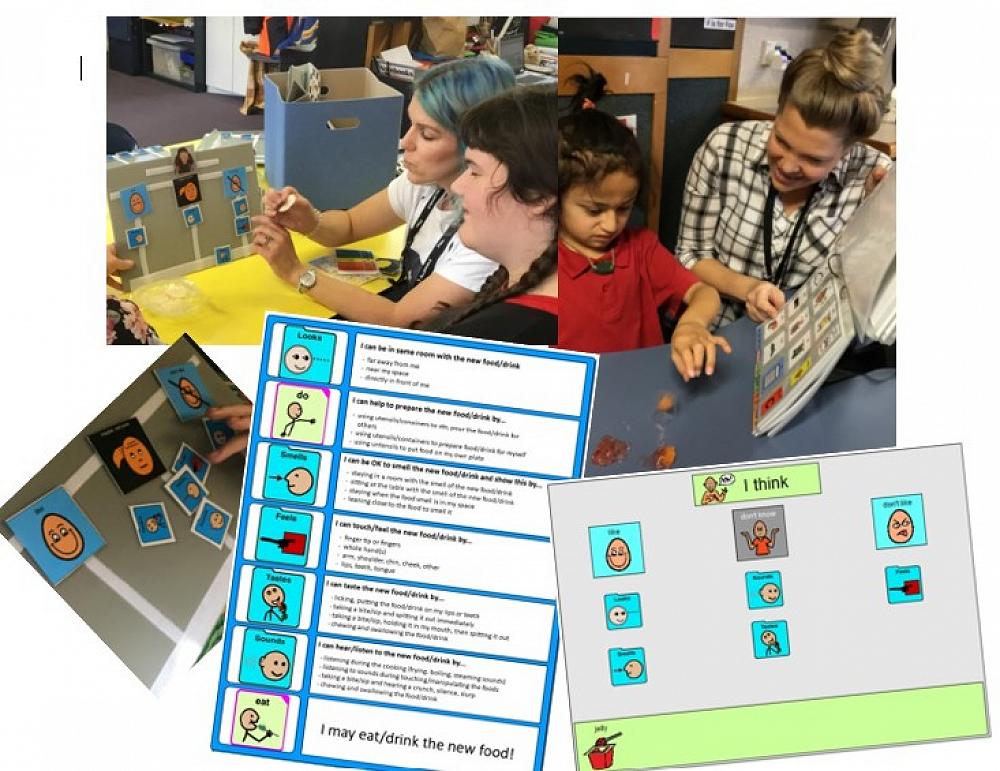
The Introducing New Foods card gives information about supporting positive food experiences. It is very important to remember that the goal is to establish a positive relationship with food. The goal is not to eat the food, though this may happen! The Food Diary and Food Inventory may be useful tools in capturing the current picture of your young person’s eating. They can be useful for you to reference when discussing concerns with relevant professionals. The Food Chat Boards may be helpful alongside your young person’s other communication system. Happier Mealtimes is a CDHB informative resource that many people find useful.
Please contact Victoria Tui'i, OT, or Michelle King, SLT and Specialist Services Team Leader, if you are interested in more support or advice on this topic.