
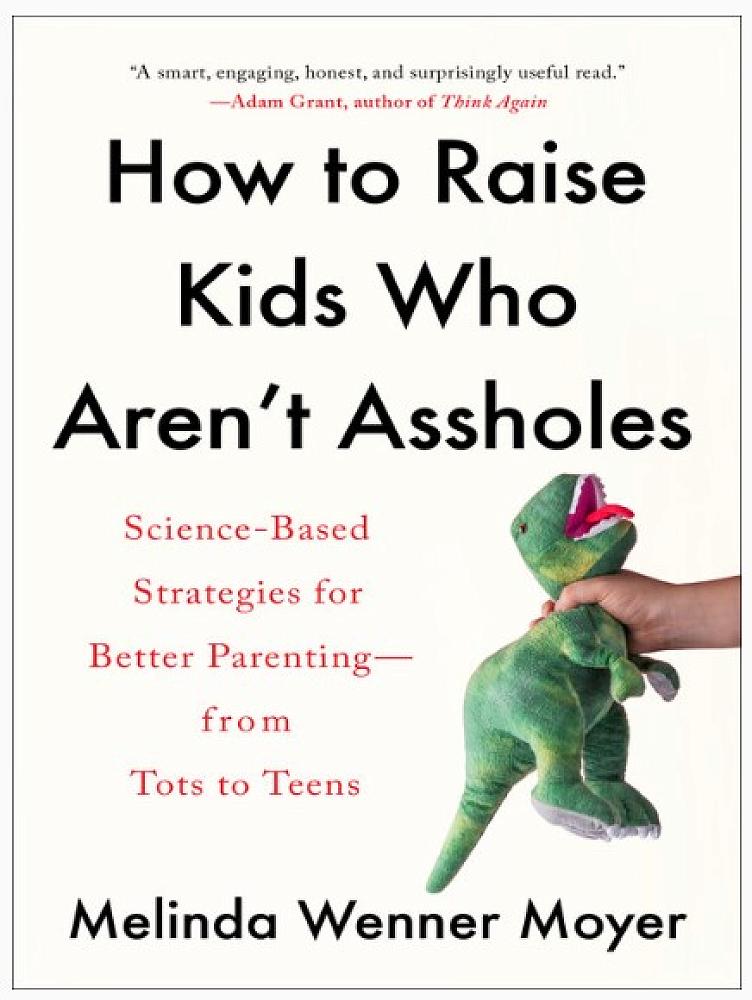
How to Raise Kids Who Aren’t Assholes
Science-based Strategies for Better Parenting – from Tots to Teens, written by Melinda Wenner Moyer
The author uses her science background to provide research-backed strategies to support parents in developing their children’s character. Below is a compilation of some key points relating to teenagers from Moyer’s book:
Kindness
· When asked what sort of person they want their children to grow up to be an overwhelming number of parents say kind. Undoubtedly, being kind is important.
· “Kindness reaps its own rewards. Research suggests that generous individuals live longer and have better health than stingy grumps. Being kind and helpful also reduces symptoms of depression, anxiety and stress and causes people to feel more energetic in what is known as a ‘helpers high’”.
· Being kind makes people happier too
· By raising our children to be selfless we are nudging them down the path towards a successful and happy life.
· Being able to recognise and name emotions is important. However, many young men are socialised to see happiness and anger as the only acceptable emotions. We need to work to help young men recognise the full range of emotions and understand that even though some of them might be unpleasant they are simply part of life. This is essential if they are to develop the ability to regulate their responses.
· Parents can help by talking about your emotions/feelings e.g. “I’m feeling a bit stressed/upset/angry/disappointed/happy today because....” and the emotions/feelings you identify in your son’s behaviour e.g. “I can see you are feeling a bit stressed/upset/angry/disappointed/happy today....”
· When your son behaves in a manner that makes you upset/sad/angry/happy tell him that – name the emotion and link it to his behaviour
· Research found that when parents discipline young people with explanations of how their actions affect others they are more likely to grasp the significance of their choices and amend their behaviour.
· When young people help with jobs at home – especially when they do tasks that directly assist other people – they also become more compassionate.
· Teens who participate in community service and who are encouraged to reflect on their involvement have better attitudes towards others and do better in school than teens who don’t. So, if your son volunteers, talk to him about how his volunteering makes him feel and how it might be contributing to the community.
Values
· We all have ideas about how we want our children to behave in particular situations and what values we want them to develop
· We need to make these expectations explicit – talk to your son about the values you believe are important and model them.
· Draw up a list of family rules or values, give your son the opportunity to contribute to this process.
Motivation
· Motivation and effort – not IQ – is what separates those who accomplish the most from those who accomplish the least
· Some research suggests that IQ itself is rooted in effort and motivation
· To develop Grit – the will to persevere in the face of challenges and difficulty – encourage your son to try new, engaging and difficult things
· People have Grit when they enjoy what they do (interest), have the self-control to engage in regular and deliberate practice to improve their skills (practice), believe that what they are doing is important and has a positive impact on others (purpose). People with Grit can remain optimistic in the face of challenges (hope).
· ‘Success Spirals’ – when young people have the opportunity to achieve something that feels good, that accomplishment instills confidence, which then motivates them to more accomplishments. Parents can work with their sons to identify opportunities for achievement – e.g. learning a new skill such as cooking or working through the process of getting a driver’s licence.
Mindest
· Praise effort rather than skill or ability
· Young people who are praised for their effort are more likely to choose to take on challenging problems and are more likely to persist in trying to solve them.
· “When you praise kids for smarts or ability, they become less interested in learning and overcoming challenges and they become more interested in safeguarding their reputation. In a nutshell, they lose motivation and launch into self-protective mode. Those who are praised for working hardy, on the other hand, are more likely to embrace challenge and stay motivated.”
Procrastination
· Most young people are procrastinators
· People procrastinate because they’re bored, scared of the task (scared they might fail for example) or because they’re frustrated because the task is too hard
· One solution is to help make the task seem less intimidating by breaking it down into smaller manageable chunks – teenagers need help to do this
· Have your son set deadlines with a group of mates so that he feels accountable to them
· Help your son identify and eliminate distractions
Rewards
· Don’t rely too much on rewards
· Rewarding adolescents for specific behaviours can erode their innate desire to do these things in the future
· Use rewards sparingly and for tasks that your son despises
· For other tasks work with him to help him develop his intrinsic motivation – e.g. how might completing the task help others in his family
Bullying
· Research tells us that parents overestimate the chances that their child will be bullied and woefully underestimate the chances that their child will do any bullying
· Parents of bullies are among the least likely to think that their children are bullying
· Most bullying is spoken about as if one person is 100% evil and the other is 100% innocent. “In reality, kids can frequently bully, occasionally bully, or bully one day and be bullied the next. Some never instigate bullying but still laugh along with the perpetrators. Put another way, bullying is a continuum and a child’s involvement and role can change from day to day.”
· “Research suggests that what happens at home, and how parents talk to their kids about bullying and anger, can influence whether or not kids act aggressively toward other kids.”
· When young people don’t get the care and attention they need at home they are more likely to bully others
· The “parents who are least likely to end up with children who bully others are those who adopt an authoritative parenting style – they set boundaries and rules, but they also listen to their kids and negotiate with them, and explain their reasoning rather than barking orders.”
· “Research has shown that authoritarian parents, who are more distant and treat their children with less respect and independence, are much more likely to wind up with kids who have trouble controlling their aggression.”
· Regularly talk to your son about bullying – “Make sure they understand that it’s less about their intention than the other person’s interpretation.”
· Talk to your son about being an upstander and responding when they see bullying behaviour – if they aren’t comfortable speaking up in the moment, explain they can still make a difference by supporting the victim
· Teach your son about anger – talk to him about feelings and emotions, help him to label and talk about his
· Allow your son to experience emotions without shaming him – telling him to calm down, cheer up, grow up etc. does the opposite as it gives the message that expressing feelings is unacceptable and he should bury them instead
Lying
· Your son will do as you do, not as you say. Your children have probably heard you lie, even if you don’t think you have – think of the times you might have withheld the truth so as not to hurt someone’s feelings
· It’s important to have conversations about when it’s ok to tell certain kinds of lies (such as to spare someone’s feelings or embarrassment) and when it isn’t (for personal gain)
· Kids are more likely to lie if they have older siblings – they learn by example
· “When you catch your child in a lie, try to stay calm. Point out what he has just done and tell him what you expect him to do – which is to tell the truth regardless – and tell him why it’s important to tell the truth.”
· Frame discussions on the importance of honesty rather than focusing on the dishonesty
· Be open with your son about your life: “Research suggests yes – the more we share with our kids, the more open they’ll be with us.”
Parenting Styles
· “Kids do and behave well when they’re led by an adult who is respectful and supportive. On the other hand, they become aggressive or apathetic when led by an adult who bosses them around and shows them little respect, or one who provides no guidance or rules at all.”
· “Authoritarian parents believe in a clear family hierarchy and expect their kids to adhere to strict rules. They aren’t particularly warm or supportive, they discourage negotiations, and they punish frequently (and sometimes inconsistently and without explanation).”
· “Permissive (or indulgent) parents are the opposite: they are accepting of their children’s behaviour, consider kids and parents as essentially equals, don’t use punishment, and often give in to their kids’ demands and whines.”
· “In between these two extremes are the authoritative parents, who are neither coercive nor indulgent. They are responsive but also demanding, affectionate but also willing to assert their power. In authoritative parenting love and control aren’t two ends of a spectrum, but two separate dimensions—parents can be both loving and warm as well as highly demanding. Authoritative parents encourage a child’s individuality and are willing to explain their reasoning and negotiate with their kids, but they also provide clear structure and boundaries.”
· Authoritative parents typically start with clarification and reasoning and they are flexible and willing to listen and negotiate
· “Authoritative parents want their children to adhere to social conventions and moral codes, but they also want to preserve their kid's free will and independence. They respond specifically to misbehaviour and keep their explanations centred on that specific behaviour” rather than making comments/judgments about their child
· When you talk to your son about his choices (behaviour), try and link those choices with the impact they have on other people’s feelings and lives