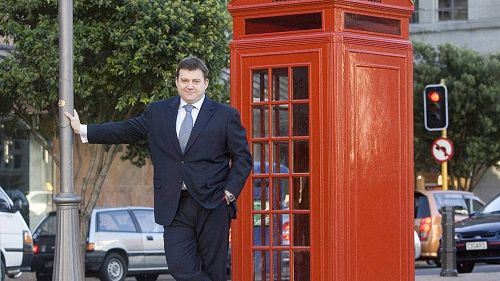
Clash of the codes? Bart Campbell's conscience clear as he returns to his rugby roots
Conflict of interest? Try an over-abundance of it. New Zealand rugby’s latest boardroom mover and shaker, Bart Campbell, might have spent the last seven years ensconced in that other code in Melbourne, but there is no shortage of the XV-man game cascading through his veins.
He’ll likely need it, too, for what lies ahead. Campbell is managing a strategic exit from his position as chairman, and a hefty shareholder, at the NRL’s Melbourne Storm. He is doing so because it’s the right thing to do as concerns his latest dual roles as an independent director for New Zealand Rugby and a member of World Rugby’s powerful executive committee.
At a time when rugby, both in New Zealand and globally, is having to dig out of the deep hole served up by the global pandemic, this Kiwi will be central to pivotal decisions in virtual boardrooms of both hemispheres. And his sudden elevation to the game’s corridors of power has not come about by chance either.
Some eyebrows were raised when Campbell’s new rugby responsibilities were unveiled this year, but none from those connected with the inner-sanctums of New Zealand rugby. This is a capable, connected, motivated entrepreneur whose links with his native country’s national game have been maintained throughout a high-flying career.
Put simply, the love of rugby has never left this 49-year-old go-getter, despite his gravitation towards the other code when he came on board as part of the new ownership group with the Storm in 2013. That was business and, as he makes clear in an exclusive interview with Stuff from a second lockdown in his Melbourne home, it has neither compromised, nor conflicted, his passion for rugby.
Campbell was born in New Plymouth and raised in Palmerston North in a boots ‘n all rugby family. He is the nephew of former All Blacks coach JJ Stewart (“a hero of mine as a kid and a great influence”) and his father Terry played senior club footy in the Taranaki and coached the Massey University Bs in the top Manawatū competition.
“That Massey team had a chap named Neil Barnes (now an assistant coach with the Chiefs), and one thing I got out of Neil Barnes was an expanded vocabulary,” muses Campbell of his formative years.
“It was going along to trainings as a kid, kicking balls on the sideline, going to the clubrooms on Saturdays … I played, with no distinction of any sort, from the age of 5 to 27 (he was a far more accomplished cricketer) and as a youngster the ’87 World Cup in New Zealand was a seminal thing for me.
“Those experiences culminated in heading off to Otago University and being around some great characters from that NPC team of the early ‘90s – your John Leslies, Marc Ellises, John Timus – and being on the fringes of that socially, watching those guys was really enjoyable.”
Eventually Campbell, who studied law and arts at Otago, and did his masters in commercial law at Auckland, gravitated into the business of sports management and marketing. His first client was brother-in-law Tabai Matson and what followed was the best part of two decades – mostly in London – at the helm of a succession of influential companies in the form of Global Sports Management, Essentially, CSM and international juggernaut TLA Worldwide. He knows professional rugby, indeed professional sport, inside and out.
Seven years ago he took that detour into rugby league with the Storm and now also runs innovative sports agency Left Field Live, is chairman of Melbourne-based independent brewers Brick Lane Brewing Community and is a partner in a small property business in New Zealand.
A busy man, in other words. And about to get busier, with his rugby responsibilities set to ramp up significantly.
As mentioned, Campbell’s shoulder-tap to join NZ Rugby should not come as a surprise. He’d worked with the organisation previously on a number of projects, including a Barbarians game at Twickenham in 2003, the 2005 Lions tour, the All Blacks ventures into Chicago and the Earthquake Appeal match at Twickenham in 2011. His agency also brought in Investec as a major sponsor among a number of key commercial deals and two years ago he was co-opted on to a strategy committee at HQ.
Campbell considers his board role with NZ Rugby a natural next step, though admits the nomination, and eventual appointment, to World Rugby’s executive committee came as more of a surprise. “The mandate is to help the game globally and make decisions for the good of the game in totality, and I’m ripping in and trying to do my best,” he says.
But Campbell’s growing influence in rugby has caused a ripple or two, including criticism by Stuff columnist Mark Reason that his appointments were “riddled with conflicts of interests”. It was an accusation vehemently denied by NZ Rugby chairman Brent Impey who noted: “Bart brings a much-needed set of skills, including a deep understanding of the professional game and revenue drivers that are going to be necessary in the post Covid-19 world.”
Campbell refutes any conflict of interest at play, though concedes there are times when his business and boardroom interests may overlap a little.
“Within all boards conflicts exist,” he says. “It’s how they are managed that matters. At NZ Rugby the chair is very firm on ensuring all potential conflicts are disclosed and best practice corporate governance protocols followed.”
For example, Campbell, prior to his NZR directorship, introduced London-based firm Oakwell Sports Advisory to the NRL and NZ Rugby as a potential financial intermediary, and was upfront about secondary connections he had with that organisation. Nothing ensued anyway.
And in terms of his role with the Melbourne Storm, he says he’s “proud” to have had the involvement he has had, declared it fully prior to joining the NZ Rugby business and is in the process of relinquishing both the chairmanship and a good chunk of his investment at the NRL club.
“This is in part driven by my understanding of the optics and a desire to focus solely on all things rugby going forward,” he says. “When I worked for a firm in London called CSM our clients were Uefa, Fifa, the IOC, World Rugby and NZ Rugby. We took information from each client, we kept it in confidence and we did our job for each client. I have a long track record of working for people and doing the right job for that business.”
Campbell also enters the loop with NZ Rugby at a pivotal time, with the trans-Tasman relationship precarious, to say the least, as a Super Rugby 2021 remake is worked through. He is well aware of the role he could play in a much-needed peacemaking process.
“It’s self-evident we are mutually inter-dependant,” he adds of a process that has clearly got the Australians’ backs up. “I know Rob (Clarke) from when he was running the Rebels and I knew Hamish McLennan in his previous life, and have got to know him again over the last few days. Fundamentally they are sensible people, doing the best job they can for their stake-holders.”
In terms of just how many Australian teams are eventually included in a competition still in its collaborative process, he treads cautiously.
“I would encourage Rugby Australia to focus on getting their teams as strong as possible to get as many as possible into the competition. They will be our partners and fellow shareholders in this competition, if they so desire, and hopefully [people] can get around a virtual table and nut out the details. I trust cooler heads will prevail.”
Cool heads are necessary the world over, he says, as the game seeks to come out of this crisis intact. He is bubbling with ideas around the international season, around clear windows being established for club and country in the north, around pathways for the developing nations and increased capital being added to fund the game.
Campbell is, at heart, an ideas man with a global view and a deep understanding of the core tenets of professionalism. Now he has the platform to really make a difference. It is time for him to do his bit for this game he’s always loved.
Written by Marc Hinton | Senior Sports Writer | Stuff.co.nz
Gallery