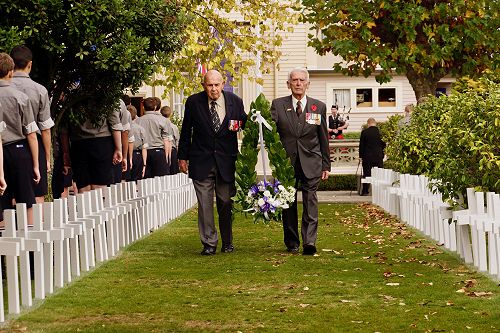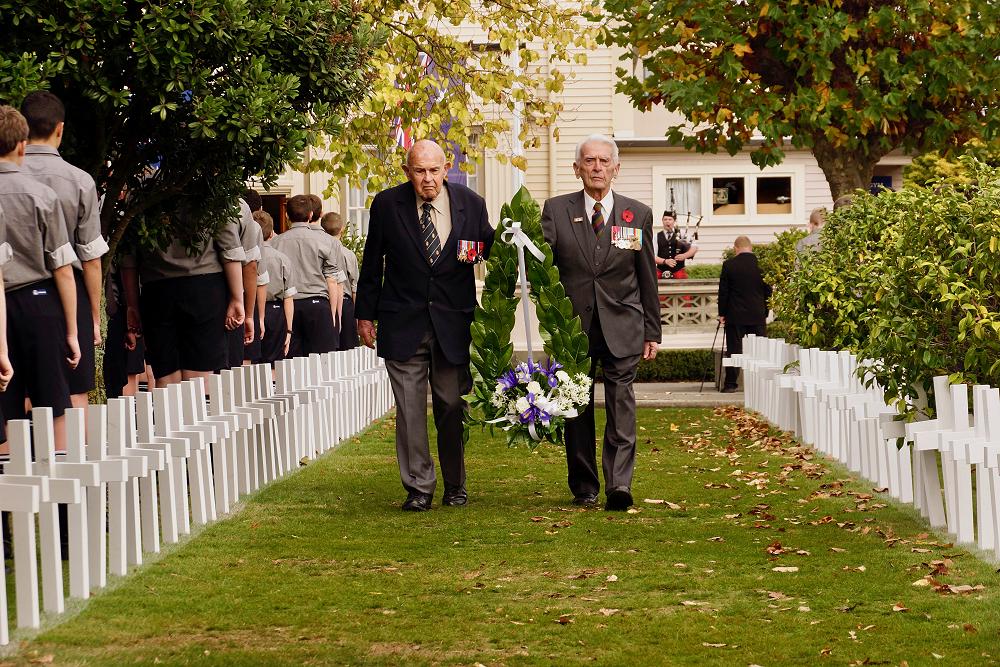
Patron of the Old Boys' Association, Alan Cull recalls his time serving in the war
Old Boy Alan Cull (1937-40) “We all had to join EPS (Emergency Precautions Scheme). Occasional emergency drills were held, and when the siren sounded, I was to report to the X-ray Dept. I lived a considerable distance from the hospital and, cycling, I would quite often arrive as the “All Clear” sounded.”
Two wars played a big part in dentist Alan Cull’s career.
Now 94, Palmerston North-born Alan looks back at those events that shaped his life. “When I turned 16 in 1940, I began work at Palmerston Hospital as a trainee radiographer. It was during World War II, and we did a lot of work for the army and air force as every recruit had to have chest X-rays.
“We all had to join EPS (Emergency Precautions Scheme). Occasional emergency drills were held, and when the siren sounded, I was to report to the X-ray Dept. I lived a considerable distance from the hospital and, cycling, I would quite often arrive as the “All Clear” sounded.”
At the end of three years, Alan had qualified as a radiographer in the X-ray department, headed by Dr Denny Gillies. Alan recalls that she was in charge until about 1947. “In those days the hospital was designed around one big corridor with wards and the pharmacy off to on one side, and the operating theatres, two I think, and the X-ray department were on the other side. Upstairs were the bacteriology and pathology departments. It was certainly a lot smaller place than it is today and I knew most of the staff. There was no dental department then, but I recall we did have visiting dentists from time to time.
“After a while I felt that the job had become routine. In 1943, there were bursaries on offer for those wanting to go to Medical or Dental School. I was lucky enough to secure one in 1943 and went off to Dental School in Otago for five years. Often, during the Varsity long vacation I would do relieving work at PNH X-ray department.
“On qualifying, I worked at Wellington Hospital for 15 months. I had joined the Territorial Army in 1949. “When the Korean War broke out in 1950 I applied to go and was appointed to Command Mobile Dental Section. I spent the next two years in Korea attached to the 16th Field Artillery Regiment. We landed in Pusan on New Year’s Eve 1950 and spent two weeks there while the big guns were made ready. Then we went north to the combat zone.
“Conditions were primitive and bitterly cold and we weren’t properly kitted out for winter. We were in tents and it was 30-degrees-below outside. By the second and third winter, conditions had improved a bit because we were given better gear. “My work consisted of tending to any dental casualties. Periodically, when we weren’t moving around I would undertake routine examinations of the New Zealand troops but this was not always possible. There were four of us in the dental unit– myself, a dental orderly, a dental mechanic and a driver/clerk. I held the rank of Captain.
“There were 1000 troops in the original K Force. This grew to 1500 later. All our equipment was treadle-powered as there was no electricity. We worked by daylight, or in extreme cases, I wore a headlight but this wasn’t really satisfactory. “Very seldom I might be called on to treat a local person. Honestly, there were no civilians around as they had fled the fighting. “I left in February 1953 and the Armistice was declared in July 1953. When I got back to New Zealand I was still in the territorials but joined a group dental practice in Palmerston North – McKegg, Andrews, Cull (and later, Hawke in 1960). I was there for 30 years before retiring.”
Amos McKegg later became Chairman of the Palmerston North Hospital Board. He was also a former President of the New Zealand Dental Association. Alan was awarded an MBE (MILT), which was published on 20 June 1953 in a publication special to K Force. During the Queen’s visit in late 1953 and early 1954, Her Majesty presented the award at the Investiture in the Town Hall, Wellington on 2 January 1954. Many years later Alan’s service in the Korean War resulted in an impromptu trip to India.
“In Korea, I had got to know the dental officer in the Indian army medical unit, which had camped nearby for six weeks. “Forty-seven years later,” he said, “out of the blue this man invited me to stay with his family in India. “When I arrived at Delhi the first thing I saw was a cow walk unimpeded in and out of the airport building. “I had a wonderful time in India, and it was amazing that after 47 years this man and his wife would contact me and offer such hospitality.”
Written by Paula McCool - Mid Central DHB
New Zealand History - Alan Cull describes being a dentist on Korea
There is also a great audio based interview with Alan created by New Zealand History. The Interview was lead by Pip Desmond with Alan describing what it was like to arrive in Korea and the daily life as a dentist during the war. Listen to the audio feed here.
Transcript
Alan - We arrived in Pusan on the 31st of December.
Pip - Tell me about your first impressions.
Alan - After the heat of Manila and Australia, we were frozen to the decks. It was winter, a very severe winter in Pusan. Very, very cold. And we weren’t really equipped for it.
Pip - Where did you stay?
Alan - We were in a camp called K9 and we set up our dental section in a room in a school house there.
I remember sharing a tent with two others and we had a basin of water that we put on a kerosene burner. And in the morning, the kerosene burner was still going and the water was a solid block of ice. So that shows you how cold it was.
Pip - The water got colder, not hotter?
Alan - Yes, and the flame was still going underneath, but it was well below zero at that time. And I wondered, what’s it going to be like? Yes, it was brutally cold, actually.
Pip - Your uniforms, what…?
Alan - We were wearing our usual winter dress, just the usual army khaki which wasn’t sufficient for those temperatures. But, you volunteered, you didn’t have to come.
Pip - So there’s no point complaining?
Alan - No, no.
Pip - Did people complain?
Alan - Well, there’s always whingers about. But by [the second and third winter] we had very good winter clothing. We also had heaters for our tents which we didn’t have originally. And also, things were static. First winter, when we moved off, you might be moved from one place to another, settle and then all of a sudden the word would go round, ‘Right, we’re moving in twenty minutes! Pack everything up!’ And then after a full day on the road, through the snow, you’d think, there must be a nice place to put a tent up. Then you’d arrive on this snow-covered paddy field. That’s where we were staying the night.
Pip - Do you want to tell me just a typical day?
Alan - Well, no day was typical. There’s one thing about in the forces, tiredness in men is a thing. You might be moving at night, in the end the clock doesn’t mean a thing, so get used to that. When we were moving, of course, we could always do first aid treatment for dental and medical. But it wasn’t until we were reasonably static that we could do routine treatments, routine inspections. But we were always there for anybody with toothache. We had a little bag that contained first aid stuff.
Pip - You started off by working out of a tent, but then you had a couple of changes, didn’t you?
Alan - [The tent] was really too small for us to work in and four of us to sleep in at the same time. Later on, [we also] asked for a larger [three-ton] truck so we could work on the back of that. And that was approved, and the L.A.D., Jack Wilson and his crowd, put a few cupboards in it, and we worked in the back of the truck. It made everything so much easier. Between those times, we managed to acquire an American tent which was much larger.
Pip - Is ‘acquired’ in inverted commas, is it?
Alan - Yes. That happened during a retreat from Kapyong.
Pip - Tell me about Kapyong then.
Alan - Well, that was in April ‘51 when the North Koreans and Chinese broke through the lines, and we had to retreat. We were on the road night and day. And we arrived one night at an American engineers’ camp and all the Americans had disappeared into the sunset. They hadn’t even left one person there. So the Kiwis in their own style had quite a time. K rations, food rations, and cigarettes. And also there happened to be a tent or two. So that explained that.
Pip - So they’d basically left the camp set up.
Alan - They’d done a runner. And next morning, [Padre] Pat Parr was in the tent with a few other Kiwis looking through what was left of the K Rations, the American rations that were there (food and tin rations), going through them to see what he could use, and an American colonel came in and tapped him on the shoulder and said, ‘Hi, captain, I wonder if you could get your men out of here!’
Pip - Are you doing your dental treatment while there’s guns firing?
Alan - If things were alright, yes. When I say ‘If things were alright,’ as long as the guns were firing from our side.
Pip - So you were right up there with the gunners?
Alan - [Yes.] I remember the first night all the guns fired. Twenty-four 25-pounders. Called a regimental fire? I forget. We were in our tent with our candles lit and the row of those guns was amazing. The tent went whoosh and all the candles went out.
Gallery