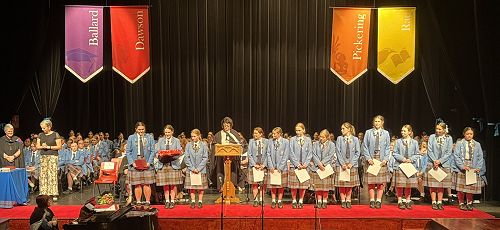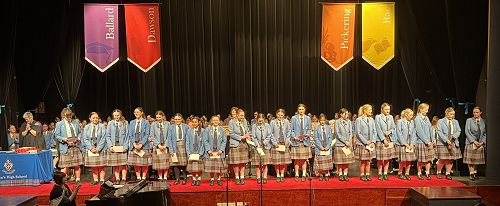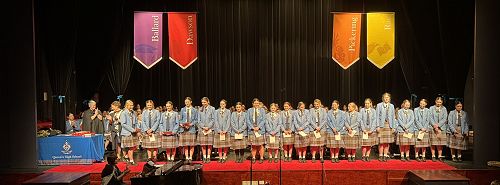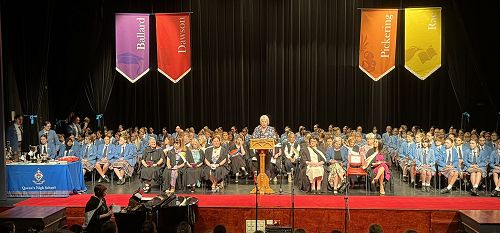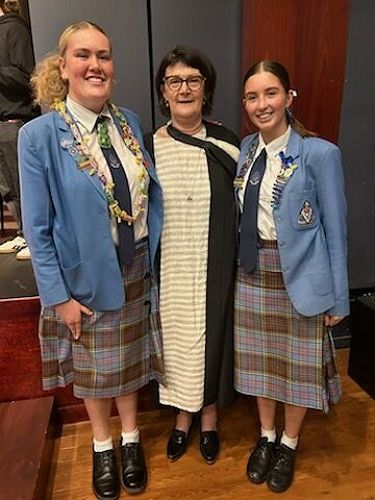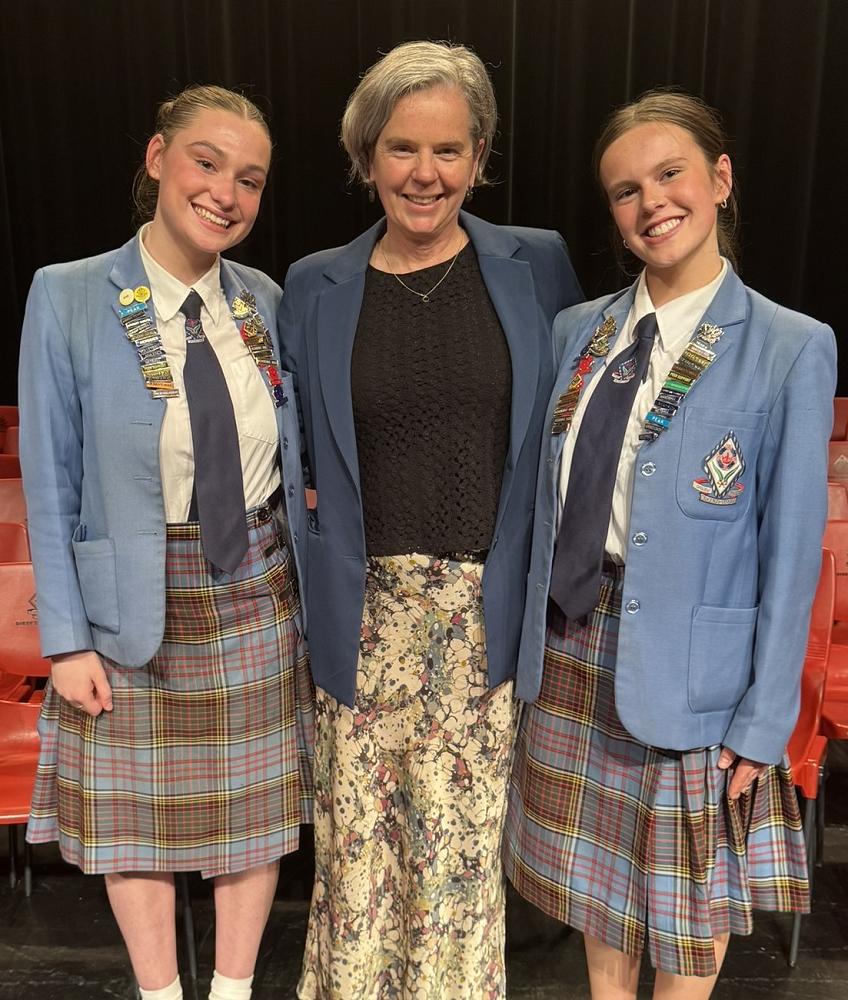
Top Scholars 2024
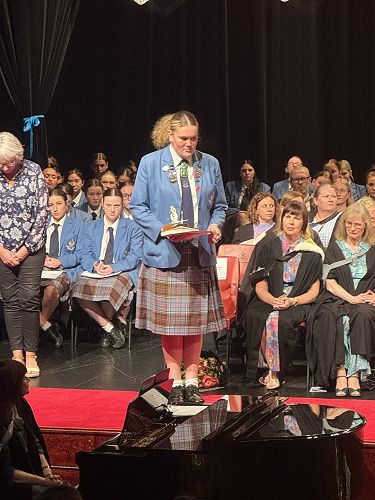
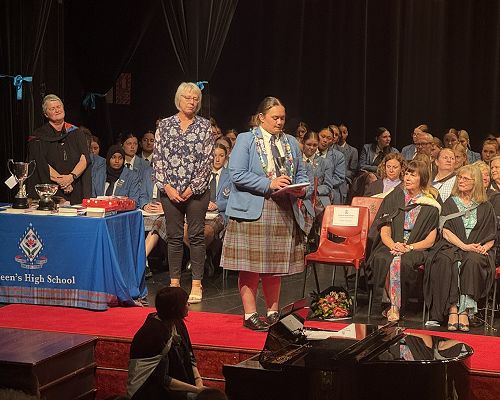
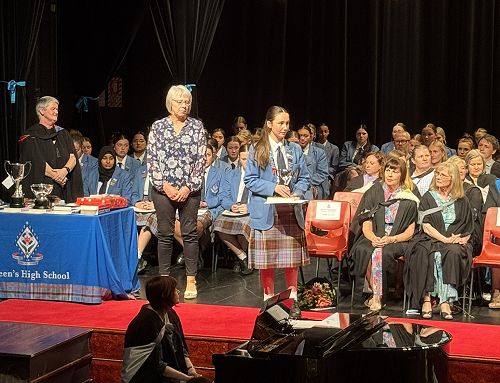
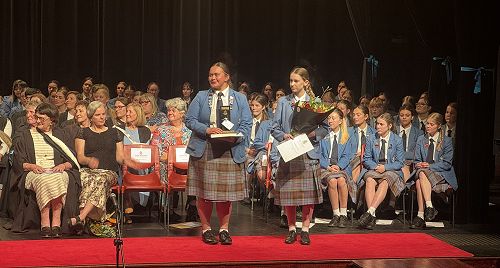
Abby Newell named as Queen's High School Dux for 2024.
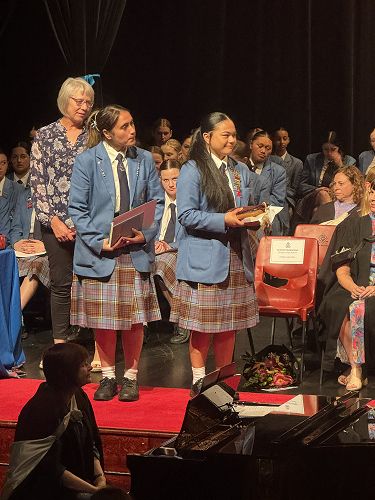
At our Senior Academic Prizegiving earlier this week we celebrated the many successes of our senior students. My particular congratulations to Abby, as our 2024 Dux, and to Micaela, as our 2024 Proxime Accessit. Gaining the top scholar awards is no easy feat and is testament to both your efforts and your hard work.
To our guest speaker, Josephine Johnston, thank you. The message of 'using your voice' is one that we all need to remember and sadly, is still needed for women. Josephine's speech is shared below.
To our performers on the night, how grateful we are that you are preapared to share your talents with us all. Thank you.
Congratulations to our top award winners for 2024.
Dux - Abby Newell
Proxime Accessit - Micaela Sumner
J Ira Fraser Bowl for Best All Round Girl - Micaela Sumner
The Andrea Deuchrass Cup for Service to the School - Antonia Burnett
The Shannon Leigh Buchanan Cup for Service to the Pacific Island Students - Gabbi Uriaro
Honore mō ngā Tuakana Trophy for Senior Māori leadership -Manea Renata and Jordy Wade
Clarke Whānau Award for Commitment to Kaupapa Māori - Rīpeka Pōtiki
Most Outstanding Cultural Achiever Award - Rīpeka Pōtiki
Best All Round Sports Woman - Maia Scott
And finally, to the Year 13 students of 2024, who have been so ably led by Billie Askerud and Rīpeka Pōtiki, our heartfelt gratitude for your many contributions to our school community. Your enthusiasm, talent, and friendship have enriched the lives of everyone around you. As you embark on the next exciting chapter of your lives, we are confident that you will continue to make a positive impact on the world. May your future be filled with joy, success, and endless possibilities.
Remember, you will always be a part of Queen’s. Be proud of who you are and where you come from: know that you can be anything you want to be.
Whāia te iti kahurangi, ki te tūohu koe, me he maunga teitei.
Seek the treasure you value most dearly and if you bow your head, let it be before a lofty mountain.
Ngā mihi nui
Barbara Agnew
Tumuaki|Principal
2024 Prizegiving Speech - Josephine Johnston ( Queen's student 1987-1991)
Tēnā kotou katoa
Kā mihi nui ki a kotou mō tō manaakitanga i tenei ra
Thank you so much for having me back.
Congratulations to each and every student on all that you have achieved this year. I know that some of your achievements are being recognized here tonight. But I also know that you have all done so much more than can possibly be acknowledged during a high school prizegiving, whether that be cooking dinner for your family, juggling schoolwork and a job, supporting a friend, representing your community, or getting over a heartbreak. I remember very clearly how much can happen in the final three years of high school—it’s a lot to manage!
It’s tempting in the rush of high school to miss all the people who stand beside and behind you, helping you to thrive. So, congratulations also to your teachers and coaches, and to your parents, whānau and friends for their support. As you might imagine, in addition to being a huge honour, it’s also a bit intimidating to be invited back to speak at your old high school’s senior prizegiving! It’s been 33 years since I finished high school and in the weeks since Ms Agnew invited me to speak, I’ve asked myself, what message can a middle-aged Queen like me offer to you, the Year 11, 12 and 13 Queen’s High School students of today? And as I have turned this question over in my head I keep coming back to a simple imperative, a message that I took away from my time at this school—Use Your Voice.
This is not something I could do right from the start! In 1987, when I arrived at Queen's High School, I was only 12 years old. I came from Portobello, under the protection of Hereweka, the Harbour Cone. I felt very at home on the hills and beaches of Muaūpoko—the Otago Peninsula. But on my first day at Queen’s High School I felt quite overwhelmed: I had just two friends in the whole school, rooms to find and a timetable to memorize, and the halls were a big blurry sea of blue.
But the 1980s was also a time of women’s empowerment in New Zealand. There was a whole advertising campaign built around the phrase “Girls Can do Anything”. I believed those ads, and I chose to attend Queen's High School because I knew that there was research showing that boys tend to dominate classrooms, asking more questions and taking more of the teacher’s time. I also knew enough about myself to know that in a co-ed space, I would be at risk of silencing my voice in an attempt to make boys like me. So, I very explicitly wanted a school that was all girls—a place that was full of the thoughts, questions, dreams and voices of girls. And so it became the norm for me, here at Queen’s High School, to raise my hand, to ask my questions, to share my ideas, and to use my voice. This was true in lots of different ways—in art, and drama, on the netball court, in maths class, or the school orchestra. I tried to be brave, to try new things and I pushed myself to achieve.
But it was most true in my 6th and 7th form years when I joined the school debating team, which was coached by the school principal, the amazing Dame Patricia Harrison. Mrs Harrison was a force of nature, as many ex-girls know—and she never doubted that the debating team had something worth saying—and that we could win. And we did win—we practiced like crazy, mind you—Mrs Harrison would walk into our maths with stats class with her two little dogs at her heels and we’d follow her back to the principal’s office to iron out our arguments, work on our delivery, and fire up our rebuttal. Then we’d head out in her little car to a debating competition at Bayfield or OBs—and again and again, we would win.
I remember one competition at Southland Boy’s High School where I really felt like we’d trounced the boys until the judge said a bunch of mean things about us, including that he wouldn’t want to be one of our husbands when we got mad and stamped our feet—but we won that debate too because even with that striking bit of sexism from the judge, he had to admit that we were the best. And ultimately we won the whole national competition.
And so even though I arrived at Queen’s a bit awestruck and overwhelmed—lost in a sea of blue—by the time I left I really did feel empowered and supported to use my voice—quite literally! And I saw evidence of this in my first year law class when a question was asked, and I raised my hand and then I looked around and again and again I would be the only woman in a class of hundreds with my hand in the air.
I tried to stay true to that Queen's High School student in my University studies and in my work, first as a lawyer and then as a researcher and academic. Through a bit of a twisting path I ended up working in the field of bioethics—not an area I had even heard of in high school, but one that turned out to be the perfect place for me to merge law and philosophy with medicine and science—an area that allows me now to help train the next generation of doctors, pharmacists and dentists for New Zealand while also researching issues like how we should use genetic tests or when it is ok to use human body parts in medical research or how to ensure that pregnant people get to make informed decisions about their care.
Some of this is worlds away from high school debate competitions or German class with Dr Stone or Drama with Terry McTavish, but I’m using the skills those teachers instilled—trying to be brave and thoughtful, rigorous and fair. In my work—and in the time I’ve now spent out in the big wide world, far from Surrey Street—and I’ve been a few places, living in Germany, England, Canada and the United States—I have learned a lot about the history of silencing and disempowering women and seen the ways in which the battle for women’s voices is still ongoing.
Because unfortunately, there are still people who seek to silence and control women and girls—there are still places where our voices cannot be heard. One of the most striking examples right now is Afghanistan. Women in Afghanistan were relatively free until quite recently, but now they are forbidden from being seen in public alone, they cannot travel further than about 70 km without a male chaperone, and when out of the house they must cover all of their bodies, including their faces. Girls are banned from high school and are not allowed to take university entrance exams. Earlier this month, the men in the Afghanistan government announced that it is now against the law for a woman’s voice to be heard outside her home.
But this is not the only example. I mentioned that I lived in the US—I actually spent almost twenty years there, mostly just outside New York City (side note—a very fun place!). America likes to say that is it a nation that values freedom and where everyone is equal—but the truth is much more complex, and in the past few years I have seen how millions women and girls in parts of America have been stripped of their ability to make decisions about their healthcare, their bodies, and their lives.
I don’t say this to frighten you—I imagine you are well aware of how difficult some people’s lives are in other countries, and even here in ours—but I do want to emphasize that progress for women and girls is not a guarantee. Sometimes countries slip backwards, rights are lost, and women and girls suffer. If you spend 5 years in a place where girls voices are heard, their opinions are shared, where their art is on the walls and their stories and poems and songs are celebrated, if you spend 5 years in a place where girls play sport and win, or in my case play sport and lose, if you spend 5 years in a place like Queen's High School where girls matter, its easy to take it for granted. So I just want to remind you to hold onto the power that this school has given you.
Congratulations on your success, and good luck for your next chapter. Remember to thank your teachers and your parents and whānau, remember to keep in touch with your fellow Queen's girls. And most of all, remember to keep using your voice.
Ngā mihi nui. Thank you.
Gallery