
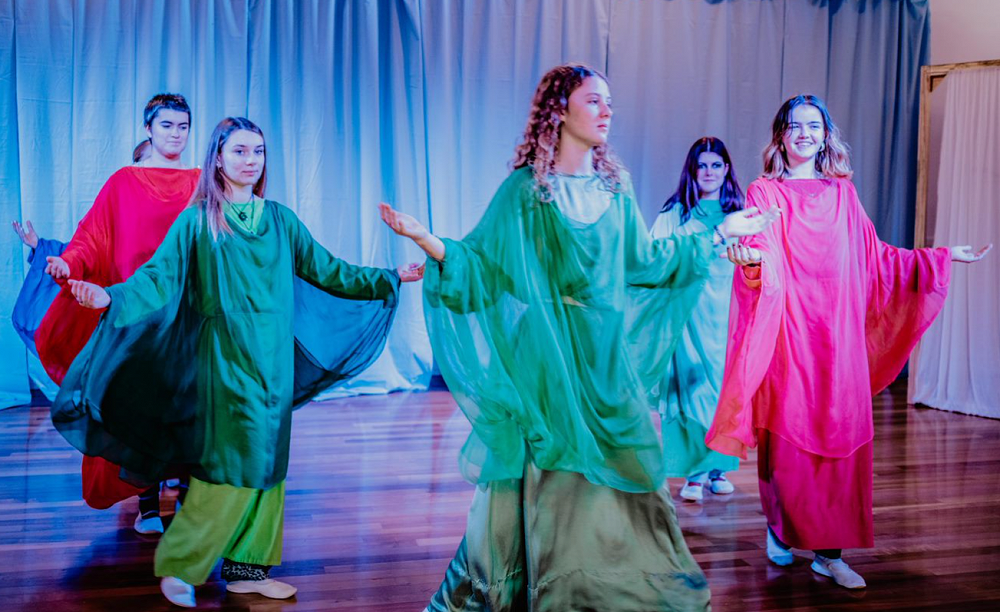
Eurythmy
Special Character Feature
When the original Waldorf School was founded, Rudolf Steiner included eurythmy among the core subjects from the beginning. As an entirely new subject and one which is exclusively taught in Waldorf schools, eurythmy has a unique position within the curriculum. Applied appropriately at different ages and in different phases of development, it is an important aid to human development. Eurythmy is an art of movement that engages the whole human being, integrating bodily movement with movements that arise within the soul, thus creating a harmonious relationship between the soul-spiritual relationship and the physical body.
Through the spiritual research of Rudolf Steiner we learn that the larynx and its neighboring organs make specific movements when we speak or sing. The arms and hands bring this movement, which occurs in the larynx and organs of speech, to outer expression. Therefore in eurythmy, the inner movement that gives rise to speech is transformed and externalized into outer movement. Through this process eurythmy expresses the movement and soul experiences of speech and music. As an art it strives to be true to the inherent qualities in speech and music and therefore the gestures are not accidental or arbitrary movements but specific and meaningful.
In contrast with gymnastics, which has different aims with regard to taking hold of the body and making it fit, lithe, harmonious and free, eurythmy is essentially an artistic process. Gymnastics has to do with the whole human being coming into a relationship with the physical laws which govern space, those of levity and gravity and the balance the human being achieves between these two polarities. Eurythmy also works with the polarities of levity and gravity, not only physically but also through the inner experience of the soul.
At Raphael House, Eurythmy is taught through the years from Kindergarten through to Class 12. It is the only subject that is taught throughout a student’s school life.
Why is this?
Eurythmy is primarily a social art that connects participants to each other, whilst providing a corridor between inner and outer worlds through judicious choice of music and poetry.
In the kindergarten, classes one and two, all teaching comes from the stories and songs used by the eurythmy teacher. This means the students, together, build a group imagination and move to this, always staying in the imaginative realm. Potentially, this is a profound social skill to nurture and develop.
While some artistic work is done with poetry and music in the middle years, the bulk of the work targets coordination skills and strengthening spatial orientation for individuals within a group: when the students are asked to create their own performance in the upper school they have the physical technical skills with which to do so with joy and laughter. When the students are asked to create their own performance in the upper school they have now acquired the physical technical skills of Eurythmy and are able to experience the gratification of an artistic process of a Eurythmy performance. Normally these performances are open to whānau and the wider public with short tours occasionally taking place to other schools. Hopefully this will happen again in the near future.