
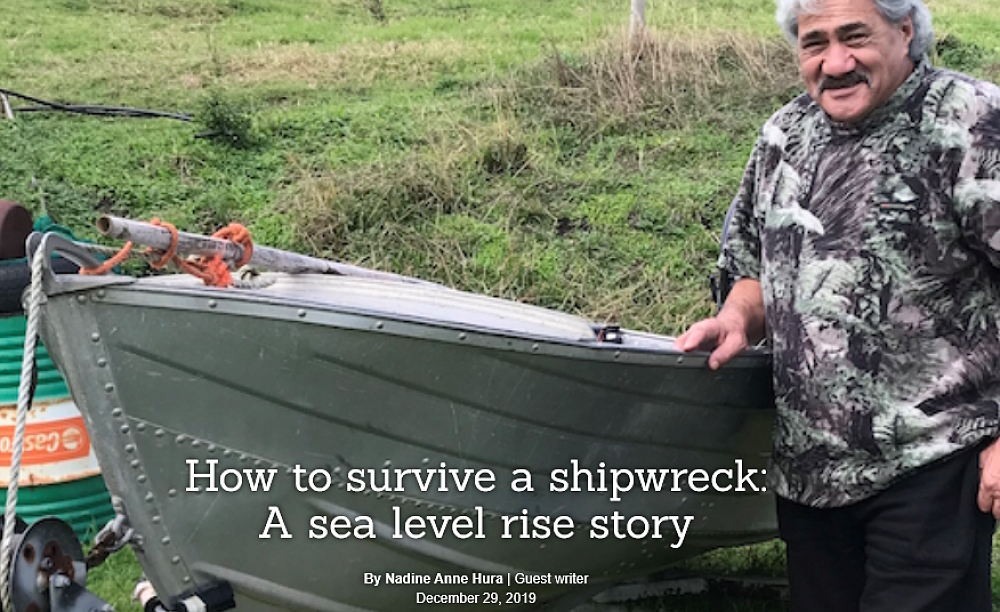
How to survive a shipwreck: A sea level rise story
There are many lessons climate scientists can learn from mātauranga Māori. Lesson one is: don’t panic.
This story was made with support from the Science Journalism Fund
Hank Dunn (Te Uri o Tai, Te Rarawa) has survived five shipwrecks in his lifetime. He told me this a few moments after I met him at the Deep South Challenge climate change conference in Auckland. The room was full of scientists and researchers and Hank seemed to stand out the same way I did – like maybe we’d washed up at the Maritime Room on the Viaduct by mistake. I told him I was there to write a story about sea level rise and he chuckled with raspy laughter and said he’d had heaps of near-death scrapes with Tangaroa.
“The last time,” he said, leaning in and whispering, “was out in Whangapē. Me and my mate went out to get some pāua. Normally we just park up at the mouth and walk around the coast but on that day it was oil-slick calm, so I said to my mate, it’s oil-slick calm, I may as well take you round and drop you off and then come back to anchor. Well, I dropped her off with all the gear but without the extra weight the boat was sticking up in water, like this.” Hank pointed his hand up, elbow down.
“I reached for the tiller to extend it but I wasn’t watching the bar, my own stupid fault, and when I stood up a small wave hit the boat from side on and knocked me clean overboard. Boom! Hit the water, down and straight out to sea. I kicked off my gumboots and swam for a bit but nope, no chance. The tide was on the way out. I looked back and the boat was spinning round and round in circles.” Hank cracked up laughing and slapped the table. “The tiller was jammed hard to the side!”
A few people looked over at us. I lowered my voice. “So what’d you do?”
“Well, like I said, it’s not the first time I’ve had to swim for my life. I didn’t panic.” He took a sip of his coffee. “Panic’s what kills you, you know.” He told me that he flipped over onto his back for a while to rest and get his breath back, and a moment later he felt something hit his shoulder. He turned around to see his fish bin floating past. “Well I grabbed that and turned it upside down to trap the air. Then I pitched myself across it and just lay there, heading out towards Australia.”
By this point the welcome speeches were underway and a hush had fallen over the room. Hank raised his eyebrows at me as if to say ‘here we go,’ and turned to listen. I took out my notebook and opened to a blank page.
What the science says about sea level rise
Western science is useful to help us understand climate change generally, and sea level rise specifically. Using complex modelling systems, scientists can paint a picture of how the planet has changed over time and try to predict, with a mixed degree of certainty, what will happen in the future. In terms of cause and effect, much of the science around sea level rise is common knowledge today: greenhouse gas emissions are causing the atmosphere to heat up and as temperatures increase, the sea is rising and expanding. Scientists warn that the consequences of sea level rise are potentially catastrophic. We’re already feeling and experiencing the consequences in Aotearoa, including increased intensity and frequency of floods, coastal erosion, storm surges and contamination of fresh water. Around the country, the cascading effects have been seen with bridges collapsing, landfills spewing their contents, and urupā teetering on cliffs.
What western science isn’t so good at is communicating to non-scientists how different environmental processes are interconnected. The language of climate change assumes I already understand what phrases like parts per million mean, or the significance of 1.5 degree warming, or how an agreement made in Paris might impact decisions that are made by my local council where I live in Porirua. To further complicate things, Western science (as with Western health and education) has a tendency to isolate issues and treat them separately. Ocean acidification is discussed in one report, overfishing in another, plastic pollution in another – even though all of these things have implications for the delicate balance of the same marine ecosystem.
There’s a risk that those less familiar with the terms, like myself, can become locked in unhelpful binaries of ‘good’ vs ‘evil.’ Carbon dioxide, for example, isn’t bad. Plants consume it and give off oxygen. Without these natural ‘sinks’, as they are sometimes referred to, we wouldn’t be here. The problem is that nature can’t process the bad stuff at the rate at which humans produce it. Not even close.
Floating towards Australia
Hank had time to think while he was heading out to sea on his fish bin. “I said a karakia to Tangaroa and Tāwhiri-matea to ask for help. I said, Help me! I want to go home! I was lying there on my fish bin when I heard a funny noise. Nnnneeeeeeee! Nnnnnneeee! I turned around and there’s the coast guard. Guy leans over the boat and says to me, ‘what are you doing out here?’ I looked at him and said, havin’ a swim mate, what does it look like?”
Hank boiled over with laughter. We were sitting outside overlooking the glittering Waitematā in downtown Auckland. He dotted a measure of tobacco along his paper, rolled it up with one hand and sealed it with a lick.
For two years, Hank Dunn collected water samples from all around the valley, recorded daily temperatures and rainfall information, and conducted interviews and household surveys (Photo: Nadine Anne Hura)
“I’ve had some scary ones. Out in the Hawkes Bay one time I swam five miles in the dark to get to shore. I was only 20 years old, young and strong and powerful. My great grandfather’s brother was an endurance swimmer. He survived a shipwreck in a storm off the Kaipara Heads in 1903, so maybe a bit of him has rubbed off on me. Anyway, my sister was having a birthday party and Mum said to me, go and get some kai. The boat was a 16 footer, 40hp Johnson motor. I went out from Napier towards Cape Kidnappers because that’s where the pāua is. I dropped the anchor, threw my tube over the side with my bag on it and got in the water and started diving. Filled my bag with pāua and kina. Then I went to get some snapper. There’s this place called the Springs, fresh water comes up from underneath the ocean. It bubbles up like a fountain. Just down from the current I caught about eight good snapper. It was about 6pm and coming on dark. I looked over towards Māhia and I could see all these dark clouds. I thought, shit that doesn’t look good, I better get the hell out of there.
“I pulled the anchor up and started the motor and took off. The wind got up really strong, blowing me from behind. When you’ve got a following wind and the waves are all going the same way as you, you have to stay off the wave so you don’t fall in front. Sometimes you have no power but the wave is still pushing you. Other times you got to use the throttle to stay with it. Well, anyway, the worst happened, the boat fell off the top of the wave and hit the bottom and flew apart. Just disintegrated. Electrolysis, a boat engineer told me afterwards. So I was swimming. I surfed in on the waves and whenever I got tired I’d roll over onto my back and have a rest. Swam ashore, walked back to my car, got in and drove home with an empty trailer. Mum came out on to the porch and said: Where’s the fish? Where’s the boat?”
Hank took a drag of his smoke and puffed with laughter. “I said to her, There’s no fish. There’s no boat. Boat’s gone!’”
Don’t panic
The debate about human-induced (“anthropogenic”) climate change has largely been settled, but it has been replaced with a new and equally passionate debate: how do we tackle the problem when the political and economic incentives still reward “business as usual?” The urgency of the situation, combined with a lack of clarity about how the science should be interpreted and applied – personally, politically, locally and globally – contributes to a sense of panic.
But panic, as Hank says, is exactly what kills you.
Hank isn’t your typical lab-coat wearing researcher. A structural engineer by trade and a fisherman at heart, he was invited to attend the Deep South Challenge conference to talk about a water quality project he’d been involved with in his papakāinga of Pawarenga. This Te Rarawa-led research project focused on water sustainability into the future. For two years, Hank collected water samples from all around the valley, recorded daily temperatures and rainfall information, and conducted interviews and household surveys. Hank was ideal for the role because he was born and raised on the whenua and knows it better than his own reflection. The papakāinga stretches the length of a long gravel road on the southern shores of the Whangapē harbour. To the north is Ahipara, to the south-east is Pangaru. On the map, the Hokianga looks like a long, jagged scar extending deep into the tail of the fish. Whangapē, by contrast, is just a small tear, a narrow thread of water leading to a sheltered enclave flanked by forested hills. It’s a kete kaimoana, a fish-basket. To Hank, it is paradise.
With his hands-on experience, Hank joined one of the conference panels to talk about the future of water in our changing climate. He took a seat at the edge of the stage beside another Māori researcher, Lani Kereopa from Te Arawa’s Climate Change Working Group. At times it felt like there were two different conversations going on. Every time Hank or Lani spoke, the discussion would ebb and then flow off in a different direction. Where scientists used words like climatological forecasting and causality, Lani used words like restore and protect. Where an engineer talked about the tensions between valid versus non-valid uses of water, Hank described the waiora of Tāne that runs down from the ngahere in small streams as a gift from our atua, Tāne Mahuta. At one point, in an attempt to weave the disparate threads of conversation together, the facilitator, Simon Wilson, asked ‘who is science for?’ and Hank, not realising his mic was on, leaned over and whispered to Lani, ‘Science is for Pākehās’.
The room erupted with laughter, but Hank wasn’t joking.
Mātauranga Māori and sea level rises
Like the word kaitiakitanga, mātauranga Māori is a term that is becoming more and more familiar to Pākehā scientists in the climate change space. Loosely translated it means ‘knowledge.’ It is often seen by Western science as a Māori perspective on science, or as Simon Wilson suggested, ‘a cultural overlay’. In fact, we could describe mātauranga as a complete system of knowledge and Western science as the cultural overlay. Science is based on evidence and observation, and accumulates data to generate pictures and predictions. But in order for the information to make any sense it still needs to take the shape of a story. This is where science tends to fall down and mātauranga excels. Facts just don’t make for very memorable or compelling characters.
I’m no expert on mātauranga, but it has helped me to think of te huringa o te āhuarangi, or the changing of the climate, as the next chapter in our story of creation: Much has changed since Tāne-mahuta made the call on behalf of his siblings and wrenched his parents apart so that there could be light in the world. Papatūānuku’s intimate cycles have been observed and harnessed to sustain the living. Tamanui-te-rā rises in the east and provides heat, energy and light. Tāne absorbs the excess heat produced by living creatures and transforms it into life-giving oxygen. Tangaroa draws and captures harmful excesses in the atmosphere and buries it all deep in the ocean floor. Rongo-mā-tāne and Haumia-tiketike provide sustenance in the form of kai and medicine for healing. Everything both living and inanimate possesses mauri, an inherent life force which generates, regenerates, upholds and unites the diverse elements of creation. Tohunga adept at reading signs in the natural world (land, sea and air), provide guidance and caution – as do non-human kaitiaki. The organisation of society is held together by beliefs, habits, rules and customary practices that help non-tohunga (or non-scientists) navigate and live within the natural world harmoniously. Although Tāwhiri-mātea can be fearsome, with his storms and gusts of riri, he and his brother Tūmatauenga remind us that all families have mamae and all things exist in balance, even struggle and hardship. Ranginui keeps watch on his whānau from a distance, lamenting the separation from Papatūānuku in a way you can occasionally catch glimpses of when red streaks appear on a fractured grey sky