From the Principal's Desk
Kia ora e te whānau!
I hope that you all had a restful period over Easter and were able to spend some quality time with whānau and recharge your batteries as we enter the final push towards the end of Term 1 break.
You may be aware that before losing the last election the Labour government had embarked upon a 'curriculum refresh' that was to be implemented over a 5-year period.
With the change of government late last year this implementation was placed on the back burner as we waited to hear whether or not the new National government would continue as planned or change course completely.
Information coming out of the Ministry of Education strongly suggests that the curriculum refresh will be going ahead as planned with just a few tweaks to be made here and there.
It appears that the major changes will instead come through within the assessing and reporting requirements that we expect to be issued by the Ministry of Education.
So, the question is, how much do you know about the curriculum refresh? For most of you, I would expect the answer to be 'very little'; so over the next few newsletters, I will attempt to explain what the changes are and the implications they have for your child's learning journey.
The new curriculum is made up of 4 components:
- Te Mātairea - The Progressions Model
- Te Mātaiaho - The Learning Strands
- Te Mātainuku - The Purpose and Principles
- Te Mātaitipu - The Vision
These 4 components are supported by the Common Practice Model (CPM) which is a nationwide guide as to how these things are taught.
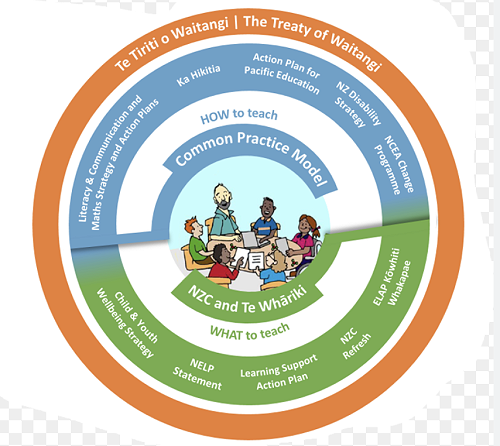
The key thing to remember here is that the refreshed National Curriculum (NZC) is 'what' is taught and the Common Practice Model (CPM) is 'how' it is taught.
How the NZC and the CPM fit together is best illustrated using the diagram below:
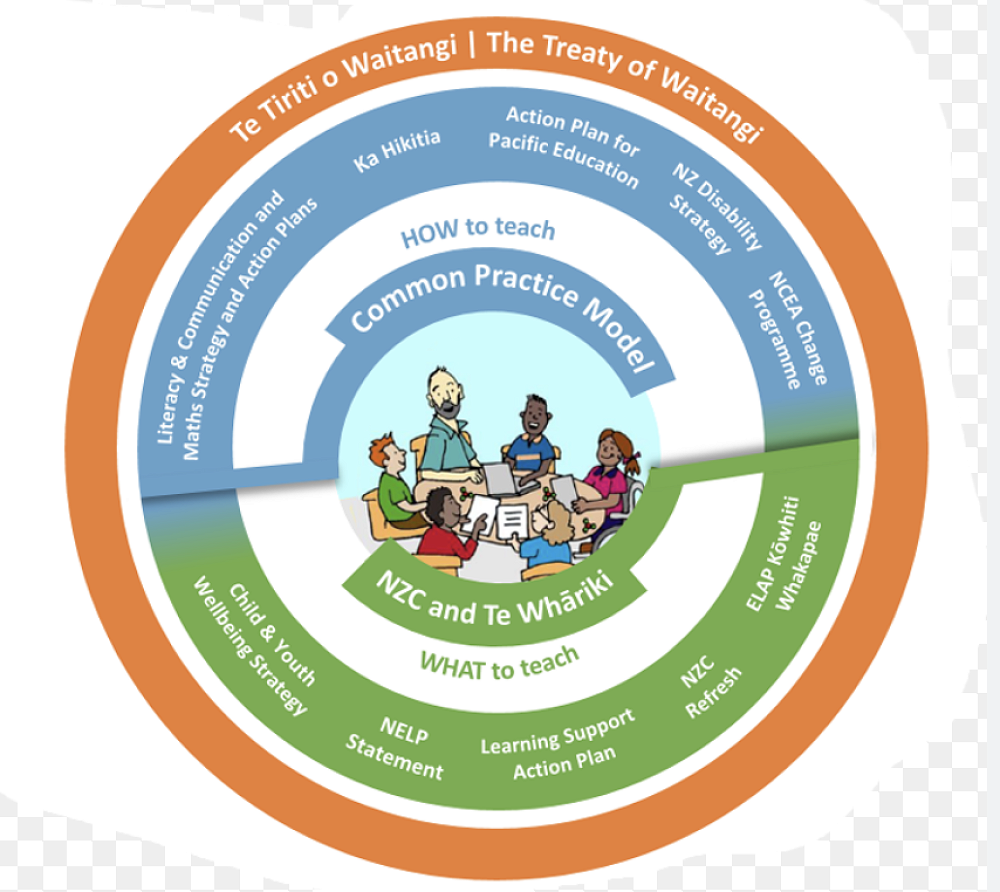
In this newsletter, we will just look at the CPM (top half of the circle); the 'how' aspect of the curriculum refresh.
The main aim behind the CPM is for 'Every learner to reach their potential, secure in their identities, languages and cultures'.
Another of the main aims of the CPM is to provide clarity and direction for literacy & communication and mathematics teaching; it comprises:
- Principles to guide teaching literacy & communication and mathematics across the learning pathway; these principles are essential and enduring
- Pedagogical approaches that are theoretical frameworks or approaches to teaching, informed by evidence of how students learn
- Practices that are purposeful (deliberate) acts of teaching
- A suite of supports for teachers including guides, resources and professional learning.
As you can see, everything is encircled by Te Tiriti o Waitangi (The Treaty of Waitangi) as the principles of Te Tiriti are part of the foundations that support all pedagogy within New Zealand Education.
The next layer outlines the existing pedagogical approaches and frameworks that strongly influence how we teach the students of Southbridge School.
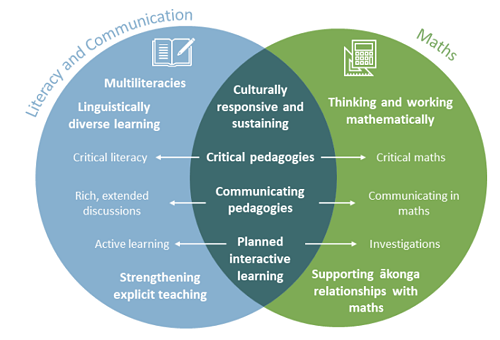
Research conducted by the MOE found that some key pedagogical approaches are common across both literacy & communication and maths teaching:
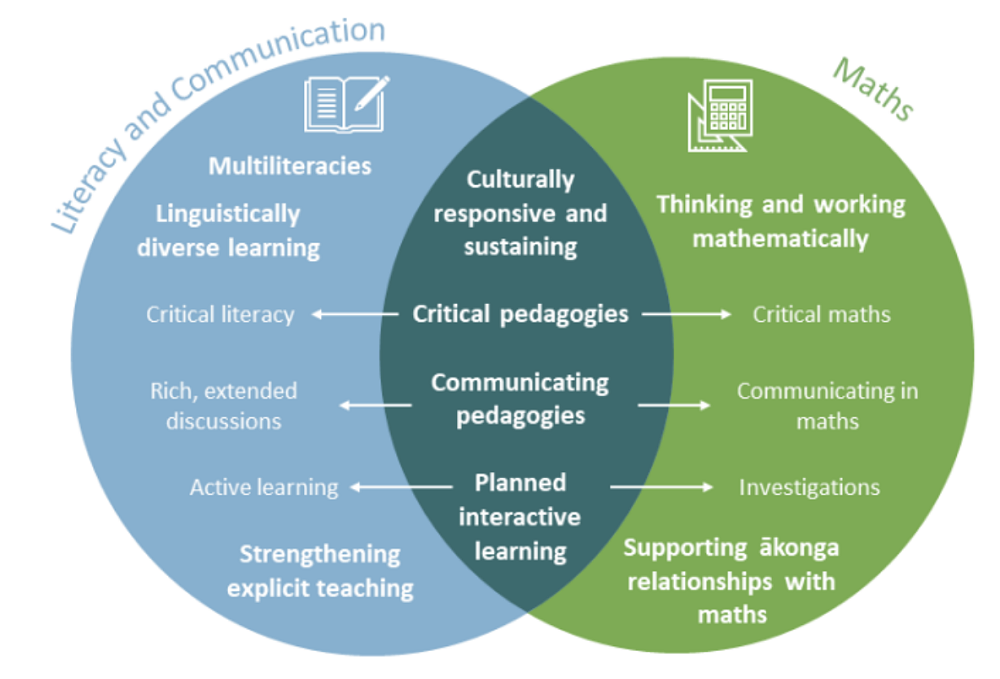
Within the above Venn diagram, you will see some of the pedagogical approaches to teaching literacy & communication and mathematics.
The implementation of these approaches will strive to find a good balance between national consistency and localised flexibility.
This indicates that whilst there will likely still be some nationwide 'must-dos' there will also be room for us to do things in 'The Southbridge School' way because we know what works best for our students in our own, individual context.
The 5 focus areas of the CPM are:
- Clear, nationwide expectations for teaching and learning to guide effective practice
- Capability supports along the career pathway to develop effective teachers who can meet the needs of diverse groups of students
- Educationally powerful connections that support and enhance learning
- A system of learning support that responds to the needs of all students
- System-wide evaluation that supports a system that learns and can adapt
Remember, the CPM outlines how we teach the NZC and the NZC outlines what we are required to teach your children.
All we have discussed above relates to the how; which up until now has been hugely varied across schools and will now be more prescriptive to ensure continuity and consistency with the teaching of literacy & communication and mathematics across the whole of New Zealand.
I have tried to outline the thinking behind the CPM in as simplified a way as possible; however, I realise that there is still a lot of 'teacher talk within my explanation; so if you would like to know more about the CPM then please pop into the office for a chat.
Ngā mihi nui
Ian Quilter
Gallery