Reflections - The Last Marist Rector
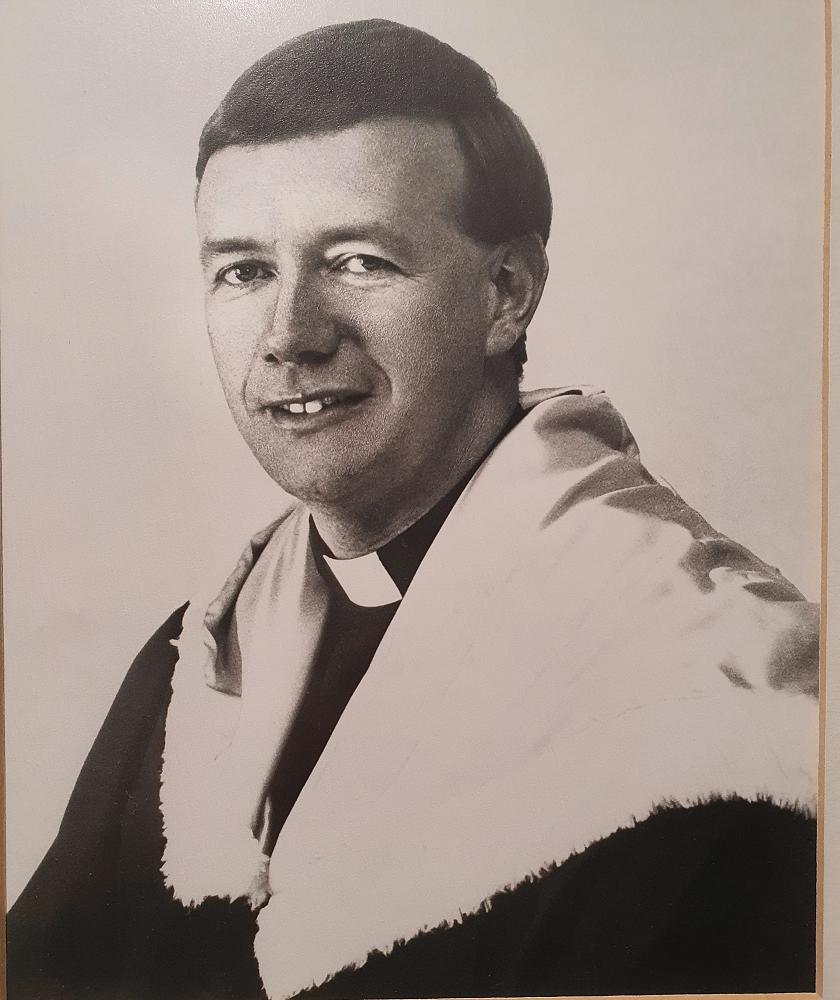
We take a look back at life at St Bede's under the guardianship of our fourteenth Rector Fr Brian Cummings SM, following his death on Friday 19 August.
Brian Cummings, Rector 1990–2001, was the second-youngest rector appointed after Charles Graham. By coincidence he was to equal Graham’s record of 12 years in the position, before the college passed into layman direction, probably forever. The astute Cummings was well aware of how things had changed since his first arrival at St Bede’s, newly ordained, in 1980. Until then very much a Wellington boy (St Pat’s Town) he served eight years’ ‘apprenticeship’ at Papanui – and then spent 20 of the next 22 years there, returning in 1990 to take on the role of rector.
At St Patrick’s he was taught by Fr Gus Hill, who on learning that young Cummings was to go to Greenmeadows to study for the priesthood said, ‘Just as well. You’d never get a real job!’ When the inimitable Fr Hill retired from teaching at St Bede’s in May 1991, Fr Cummings was his rector.
While training in the seminary Fr Cummings took a BA majoring in English literature at Victoria and added a Bachelor of Sacred Theology (at Greenmeadows) from the Angelicum University in Rome.
He quickly immersed himself in the mainstream of Bedean life – he was fifth-form dormitory master in his first year and in charge of the sixth- and seventh-form boys the following year. He was head of English by 1982 and dean of boarders the same year, a post he retained until transferring to Wellington in 1988. ‘There were seven priests under 35 when I arrived at St Bede’s and a lot going on in the college. You had an opportunity to do many different things. I had been at school with Phil Mahoney and Trevor Tindall and that made it easier. It was very full on. By the time the holidays came you were exhausted.’ However, the holidays were not a respite in themselves. For a week of them the Marists made pastoral visits to the homes of boarders, often to remote places.
Seniority ruled at St Bede’s: the ‘junior’ priests had their own dining table while their mentors sat at another. ‘There were four cars for the priests then. The rector and the Superior shared one and we had to sign up for the other three. It was the sports master’s job to look at the draws and allot the cars but the problem was when there were delays. You would be sitting at the college sweating, wondering whether you would get to the game or the event because somebody didn’t come back in time. Sometimes there could be sharp words but the problem was the resources.’ A highlight for the younger staff members was Thursday evenings, after the boys had gone to bed, when there was an hour of socialising from 10.30pm, which allowed some relaxation. ‘It was still quite a tight structure in the college in those days and boys who did not fit sometimes did not flourish. I was anxious when my time came to widen the opportunities for as many boys as possible.’
One of the changes was to the school uniform in the late 1980s. ‘The credit really belonged to Robyn Kilworth,’ Fr Cummings recalled. Mrs Kilworth, from Ashburton, was the first woman appointed to the Board of Trustees. The blazer had been the Wednesday and weekend sporting dress for nearly 70 years. Cummings and Kilworth wanted to see it become the main uniform. ‘It had got to the stage where there were actually six different acceptable uniforms given all the options,’ Fr Cummings recalled. ‘There was also the fact that the boarders were dressed differently from the day boys, which was not ideal. There was some determination among leading staff members that they should look the same. The blazer was thought the best compromise and so the suits were dispensed with. We had to make the blazers of different material though so they could stand up to the extra work. Robyn campaigned for more than a year to get it through so it was her triumph.
He was a keen rugby coach and editor of the Bedean for five years, among his many activities. But his great sporting love was cricket, a game in which he had himself excelled at St Patrick’s. He took the First XI from 1982 to 1987 and with considerable success. He is very proud of the top college cricketers in both his years as coach and those as rector. However, when he was coaching at Silverstream, St Bede’s First XI’s were to be vanquished not vaunted. ‘At St Bede’s we had some very good teams and players like Danny Halligan and Jon Preston who were beautiful batsmen. Danny was the best in Canterbury in his time…Later Michael Dwyer was outstanding. He could demolish an attack like no other.
Fr Cummings took control at the beginning of the second term in 1990, rather than beginning the rectorship with the new school year as would normally happen. Fr Mills had been due to be relieved earlier, but a career change decision at short notice by acting rector Fr Peter Gordon – it was virtually the end of 1989 and he had been expected to take Fr Mills’ place the following year – threw college administrators into disarray. Although Fr Mills had been looking for some respite from the rigours of rectorship, he returned to the role until the arrival of Fr Cummings.
One of the first acts of his rectorship was to institute a Mills Scholarship for the fourth-year student who had done most to contribute to the cultural life of the college. The first winner was Andrew Doherty. However, it was in 1991, his first full year, that Fr Cummings set about stamping his mark on the college. Honours pockets were a reorganisation of an old tradition that had almost exclusively reflected sports achievement. Fr Mills had widened that and Fr Cummings went further. In 1991 the system produced no fewer than eight for music, and three for debating. In 1993 the first Honours pockets for drama were awarded. The new rector, while keen on his sports, was unmistakably aiming to emphasise the wider achievements within the college.
During his first five years Te Reo Maori became a compulsory course in some classes and once established was well received. There was a renewed energising of the Weekly Notes system, including ‘academic scholarships’ based on the Notes. The latter were published on noticeboards each week, and later computerised. ‘Top Noters’ were named in the newsletter. There were restrictions placed on those with notes and assessments considered unsatisfactory. Those who achieved well were sent letters of congratulation to their home and an academic honours board was mounted in the dining room.
One of the major challenges of the time was in the field of discipline and social change. Corporal punishment was gradually phased out in the 1980s, though at times still used as a last resort. Once abandoned and with parents tending to give their children greater latitude with their social decisions – or having them made without their knowledge – some friction and soul searching was experienced among the hierarchy. There had also been an inexplicable trend toward teenage suicide, which affected a number of Christchurch colleges. St Bede’s was not exempt and such traumatic experiences are testing for any leadership team. Part of the dilemma was agreeing on what part the college played in responsibility for boys outside of school. ‘I considered there was a limit to what they could expect as our responsibilities,’ says Fr Cummings. ‘Some wanted control over what their boys did out of school time left to the family responsibility, others wanted us to handle virtually every issue. I did not see the latter as our role.’ Serious cases were referred to the board and at times opinions among college administrators and the board on the best policy to adopt diverged to the point where there was tension. Serious disciplinary matters were gaining wide media attention during this period and Fr Cummings was determined to find a course that would strike a balance. ‘The leavers’ ball was one example. I merged two previous balls into one and the parents were expected to attend. The first dance for every boy was with his mother. We introduced alcohol sales at these balls – but it had to be purchased by the parents so that they knew how much their sons were drinking. We also opened up the eligibility question for the girls so the boys could ask virtually anybody they wanted.’ St Bede’s College certainly became a different place under Fr Cummings, but the affection held for him by many of the boys of his era suggests it was a better place.
We
pray eternal life for Fr Brian Cummings who died at Mary Potter Hospice Wellington after a
short illness. He was 68 years old.
This article was taken from 'The Faith of our Fathers - The History of St Bede's College'.