Reflections – ANZAC Day: The Donohue Brothers
As we continue to reflect on the sacrifices made in the name of freedom, we turn our thoughts to two remarkable young men whose story lies at the very heart of St Bede’s College’s earliest chapters.
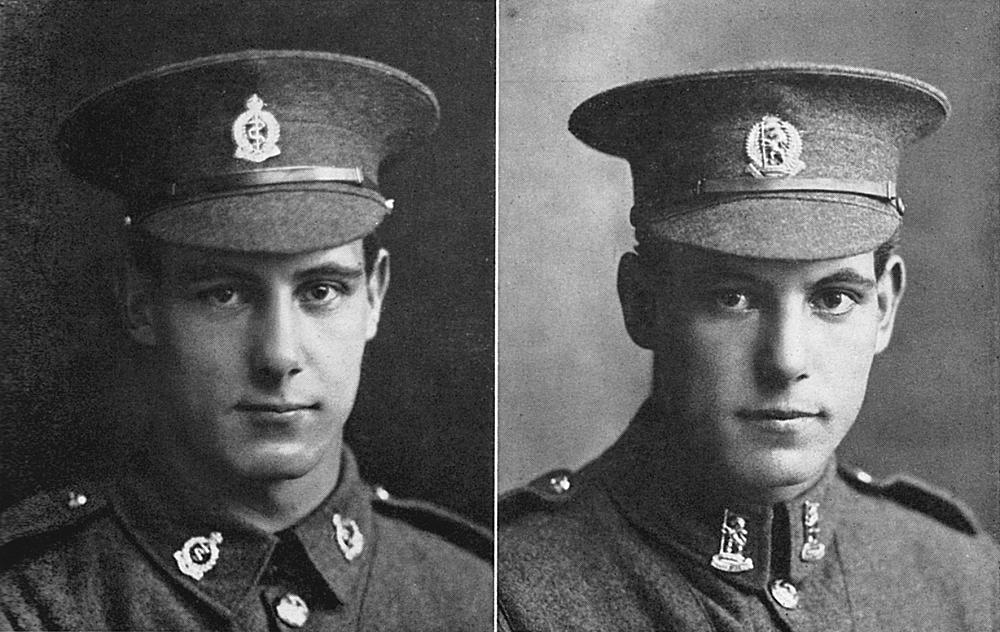
Twin brothers Leo and Laurence Donohue were among the first students enrolled at St Bede's College. Their legacy, and the sacrifice made by their family, offers a deeply moving and profoundly personal insight into the cost of war.
Born in 1896, Leo and Laurence were the youngest of eleven children born to Martin and Annie Donohue. The Donohue family home on Normans Road in Christchurch was a lively, faith-filled household shaped by Catholic values and service. Their sister Rose would later become Sister Angelica of the Sisters of the Mission. One of their older brothers, Michael (known as Frank), left New Zealand for Australia the same year the twins were born and later entered religious life as Brother Gilbert.
Leo, the taller of the two, was affectionately nicknamed "Jum" (short for Jumbo), while Laurence, slightly smaller in stature, was known as "Tiny." Both were clerks—Leo with the Farmers’ Co-operative in Christchurch and Laurence with the Victoria Insurance Company—when they enlisted for service in August 1916. The nation, like the rest of the world, was well into the second year of what was then called the Great War. The idealism that had initially drawn young men to war had given way to grim reality, but the Donohue twins did not hesitate.
Tragically, the war had already reached their family. In September 1916, just a month after the twins enlisted, their older brother Ernest was killed in action during the Battle of Flers-Courcelette on the Western Front. Ernest, who had three children, was one of the few married volunteers from the Papanui area. He had served first in Egypt and then in France as a sergeant in the Canterbury Battalion. His death at over 40 years of age was a bitter blow to the family—one that would soon be compounded by even greater loss.
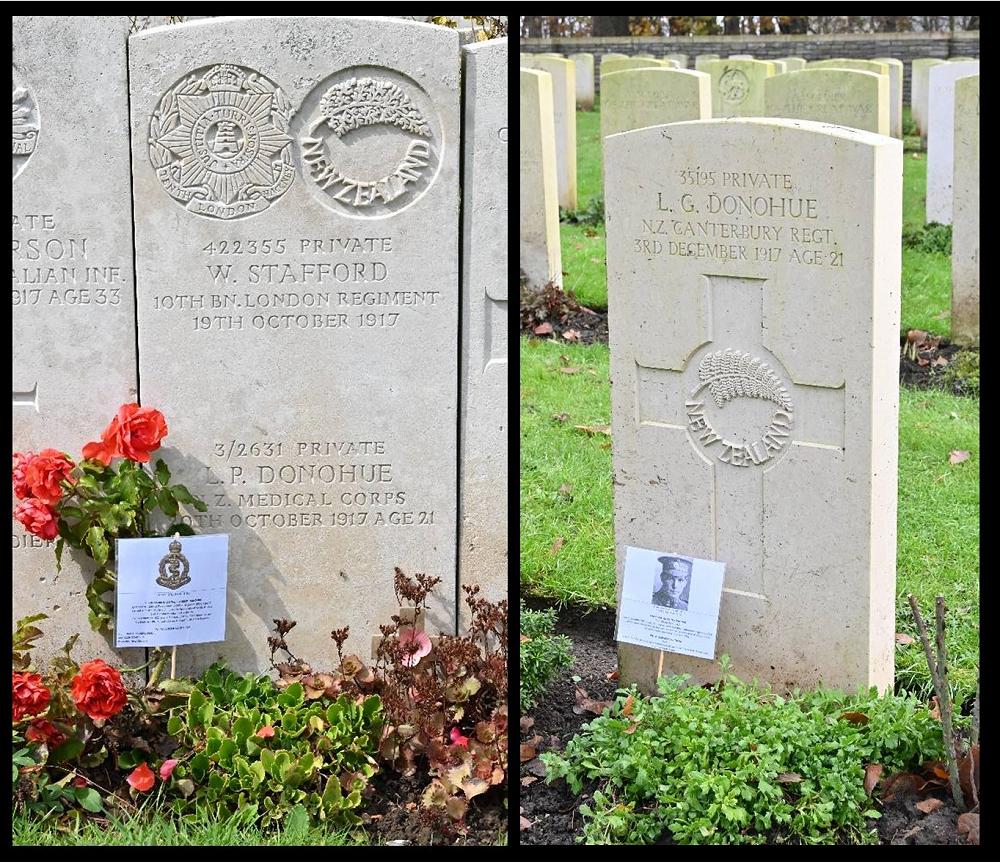
Laurence served with the No. 4 Field Ambulance, part of the New Zealand Medical Corps. These units, and particularly their stretcher-bearers, were known for extraordinary bravery, retrieving wounded soldiers under relentless fire. Laurence, strong, fit, and quietly courageous, was well-suited to this demanding and dangerous role. In May 1917, he arrived in France, having completed intensive preparation at Sling Camp.
On 13 October 1917, during the Battle of Passchendaele, Laurence was exposed to mustard gas—one of the most insidious and feared weapons of the war. Though gravely ill, he placed duty before personal wellbeing, continuing to serve until he could no longer go on. He died a week later in the 50th General Hospital and was buried in St Omer. He was 21 years old.
Leo, meanwhile, had joined the Canterbury 3rd Battalion and took part in the bloody assault at Messines in mid-1917. He later transferred to the 4th Trench Mortar Battery. His service culminated in the assault on Polderhoek Chateau on 3 December 1917—a poorly planned and ultimately futile offensive that claimed his life. He died on the first day of the battle, just six weeks after the death of his twin.
Within four months, the Donohue family had lost three sons to the war. The grief that settled over 19 Normans Road was profound and lasting. A relative, Ann Rathbun (née Milne), later recalled the silent vigils the family kept: “The family would sit in the room in a heavy silence, avoiding showing their true emotion in front of others. Every now and again one would get up and leave the room unable to control their tears. When they had composed themselves, they returned to the room to continue the vigil.”
Martin Donohue, the father of the boys, died in 1919—just a year after losing his sons. Annie Donohue, resilient and faithful, lived on until 1944. Though the direct link between the Donohue name and the College ended with Leo and Laurence, their family’s influence continued through through sister Lucy Donohue. Lucy's son Ralph Lattimore (1920-1923), was a first day student at Main North Road site and became the first Secretary of the first Old Boys' Association. Her grandchildren include Father Roderick Milne (1949-1955), the late Brian Milne (1956-1961), Kevin Milne (1961-1966), and Ralph Lattimore (1959). Lucy's great grandchildren include former President of the Old Boys' Association Stephen Kennedy (1981-1985), former Tall Blacks Captain Ralph Lattimore (1983-1984), David Kennedy (1985-1989), Tim Rathbun (1982-1986), Mark Rathbun (1985-1989), and Jeremy Rathbun (1986-1990).
Kevin Milne is a well-known New Zealand broadcaster best known for his long-running work on the consumer television programme Fair Go. Kevin writes a regular column for the New Zealand Women’s Weekly in which he has written about his Great Uncles. Two of these wonderful articles are attached below.
The story of the Donohue twins is a powerful reminder of the deep roots of service, sacrifice, and faith that have shaped our St Bede’s community. They were young men with their lives ahead of them—bright, loyal, full of promise—and their story reflects the loss felt in so many New Zealand homes during the war years.
Each ANZAC Day, we remember Leo, Laurence, and all those on our old boys' ANZAC Day Roll of Honour, not just as names etched on a memorial, but as living parts of our College’s history. They were Bedeans, brothers, sons, and soldiers—and we honour them with pride and gratitude.
Lest we forget.