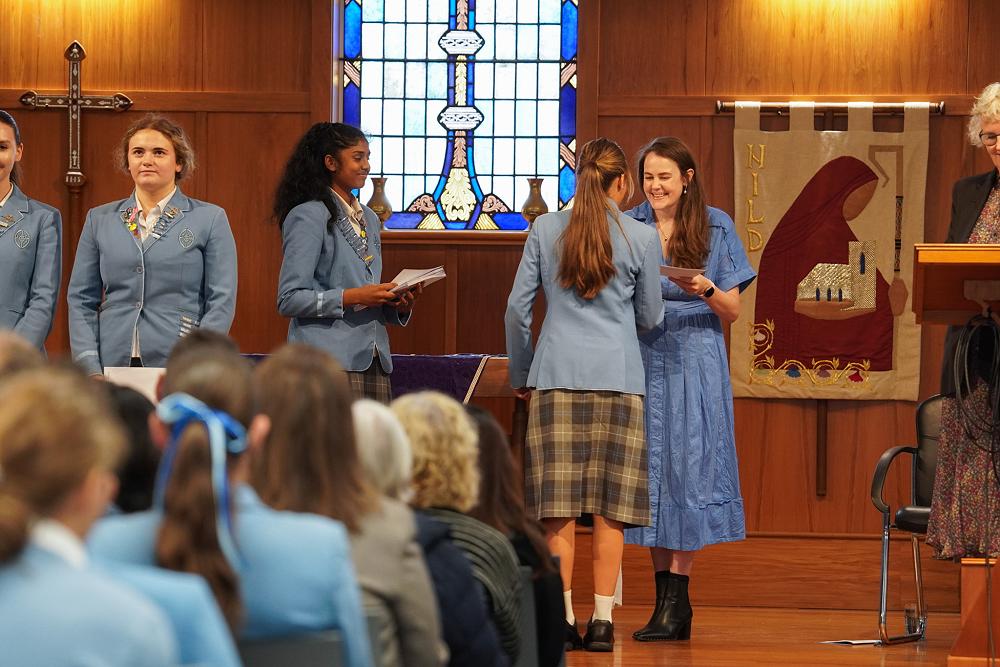
Kate Grant's Presentation at the Academic Blues Assembly
Kia ora koutou,
Nō Kōtirangi ōku tūpuna
I whānau mai au i Ōtepoti
I tipu ake au ki Maruawai
I hūnuku ahau i Tāmaki Makaurau ki Ōtepoti i tērā tau nā reira, me mihi ki a Ngāi Tahu, he mana nō rātou ki tēnei whenua.
Ko tōku hoa tāne me tāku tama nō Ngāi Tahu.
E mahi ana ahau i NSPR
Ko Kate Grant tōku ingoa
It’s a pleasure to be here with you today. Congratulations to all of you who are receiving academic blues – it’s a tremendous achievement and a testament to your hard work and dedication to your subjects.
I was what can be best described as a ‘middle of the road’ student when I went to school at Gore High a couple hours south of here. I wasn’t exceptionally bright, but I did work hard, and for the most part, chose subjects that I enjoyed. The exception here would be year 13 Biology and Statistics – these were a necessary evil because I had decided I wanted to go to university to study psychology.
Actually, my first choice was to join the police force, but I learned that they didn’t tend to take people straight out of school; you had to have life experience, so I decided I would get a degree. Then I learned that you had to pass a fitness test to join the force, and it quickly dropped down my career list.
A word you often hear in the public relations world is ‘pivot’ – a quick change in direction – and I guess this was the first one.
I began a degree in psychology with the intention of becoming a clinical psychologist. In my second year, I did an exchange to Canada for a semester, where I scraped through thanks to the university’s decision to let exchange students either ‘pass or fail’ rather than record their grades. When I returned to Aotearoa, I learned that while I’d been galivanting around North America, I’d missed a crucial paper that was only offered every other semester, meaning I’d be late to graduate.
So, another pivot. I was minoring in marketing, so I decided to turn that into a major and do a double degree, a BA in psych and a BCOMM in marketing, to give me more options once I graduated. It meant tackling 12 papers that year, but ultimately without making that change, I wouldn’t be in the industry I am today.
I also found out that they only take the top 8 students in the clinical psychology programme. So, despite three of my best friends making the cut, I took another pivot and pursued the marketing route. That psychology degree has not gotten a whole lot of use in my professional career, but it taught me some valuable skills, like never closing a tab on google when doing a research paper before you write down the source of the information, and that the brain can remember very specific scientific facts but not if you turned your hair straightener off that morning.
My first big girl job was not too far away from here – it was down the road at the Otago Museum in the marketing team. One of the parts of that role that gave me the most enjoyment was public relations and media liaison, so I took an opportunity to move to Auckland and work for a PR and communications agency.
I’ve been with that agency for just over 9 years and am now a co-owner and the managing director. I didn’t leave high school thinking I would run a business – I had intended to go overseas and work in London like every other millennial. I’d actually been saving for the trip ever since I started work, and I came to a crossroads – do I buy into the business, or do I go and see the world? Both were beautiful options that would fulfil me in different ways, so I had the very privileged choice of deciding what I would regret less, and I chose to invest in my career with the hopes that travel could come later. Pivots galore.
I’m often asked what PR, or Public Relations is – and some days I’m not sure myself. It generally sits under the marketing umbrella and ultimately, it’s about storytelling – helping people to share their stories with the world to connect with people, galvanise action and create change – and telling their stories in the right way, at the right time, and through the right channels.
Every day, we work with businesses and individuals on how they articulate, embody and express their brand, and how they communicate that with the people they want to engage with. And sometimes, we work with them on how to manage their brand when things go wrong.
When I say ‘brand’, you might think of Adidas, Apple, or Coke. Those are huge brands that have many, many people working on them. But actually, something we spend a lot of time working with people on is their personal brand.
One of the biggest business trends in 2025 is the rise of the personal brand because people connect with other people, rather than a logo. You might have seen a rise in business founders fronting their marketing, showing the humanity behind the corporate operations.
And it’s something we could all learn from.
A personal brand is about who you are, what your values are and what you stand for. It’s something that acts as an internal compass, guiding decisions and actions.
You might already have a sense of what your personal brand is, even if you don’t call it that. Think about what values are important to you. And, more importantly, do your actions reflect those?
Being genuine is key. This isn’t about creating a persona, it’s about telling the story of you in an authentic way. If you’re trying to curate a brand on social media or in interactions that is something different to who you are, you’ll be so exhausted from putting on the mask that you’ll never actually get anything done.
It’s the classic word association game. The way you might associate ‘luxury’ with the word Mecca or ‘hygienic’ with Colgate – what words do you associate with yourself?
Your personal brand should be the core motivation for all of your actions, and anything that isn’t ‘on brand’ should give you serious pause.
I’m not talking about using the same filter on all of your Insta or finsta posts - it’s about your values, your brand coming through in your actions.
Before you start thinking about what industry you want to be in, think about the type of woman you want to be. What do you consider to be your brand? Is it having a strong work ethic? Being someone that always sticks to their word? Is loyal to the people that matter to them? Sticking up for people that have trouble finding their own voice? Or someone who is always a champion for other women?
Personal brand is entirely in your control, and it’s based on what you put out into the world. But when you leave the room, that’s when personal brand turns into reputation. And reputation can be a powerful thing. Taylor Swift wrote a whole album about it. It was literally called Reputation.
However, as Taylor and I both know, sometimes women are unfairly doled out a reputation by people significantly less pleasant than themselves. But all hope is not lost. You ALSO have the power to rebrand yourself by living true to your values. People can talk, but it’s hard to argue with actions. What you do is who you are.
And this goes for anything you find yourself labelled that you don’t agree with. Are you bossy, or are you a leader? Are you bitchy, or do you simply not suffer fools? Are you high maintenance, or do you just have high standards? Are you emotional, or do you have an exceptional EQ? There is a whole list of words that are used to describe women but not men. It’s boring, but I trust in you clever wāhine to be a lot more creative.
If you haven’t guessed, a big part of my personal brand is being able to take any negative connotation you could throw at a woman and reframe it positively.
What can I say, I’m a girls’ girl.
You don’t need to know what you want to be when you grow up, or what course to study or what career to crack into. But at the risk of sounding like I’m assigning homework - I do encourage you to think about the type of person you want to be, and what you want your personal brand to be, and start living up to it now. A strong personal brand will see you through job changes, career changes, time off to travel or explore other interests – whatever path you decide to take.
A relationship, a job, even a career, don’t define you. Engineer. Florist. Mum. Builder. They’re not adjectives.
You could have 20 different jobs in your lifetime, but your values are what people will remember you for.
You can be whoever you want. You just have to decide who that is.
Congratulations again to today’s blues recipients and everyone in this room who is working towards an academic goal. You can all add ‘exceptionally hardworking’ to your personal brand brainstorm.
Kia ora.
Kate Grant
Managing Director and Co-Owner of NSPR