Toroa News
Science
These past two weeks we have been doing some experiments on energy. There are two types of energy, there is potential energy and kinetic energy.
Potential and kinetic energy
In Miss Gollans class we have been learning about potential and kinetic energy. Potential energy is where if I am holding up a pencil then it has potential energy and if I drop the pencil when it hits the ground it has kinetic energy. We also made humming birds on a snapped rubber band. When it’s at the top of the rubber band it’s potential energy But when you drop it, it becomes kinetic energy.
Elastic energy
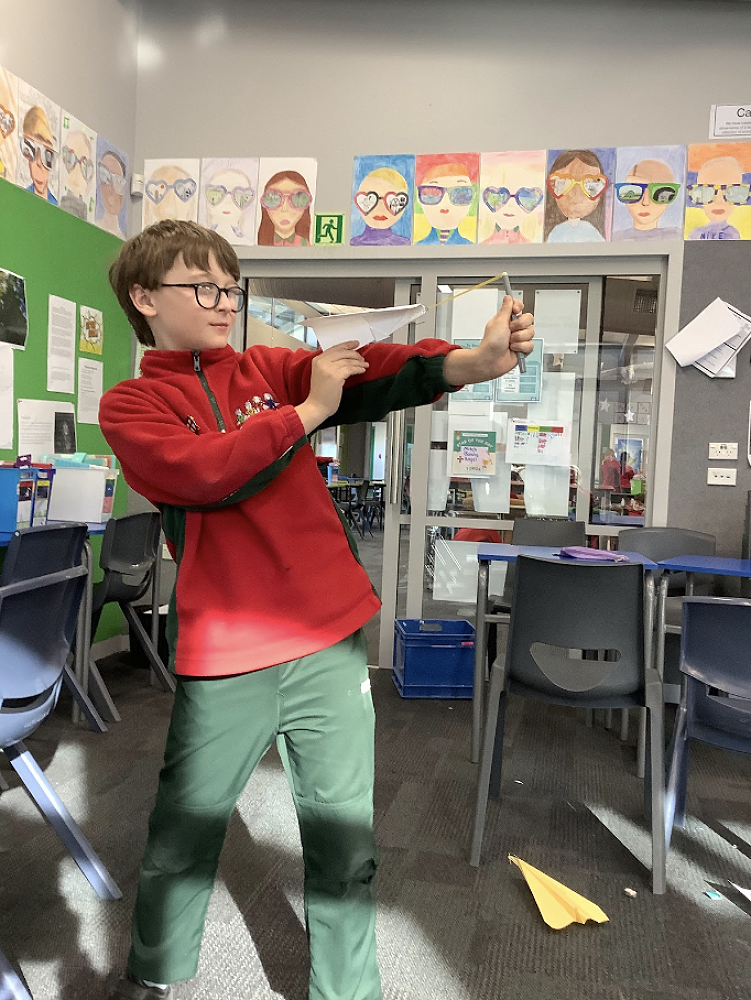
In Mr Thomson's group, we learned about elastic energy. Elastic energy is the power of elastic bands. The power of elastic bands is super stretchy. They can stretch really far and when you let them go they fling back. A way we tested this was by making paper plane launchers. We made the paper planes, and then we stapled a paper clip onto the nose of the plane. We then got a rubber band and a pencil and then we put the rubber band around a pencil and then the other end of the rubber band around the end of the paper clip then we took hold of the pencil and fired away.
Gravitational energy
In Miss Loper's class, we've been learning about gravitational energy by dropping a ball and measuring it with a ruler. First, when you drop it you let it bounce once then you see its highest point of where it's bounced. Next, you drop it again and see how high it bounced on the second bounce then you measure it and so on. We do that three times and then you have to add up all of the recordings together and then you divide it by three and then that'll be your answer.
Overall conclusion
Overall it has been really fun doing all of these activities and we really hope that we can do something similar to this soon.
Grace and Thomas
Kapa haka!
Mia: We had a Kapa Haka performance on July 2nd at the Lincoln High School. We had been practising for a couple of weeks. The girls used the poi and the boys did the actions to the song.
Evie: For our clothes, the girls had to come with black shorts and a black T-shirt or black singlets. The Boys had to wear some black shorts and a black T-shirt if they wanted to not wear a top but most of the boys didn’t wear tops. With their piupiu, the girls had aprons and their shorts and singlets. The girls had their poi. One of the songs was called Rona and I can’t remember the other one but one of the hakas was Ahatoia Mai and I think that's it for me.
Takeover team
With the take over Miss McDowell has been doing art. Our art is an illusion-type art. First, we started off with a piece of paper and drew some lines without rulers then we went over them in vivid detail. After we did that we drew smiley faces in pencil and then went over in vivid. After that, we looked at complementary colors so you chose one of your favourite colours which was on the wheel. Then the colour across was its complementary colour. For example purple and yellow. Then we could even start from the bottom. After that, we drew sad faces and went over them in vivid. Then you grab your other colour and do the same thing. Then you get a photo that looks like you are falling into a hole, cut it out and stick it on the sheet of paper. After that, we got a piece of black paper and stuck it on. Then we go the option of making 3d balls so you start by drawing a circle then two lines to make it quarters then you draw long smiley faces with lees smile both ways then we could have it our complementary colours for black and white checkered. Then we handed them in and they got put up on the wall.
In Miss Greer's group, we did a marble run. How to do the marble run is you get thirty bits of paper the less paper you use the more points you get, you either get a group of four, three, or two or you could go by yourself.
After that you start making it, then you do 8 x your time and remove so and so how many bits of paper you use. We got an hour to make our run, there were prizes for first, second and third. We got two chances and if it stopped for ten seconds you would have to restart. It was quite a challenge although it may sound easy. It was easiest to go in a group of three because we all had something to do. We all really enjoy Miss Greers challenges that she gives us.
In Miss Young's class, we talked about the body and how it works. We saw a video of the muscles and how they work then we watched a video about 3v3 basketball but we did 5v5 because there were too many people.
Elise and Briar
Matariki news letter
Last week we had a day off on friday because of matariki. We have learnt a lot about Matariki also known as the nine sisters or pleiades. We learnt about the nines sisters' meanings.
Matariki
Matariki is the mum of all 8 star sisters and brothers. She is connected to health and wellbeing and is a sign of good fortune or health. If matariki is bright and high in the sky it is a signal of peace and good luck for observers.
Pohutukawa
Pohutukawa is the eldest sibling of the eight. She is the star that represents the ones who have passed away. It is said that she carries the souls up to heaven. She is a very important star.
Tupuanuku
Tupuanuku is the third star. She is assosiated with the food grown in the ground.For example: carrots, tomatoes and potatoes. You can look up upon the star to indicate when to harvest the food.
Tupuarangi
Tupuarangi is the fourth star. He is connected to the food grown above the ground like in trees. For example: Coconuts, Bananas and apples. He has a strong connection with birds and animals in the trees as well.
Waiti
Waiti is the fifth star. She is connected to fresh water and living creatures in the rivers, streams and lakes. She has a twin called waita. The start of waitis name WAI means water in Maori, when you look upon the star you can appreciate our fresh water in aotearoa.
Waita
Waita is the sixth star. He is associated with salt water and represents the food gathered from the sea. He is the twin of waiti. Like his sister he starts with WAI which means water. You can look up to this star to set goals of protecting our salt waters and creatures living within.
Waipuna-a-rangi
Waipuna-a-rangi is the seventh star. She is connected to the rain and water in the sky. She is also known as ‘water that pools in the sky’. When you look up to this star you will recognise how important fresh rainfall is to life on earth.
Ururangi
Ururangi is the eighth star. He represents the wind. His name means “the winds of the sky”
He was traditionally used to forecast the nature of the wind every year.
Hiwa-i-te-rangi
She is the youngest star. She is connected to a promise of a prosperous season. She is also known as the wishing star. Maori traditionally would use this star to set their desires and dreams for the year. We would commonly know this as new year's resolutions.
Conclusion
It was super fun learning about Matariki and her children. We hope you had fun learning about them too in this newsletter. Now you know all about the matariki stars and their meanings. We hope you enjoyed this.
Mabel and Lexie
Nga mihi whānau from Toroa team