
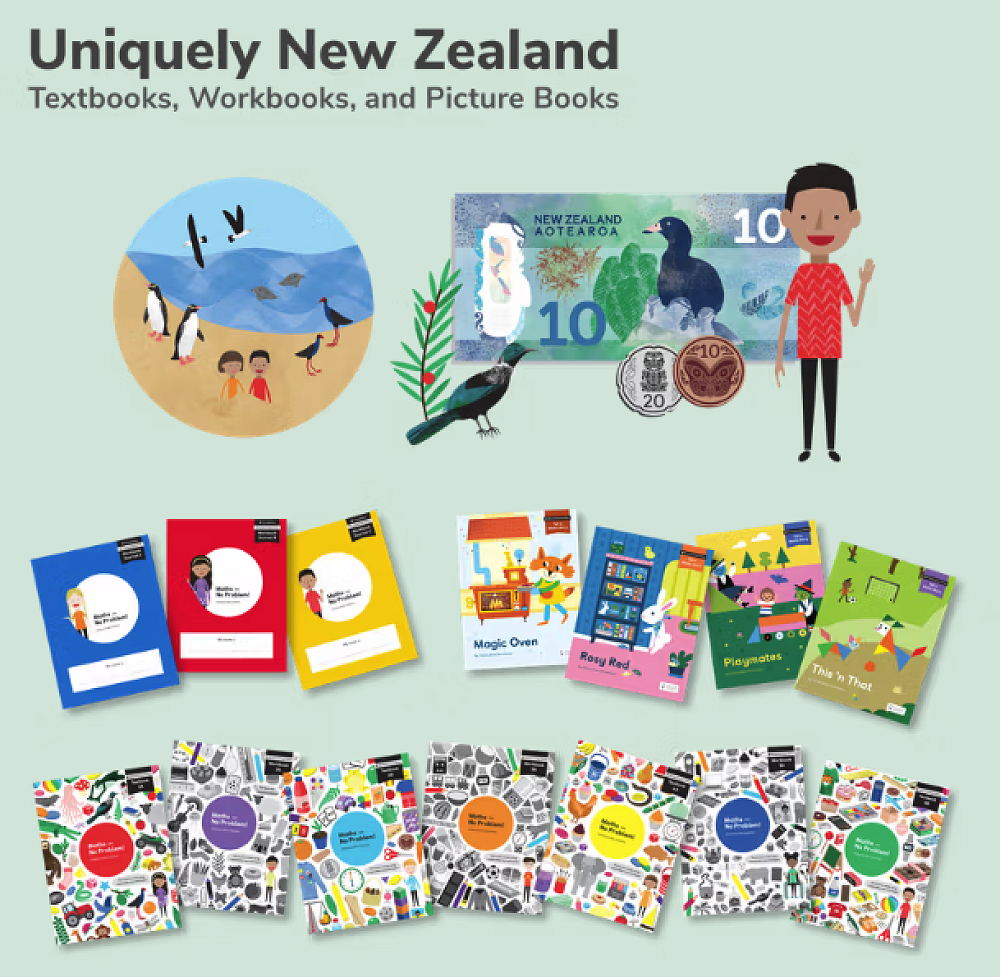
Maths No Problem!
We are excited to introduce Maths No Problem (NZ version) to our school community!
We are really pleased to see the new Maths Curriculum has been finalised. It is arranged with specific learning outcomes for each year group in the school (After 6 months at school, then Y1-8) This is something we appreciate having as it is an explicit and clear guide for us when designing our implementation plans.
Schools were asked to select one of 4 Maths programmes that would support teachers in the delivery of the new Curriculum and after careful consideration and investigation, we chose "Maths No Problem" , an internationally recognised programme (based on Singapore Maths) that has been adapted for use in New Zealand.
One of the key strengths of Maths No Problem is its use of the CPA model, which ensures that students grasp mathematical ideas in a meaningful way:
Concrete: Students begin by using physical objects to explore mathematical concepts, making learning hands-on and interactive.
Pictorial: They then progress to visual representations, such as diagrams and bar models, which help bridge the gap between concrete materials and abstract thinking.
Abstract: Finally, students move on to using symbols and numbers to solve problems, reinforcing their understanding and ability to apply maths independently.
This approach helps students develop strong problem-solving skills and a deep conceptual understanding, rather than relying solely on rote memorisation.
Maths No Problem follows a structured lesson sequence that encourages collaboration, discussion, and critical thinking:
Exploration Task – Each lesson begins with a real-life problem that sparks curiosity and encourages students to explore different strategies.
Master Concept - The teacher explicitly teaches the concept, clearing up misconceptions noted in the exploration phase.
Guided Practice – The teacher facilitates discussions and models problem-solving techniques to deepen understanding.
Independent Practice – Students apply what they have learned through carefully designed exercises that reinforce key concepts. Students have work books, text books and equipment to support this independence
Journaling & Reflection – Learners reflect on their thinking, solidifying their understanding and making connections to prior knowledge.
This lesson structure ensures that all students are actively engaged in their learning, developing confidence and resilience in maths.
The carefully designed lesson sequence ensures that all new learning builds on prior learning and that concepts are covered repeatedly with increasing complexity.
The programme design / sequencing does mean that any absenteeism will be problematic!
Although multi level delivery is possible, it is not the best way to deliver the programme. For this reason, we will start off the programme by ensuring that children are taught in their year level groups. This will mean that at times, children will be moving to another class for maths lessons. You will hear more from your class teacher about this when we formally start the programme in the coming weeks.
We will run a parent workshop to further explain the programme early next term.
In the meantime, if you would like to know more, feel free to ask your child's teacher - or pop in and see Kylie or myself.