
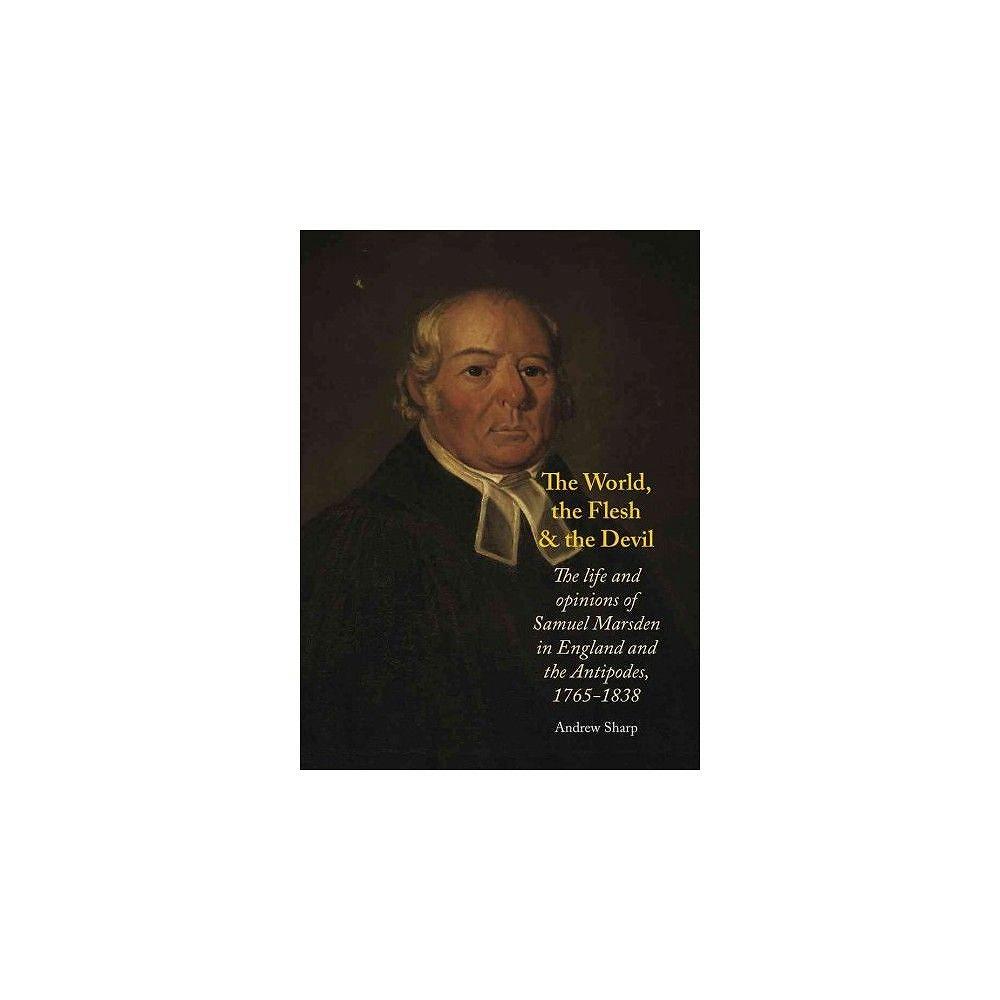
The World, the Flesh and the Devil: The Life and Opinions of Samuel Marsden In England and the Antipodes, 1765-1838
By Andrew Sharp, Published by Auckland University Press, 2016, Reviewed by Janet Crawford
This is a big book. The main text is 767 pages added to which there are pages of notes and sources, a comprehensive index and an appendix: a total of 926 pages, including numerous illustrations of people and places and a few maps. As the title indicates the book is also big in its scope, dealing not merely with Marsden’s life but also with his opinions, the ideas and beliefs that drove him to act as he did.
Samuel Marsden is little-known in New Zealand today. In December 2014 the Marsden Cross at Oihi in the Bay of Islands was the site of a ceremony celebrating the arrival of the Gospel in Aotearoa New Zealand for it was there, on Christmas Day 1814, that Marsden, with the support and under the protection of Nga Puhi chief Ruatara, held the first Christian worship service. He then established a mission station at Rangihoua with three missionaries and their families. For this reason Marsden is remembered by the Anglican Church as “The Apostle of New Zealand”. In Australia, where he arrived (with his wife Elizabeth) as chaplain to the penal settlement of New South Wales in 1794, he is more likely to be remembered as “the flogging parson” because of punishments he ordered in his role as a magistrate. (Sharp points out that this description was applied in a personal vendetta waged against Marsden and that he was comparatively lenient in his sentencing.) The fact remains that Marsden’s reputation was, and is, greatly contested. Sharp does not judge till the end of the book but attempts to understand Marsden and his different worlds in their own terms, drawing on his own words in his letters, books and public statements, and on his actions.
The structure of the book is simple. Sharp deals with Marsden’s life in chronological order, from his birth near Leeds, England in 1765 to his death in Parramatta, Australia in 1838. There are five sections of unequal length. Sharp helpfully points out that within these sections each chapter may be regarded as an essay in itself and that the longer ones probably ought to be digested in parts rather than swallowed whole. This is good advice!
Although Sharp, Emeritus Professor of Political Studies at the University of Auckland, is not a Christian himself he takes Marsden’s evangelical faith very seriously, arguing that there is no understanding him except as a deeply committed Christian moralist and preacher of salvation, a man to whom religious duties always took precedence even in his family relationships. (Due to lack of documentary evidence there is rather little about Marsden’s family and private life.) His treatment of Marsden is scholarly and scrupulously fair. He does not judge the past and its people by the moral standards of the present. His final words on Marsden are considered and considerate: “He must be judged an extraordinary man because of his energy and commitment, an annoying man to those who did not (and do not now) share these commitments, a man whose opinions were tolerably coherent and fitting to his times but are increasingly distant from those of most of the globe’s people today” (p.767).
This book requires some effort, even when read in sections, but those readers who are interested in a significant part of New Zealand history should find it well worth the effort.
Tui Motu Magazine. Issue 220, October 2017: 28-29.