
Our Blessings for a Happy Christmas
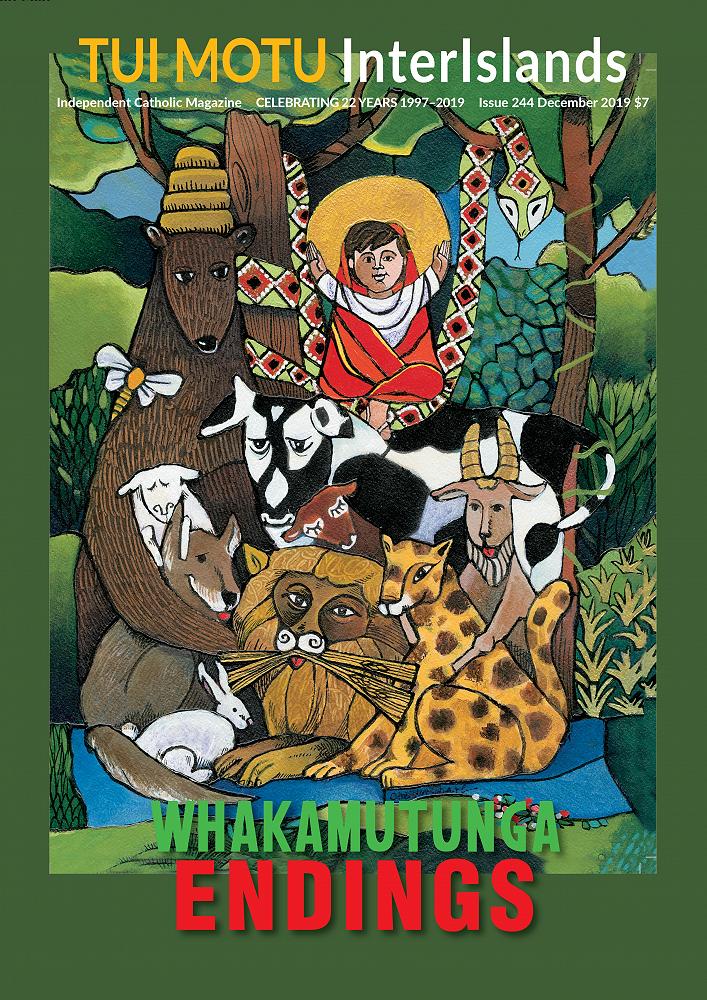
Our cover picture shows the child Jesus in a novel setting. As well as the animals depicted we can add a kiwi and kangaroo in our imaginations. It’s an invitation to end a narrow understanding of the incarnation as the Divine becoming flesh in a human person only, to the Divine becoming present and in communion with all matter — of God sharing life with every speck in creation. For some of us, this is a stretch.
In this issue we’re exploring endings. We’re coming to the end of the calendar year with all the endings that ensue — school and work finish, students graduate, clubs often take a break, Tui Motu publishes the last issue for 2019 and the last shopping days before Christmas are heralded. These are froth in the wave of diverse endings that we’ve encountered during the year. Some endings can be expected: “Max has stopped going to bed contentedly at night now and wants one of us be with him as he falls asleep,” a niece explained — a new phase in her one-year-old’s growing up. Others loom large: “The doctor says that I’ve come to the end of treatment,” a friend confided about facing the end of his life.
While we’re coming up to the end of 2019, already the Church’s new liturgical year has begun with Advent, and Christmas is on the horizon. It’s an example of endings and beginnings overlapping so much so that we can miss the significance of each. As some of the contributors to this issue write, endings can be transitions to beginnings. But endings have significance in themselves and attending to them can bring what is often called “closure”.
Some of what we’ve learnt in the endings has the potential to compost the future. Some endings are needed for new growth.
The issues of this year have called us to endings — ending clericalism in the Church, ending the suppression of child sexual abuse — all essential. An ending as important is that of our human-centred perspective that allows us to trash Earth. This is where thinking about the Divine as in communion with all life can deepen our own communion with all of creation — as Earth creatures together. It will also influence our thinking in other areas of our lives such as our relationship as Church, as community and as societies.
We thank all our wonderful contributors to this issue and to each magazine of 2019. Your research, reflection, faith, art, craft and generosity have given us a year of thoughtful, stretching, nurturing reading.
Tui Motu Magazine. Issue 244 December 2019: 2