
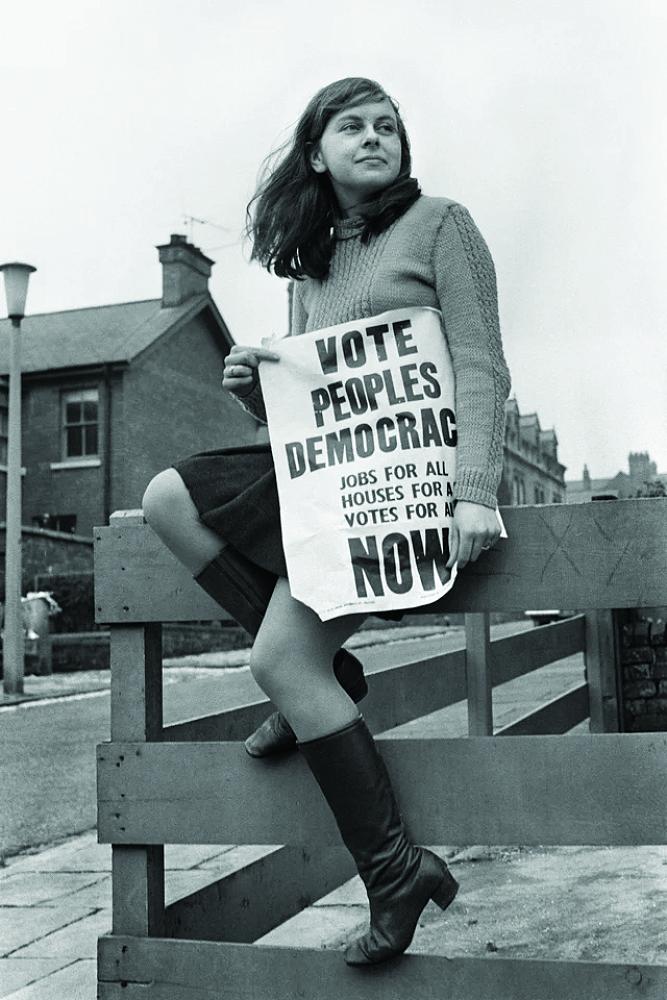
Captured by Her Passion
Aged somewhere between nine and 10 I stole into my parents’ bedroom one afternoon, probably looking for one of my mother’s library books to sneak away and read on the sly. The radio next to her side of the bed was broadcasting a speech in the Westminster Parliament delivered passionately by a young-sounding woman with a broad Irish accent.
I sat on the edge of the bed transfixed as I heard for the first time Bernadette Devlin speak about the 1969 Battle of Bogside which sought to exclude police from the Catholic section of Bogside in Derry, Northern Ireland. Devlin took the side of the residents and pleaded for the army to intervene, which they eventually did, breaking the impasse. At 21, in a by-election, Devlin had been elected to Westminster in 1969, then served six months in prison for her role in the Bogside riots and was subsequently re-elected to Westminster in the 1970 general election.
She spoke about how social deprivation underlies social unrest. She claimed to represent a non-political movement, but one not without beliefs (otherwise they’d be a bunch of cabbages, she said). In those days, she described herself as a Protestant Catholic, explaining that she had the weird idea that Buddhists and Hindus were as right as the Catholics “because it’s the principle that counts and Christianity comes down to loving your neighbour in its widest sense.” She went on to say that it basically comes down to socialism. Her words and her passion spoke to me as an impressionable youngster with an extensive Irish nationalist lineage.
Articulate and fierce, the international media embraced Devlin for a time as a modern-day Joan of Arc, a revolutionary, who was the youngest MP in Westminster in 50 years. While that status has since been replaced by Scottish National Party MP Mhairi Black, elected to Westminster in 2015 aged 20, Devlin, who became Bernadette McAliskey in 1973, has had a full and tumultuous life and at 74 remains an active Irish civil rights leader.
Devlin travelled to the US seeking support from the Irish diaspora and funds to support her cause. She attempted to draw parallels between the African American civil rights movement and the Catholics in Northern Island and came up against implacable racism.
She witnessed the Bloody Sunday massacre in Derry in 1973 and the next day, having been denied the right to speak, slapped the Conservative Home Secretary in the face in the House of Commons because he asserted the army regiment fired in self-defence.
After losing her parliamentary seat in 1974 she helped form the Irish Republican Socialist Party. She led campaigns in support of Irish prisoners and hunger strikes in the early 1980s. In 1981, Devlin and her husband were shot at home in front of their children by members of the Ulster Freedom Fighters and almost died.
In the late 1990s, she founded a programme to provide services and advocacy for community development training, support and advice for migrants.
Bernadette Devlin was my introduction to politics. I grew up in a world beset by a daily media diet of the troubles in Northern Ireland, the Balkans, Rwanda and the Middle East, and in the shadow of potential nuclear war. Devlin’s message that the underlying values of Christianity permeated all religion and social justice movements resonated enormously. For me, the self-interested institutions of specific religions were superfluous and counterproductive. I listened to stories about my great-grandfather Patrick Curran, believed to have been Sinn Féin and forced to leave Ireland, and fancied his blood ran strong in my veins.
By the time I was 21, the Springbok Tour provided ample opportunity to stretch my nascent political wings and as I stood in the Dunedin Exchange staring balefully at a busload of red squad police, while they laughed and jeered at me, I knew then that I, too, possessed an internal fire stoked by injustice and the inability of sectors of our society to have their voice heard.
I continue to stand in awe of Devlin’s unrelenting, fierce determination to bring awareness and make change for the people she represented. It was foolhardy to take my tent to the Octagon on a bitter, cold July night in 2017 to protest the treatment by the State of two young women unable to find housing and the countless others standing behind them. But as I did so the clarion cry of Bernadette Devlin rang in my ears: “I will take my seat and fight for your rights.”
Tui Motu Magazine. Issue 260 June 2021: 8