
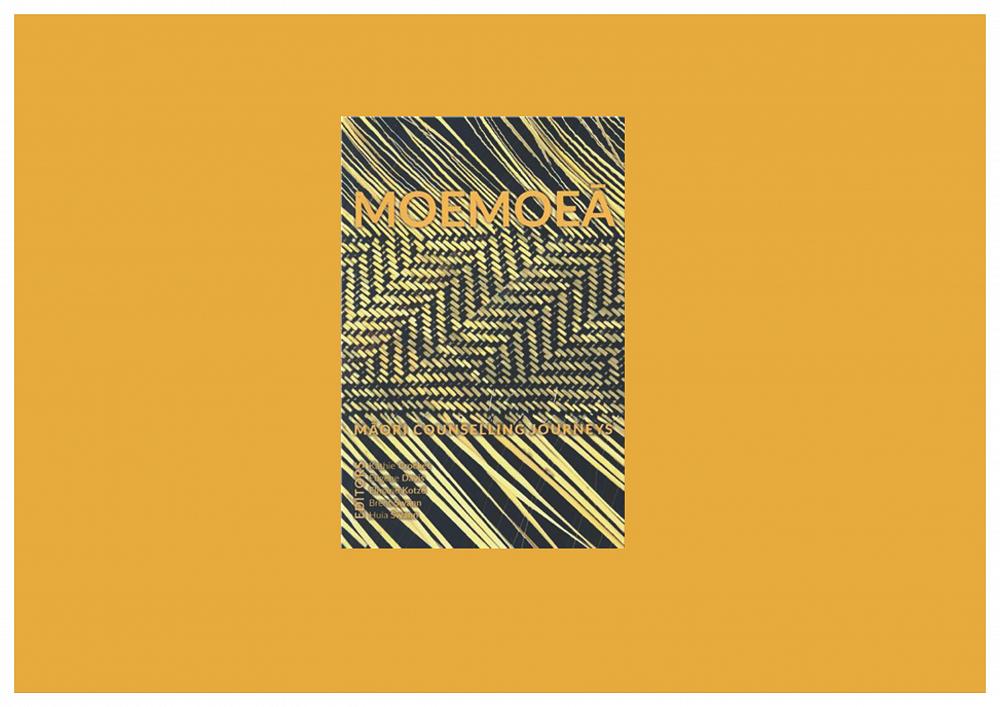
Moemoeā: Māori Counselling Journeys
Edited by Kathie Crocket, Eugene Davis, Elmarie Kotzé, Brent Swann and Huia Swann. Published by Dunmore Publishing, 2017. Reviewed by Shona Waterhouse
I take a breath and turn the pages of Moemoeā: Māori Counselling Journeys, a beautifully crafted book, written by people connected to the University of Waikato counsellor education programme. The writers welcome me, regardless of my ethnicity (Pākehā), and invite me in to their space, a Māori space. It is with manaakitanga, which encompasses caring, respect, hospitality, nurturing and support, that I feel that I am being guided through each of the sections and chapters. My small knowledge of te reo is not a handicap: there is a glossary of Māori words and phrases, and so with one finger on this page I am drawn into each chapter.
The book is divided into five sections, which cover different aspects of how the writers work with their clients; all underpinned by Kaupapa Māori. Their model of practice is also woven with a Narrative model of practice, a model that weaves in well with “waewae tapu in treading gently when we enter others’ lives”. There is an honouring of being Māori and a desire to restore mana. The writers gently highlight the effects of colonisation on Māori. I feel the weight of how my forbears, and myself in turn, have profited by colonisation. However, this does not seem to be the intention of the writers — rather, they aim to inform and to create a space to understand.
Professor Sir Mason Durie commended the skill of the writers of showing how to weave Māori traditional values and protocols with how Māori live today. Theory is shown through practice. I found the many provided composite case studies helpful as a counsellor and also deeply moving. The writers tell about how they mitigate potential power imbalances; how to use traditional knowledge to find new insights in current situations; how they build on clients’ strengths to produce positive change; and how they work as cultural supervisors.
This book gently nudged me to ask myself how safe was I, as a Pākehā counsellor, for my Māori clients? The writers’ ability to give a gentle wero, or challenge, makes this book very relevant to all those practitioners who work in the caring professions, and in particular with those who have the privilege to work with Māori, tangata whenua, the first people of Aotearoa.
Tui Motu Magazine. Issue 228, July 2018: 27.