
The Hajj — Walking in Faith
Zain Ali explains the significance of the Hajj, the five-day pilgrimage to the founding place of Islam.
The woman, a stranger in the desert, walks slowly with her son, the sun beating heavily on her and her child. Their supplies have long been exhausted and they have only drops of water. In the desert, without water and anyone to help, they face certain death. We can only imagine the woman's anguish at being unable to provide for her young son. These two are Hagar and Ishmael. Ishmael is crying and Hagar is struggling desperately to console him.
According to Muslim tradition, Hagar leaves her son in some shade and begins walking in the hope of finding someone to help — to the top of one hill and then to another. She walks back and forth between the two hilltops, hoping against hope to be seen. But there is no one and nothing but sand — dry, hot, lifeless sand dunes for as far as the eye can see. Yet Hagar doesn’t give up. She remembers one other who may yet see her and have mercy. Her husband Abraham had always told her to trust God. So, in her distress she calls out to God, the God of her husband and her God, too. Does God not hear her and her son crying?
There are two differing accounts of what happens next, and both are fascinating. God, it turns out, is listening and is carefully watching over Hagar.
According to one version of events, a spring miraculously appears at Ishmael's feet.
In the other version, an angel appears and brings forth a spring from which Hagar and Ishmael drink. Again we can imagine Hagar's astonishment, seeing a beam of light land in front of her which takes on the shape of a man, who punches his arm deep into the sand, and within seconds water appears.
Whatever the version of events we favour, God responds to Hagar, and saves the mother and child from certain death.
According to Muslim tradition, Hagar and Ishmael settled near the spring and the two hills. Travellers were drawn to that location and Ishmael as a young man built a house of worship.
The house of worship with the nearby spring became the foundation for a more permanent settlement, then a village which grew into the town named Mecca.
Mecca Focal Point of Hajj
Mecca is the focal point of the Hajj, the annual pilgrimage that is a cornerstone of Muslim tradition.
There are five pillars of Islam: to believe in God and Muhammad as God’s messenger; the five daily prayers; fasting during the month of Ramadan; charity; and the Hajj — a pilgrimage to Mecca, the home of Hagar and Ishmael.
There are rituals that the pilgrims complete during the pilgrimage, some of which relate to Hagar and her journey with Ishmael. The Hajj rituals take place over five days.
Day One
On the first day when the pilgrims enter Mecca, they set aside their everyday clothing and put on plain white robes. The pilgrims then make their way to Mina, which is about 8 km away from Mecca. There the pilgrims spend the night in prayer.
Day Two
On the second day the pilgrims go to the plains of Arafah which are about 14 km from Mina. They spend the day there in prayer, and in the evening move 9 km to Muzdalifah where they spend the night. They also collect small pebbles for the next day.
Day Three
On the third day the pilgrims leave Muzdalifah and travel towards Mina, where they throw pebbles at three pillars. This is a symbolic ritual of stoning of the devil. It is done in memory of Abraham who was on his way to sacrifice his son as God had commanded when the devil appeared and tried to stop him. Abraham threw stones at the devil to drive him away.
Later in the day, pilgrims sacrifice an animal, usually a sheep, goat or camel. This is done to commemorate Abraham who was ready to sacrifice his son before God provided a ram to be sacrificed instead.
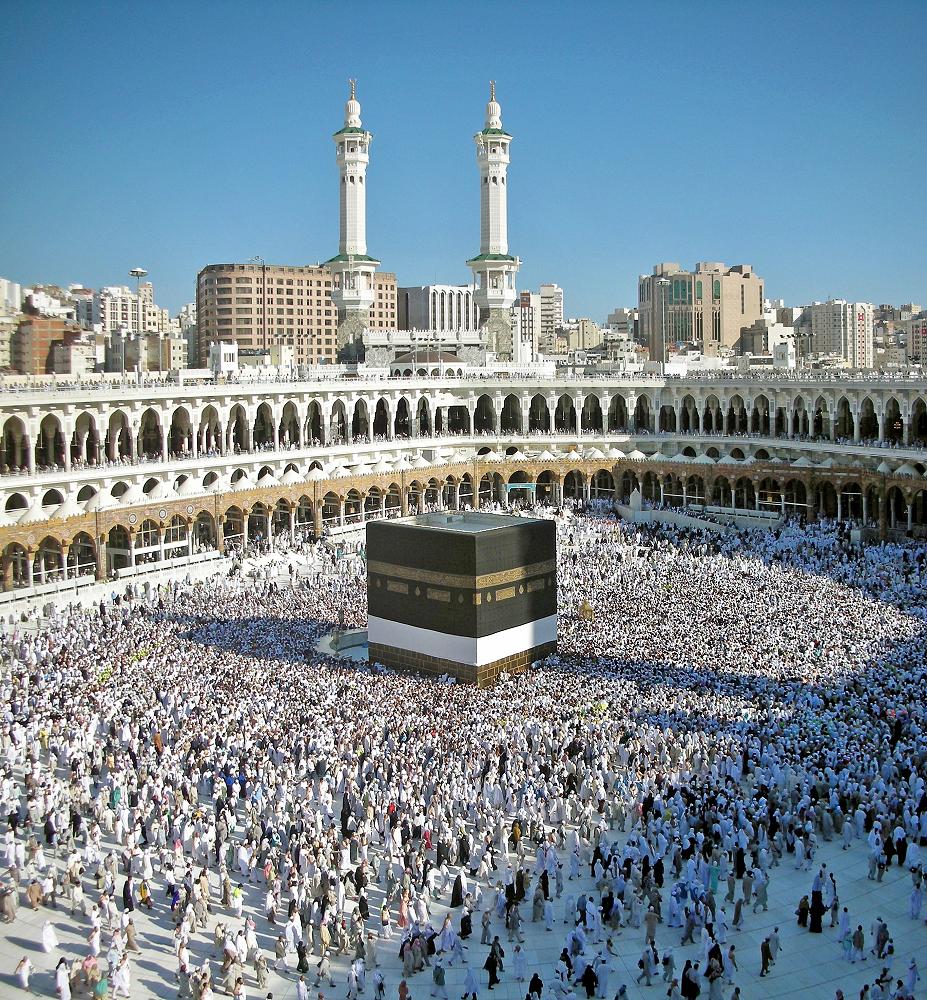
After the sacrifice, the pilgrims shave or trim their hair. Some go to the main mosque in Mecca and walk around the Kaaba seven times — thousands upon thousands of pilgrims walk around the black cube. Pilgrims also walk seven times between the two hills named Marwa and Safa, in memory of Hagar and her search for help. Pilgrims then return to Mina.
Days Four and Five
During the fourth and fifth days days, pilgrims remain at Mina and each day return to stone the three pillars. Then they go to Mecca and again walk around the Kaaba. This brings the Hajj to an end, although many travel from Mecca to the northern city of Medina where Muhammad is buried.
Significance of the Experiences
As we can appreciate, the rituals are highly symbolic and have deep spiritual significance.
The wearing of the white robes places prince and pauper on an equal footing.
Spending nights in Muzdalifah and Mina under the stars is a time for reflection — for contemplating our place in the vastness of time and space of the universe.
The stoning of the devil is a repudiation of the terrible and dark potentialities of our human nature.
Walking around the Kaaba, a pilgrim becomes aware of being both an individual and part of a larger whole.
After the sacrifice the meat is given to family, neighbours and poor people: the sacrifice is an act of thanksgiving. The Hajj is ultimately a celebration of God, a celebration of Abraham and a remembrance of the struggles of Hagar and Ishmael.
Blessings
In Hebrew the word "Hagar" is said to mean a "stranger". The Arabic equivalent is "Hajar," meaning "emigrant". In Mecca, Hajar moved beyond being a stranger or emigrant, to become the founding figure of the city — the city where Islam began, where an angel appeared to Muhammad and reached deeply into his being to remind him of God, the God of Abraham.
The Hajj reminds us of gratitude and blessings to Abraham, Sarah and Hagar, and blessings to Ishmael and Isaac and their families. And blessings extend to all pilgrims as they return home as well as to those at home:
May there always be a Hagar at your side.
May you always have water when you thirst.
May there be shade when the sun shines bright.
May you have a home when you need rest.
May the hand of an angel always be near you.
May your heart be a wellspring of gladness to cheer you.
Tui Motu Magazine. Issue 242 October 2019: 10-11