
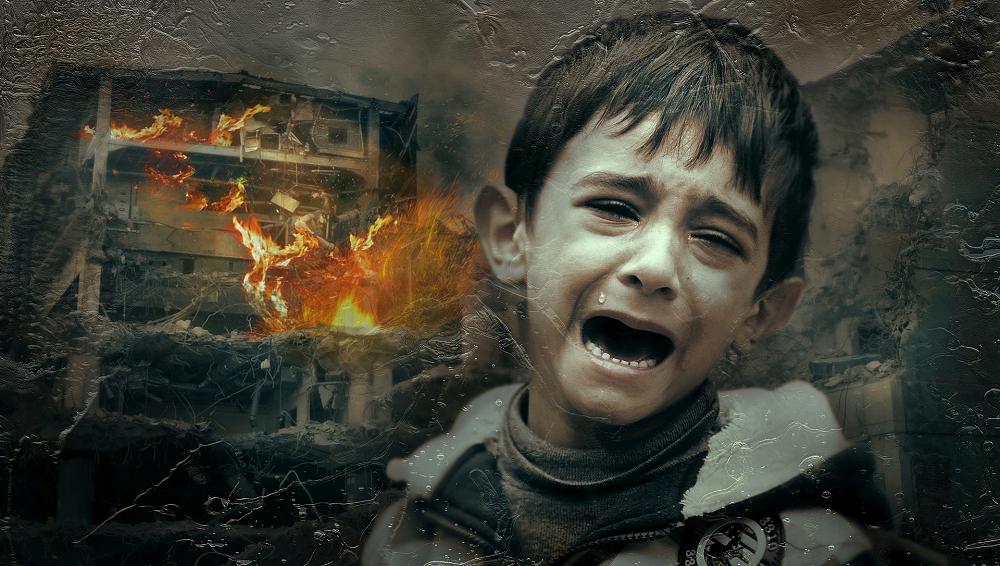
From Troy to Damascus: Seeing the Light
Hugh O'Neill reflects on the deception and lies that become the motivation for war.
Damascus, one of the oldest cities in the world, was already 2,000 years old at the time of Homer’s Trojan War (1200 BCE). In order to understand the present, we have to place it within the context of the past. However, there is a caveat — only the winners write history and so the challenge to historians is to read between (and behind) the lines.Historians must deploy judgement of the various human factors in recorded events asking who recorded them and why; and they must be aware of their own biases which inevitably influence their vision — i.e. what they choose to see or ignore.
War may be defined as the deployment of mass violence to acquire resources of the many to benefit the few. Homer would have us believe that many thousands of Greek heroes left their homes and families for 10 years so that King Menelaus could rescue Helen, his queen, who had been abducted by Paris, son of King Priam of Troy. We also learn of the cunning of the Greeks with their deception of the wooden horse. Ultimately, Troy was sacked in an orgy of extreme rapine and violence. Such base behaviour had to be given a veneer of honour — hence Homer’s paean to heroic deeds and men being the mere playthings of fickle Gods who could be blamed for man’s extreme passions, his successes and failures — his fate. There is a line from Vergil’s Aeneid, which applies equally to Homer’s epics: “I fear the Greeks and the gifts they bear”. Perhaps, Homer’s gift to us is both deception and self-deception?
Troy sits at the southern entrance to the Dardanelles (the narrow straits connecting the Mediterranean to the Black Sea, the dividing line between Asia and Europe). The Gallipoli Peninsula forms the northern shore, and the name Gallipoli is from the Greek kallis polis (beautiful city). More than 3,000 years after the Hellenic fleet landed at Troy, an army of British Colonials in 1915 stormed the beaches of Gallipoli, but this time, there was no beautiful woman to be rescued. The official reason was to take Turkey out of the war and open up a front behind the Germans.
The much less heroic truth however, is that Britain wanted the Ottoman Empire’s vast oil reserves and had already divided the spoils before the ANZAC landings.
The "heroic" deeds of Lawrence of Arabia were also a complete sham: the British helped the Arab tribes throw off the Ottoman yoke in exchange for their British one. The 1916 Sykes-Picot Agreement between Britain and France invented countries to “divide and rule”.
Oil is essential for mechanised armies and the control of oil was the cause of both World Wars — as is the current mayhem in the Middle East. The CIA and MI6 have a long history of covert interference in the democratic process in all the Arab countries to “protect UK and US interests”. The wars started since 9/11 were planned well before that event and needed only an excuse (“casus belli”) to put “boots on the ground”. It is notable that prior to Britain, US and France uniting in an unholy trinity to smite Syria, the ruler of Saudi Arabia visited all three capitals carrying his gold-plated cheque-book with which to buy hundreds of billions of armaments to continue his war on Yemen, the poorest of all the Arab nations.
Damascus is an important city and has been fought over for thousands of years. A New Testament story we know well is of Saul of Tarsus on the road to Damascus, fresh from the stoning of Stephen in Jerusalem, being blinded by a great light and a voice from heaven asking: “Saul, Saul. Why do you persecute me?” False testimony was presented at Stephen's trial for blasphemy before the Sanhedrin Court. Yet as he was being stoned, he prayed for his persecutors’ forgiveness: “Father forgive them, for they know not what they do”. One of Ten Commandments forbade the bearing of false witness which is like the fake news, propaganda and disinformation in the media now.
Saul’s vision was restored by Ananias and he became Paul the Apostle. It is of passing interest that President Assad of Syria trained in London as an ophthalmologist but was called home to replace his elder brother who had been killed in a car accident.
This story of bright light and revelation of truth is an apt metaphor for the precise moment of understanding when we move from ignorance to knowledge. We all face this choice: we can choose to remain in the dark with the multitude, or to open our eyes and minds and stand out in the light.
Perhaps our rulers got sloppy, or we are better informed because of the internet, but it is acknowledged bu many around the world that the 2003 invasion of Iraq authorised by President Bush and Mr Blair was based on a pack of lies and was therefore illegal.
The UN chemical weapons inspectors found no trace of Saddam’s alleged stockpiles of weapons of mass destruction despite the the US and UK governments claims. It appears dodgy dossiers had been compiled and false testimony given. The British chemical weapons expert, Dr David Kelly, died in a mysterious suicide — he had said the government had “sexed-up” the “dodgy dossier”.
Two million people marched in London and 38 million throughout the world, to protest the invasion — they knew they were being lied to. The governmental lies about the "evidence" resulted in the deaths of millions and 40 million refugees. The leaders faced no sanctions for their crimes.
It is clear that a government's amorality depends on the citizens' gullibility: “Dulce et Decorum est, Pro patria mori”? Democracy is predicated on an informed electorate: if we consume only propaganda, then we cannot make informed choices.
Hermann Goering admitted at his Nuremberg trial: “Why, of course, the people don’t want war. Why would some poor slob on a farm want to risk his life in a war when the best that he can get out of it is to come back to his farm in one piece. Naturally, the common people don’t want war; neither in Russia, nor in England, nor in America, nor for that matter in Germany. That is understood. But, after all, it is the leaders of the country who determine the policy and it is always a simple matter to drag the people along, whether it is a democracy, or a fascist dictatorship, or a Parliament, or a Communist dictatorship… voice, or no voice, the people can always be brought to the bidding of the leaders. That is easy. All you have to do is tell them they are being attacked and denounce the pacifists for lack of patriotism and exposing the country to danger. It works the same way in any country."
Official histories are unreliable testimonies. Sometimes it's in stories and fables that we truth — think of "The “Emperor’s New Clothes" which invites us to see our leaders as they really are. Orwell wrote in Nineteen Eighty-four: “Those who control the present, control the past. Who controls the past, controls the future.” Orwell, like Priam’s daughter Cassandra, says it well — prophecy is a gift cursed by no-one believing it.