
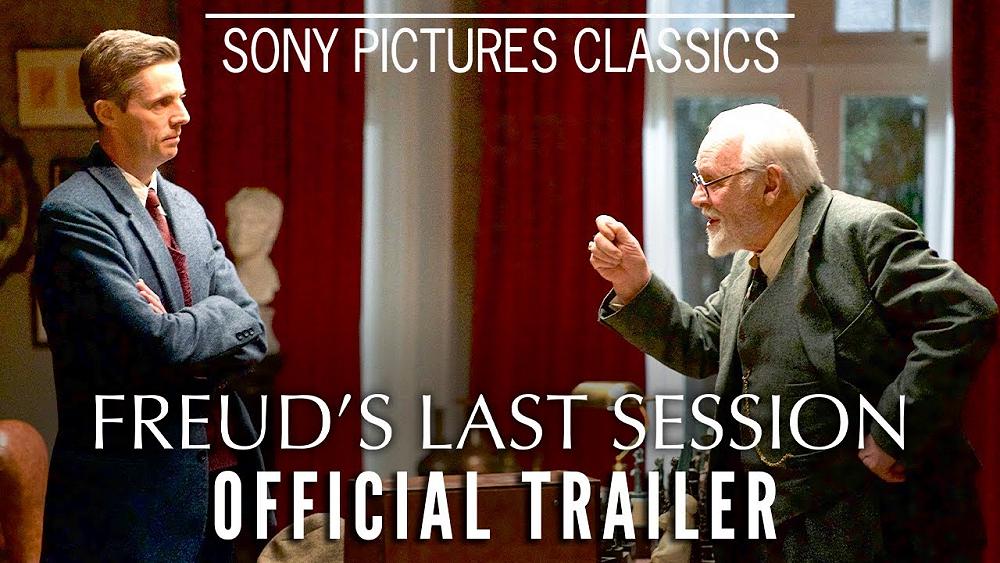
Freud’s Last Session
Directed by Matthew Brown (2024). Reviewed by Paul Tankard
This is the second feature film about the literary scholar and fantasy novelist C S Lewis, the first being the 1993 “biopic” Shadowlands, which starred Anthony Hopkins as an older Lewis. In this film, set decades earlier, Matthew Goode plays a younger Lewis meeting Sigmund Freud, weeks before the latter’s death. In a nifty role reversal, the aged Freud is here played by Sir Anthony Hopkins.
Perhaps I should get my “C S Lewis expert” observations out of the way first. 1) Lewis was not “Professor Lewis” in 1939; 2) no one ever called J R R Tolkien “John”: he was Tolkien (or Tollers) to his friends and Ronald (the first of the two R’s) to family; and 3) there is no evidence whatsoever that Lewis ever met Sigmund Freud. So the film is not a biopic, but a fantasy or a thought experiment. In those terms, I found it very successful.
These two thinkers are brought together so that the Jewish atheist and the convert to Christianity can talk. It is a very talky film and there is nothing in it for people who don’t like conversation.
The only one of Lewis’s religious books that he had published at this stage is The Pilgrim’s Regress (1933), in which he satirises Freud and Freudianism. Lewis has been invited by Freud to his home in London, and comes by train from Oxford, ready to defend himself. He is wrong-footed to find that Freud has not read the book. But Lewis has read much of Freud, and Freud in turn is surprised by Lewis’s sceptical intelligence, that he shares Freud’s doubts, but not his dogmatism. Freud mocks religious leaders and institutions, who Lewis describes as easy targets. They are pleased with each other’s sense of humour. Freud is dying and they minister, as doctor and scholar, to each other.
Whatever you think of psychoanalysis or orthodox Christianity, this is a tale for today. When extremists “cancel” or — a natural extension — murder each other, here we have two deeply serious thinkers, both skilled in the arts of disputation, whose work reflects complex and challenging life experiences, who differ intellectually as regards almost all matters of importance, who meet and dispute with kindliness, humour, mutual commitment and respect.
And although the script is not at all an evangelistic tract, it does insist that it is the propositional wisdom of Christianity that makes it interesting, or even amenable to discussion.
Tui Motu Magazine. Issue 295 August 2024: 28