
The Journey of the Magi — Matthew 2:1-12
Kathleen Rushton explains the significance of the visit of the magi in Matthew's account of Jesus's birth in 2:1-12
Established by the end of the second century, the Feast of the Epiphany, also known as Twelfth Day or Twelfth Night, was celebrated in the Church long before the Feast of Christmas. The term epiphany describes those moments triggered suddenly by new information, when we understand or become conscious of something important. A leap of understanding follows.
II Born into Chaos
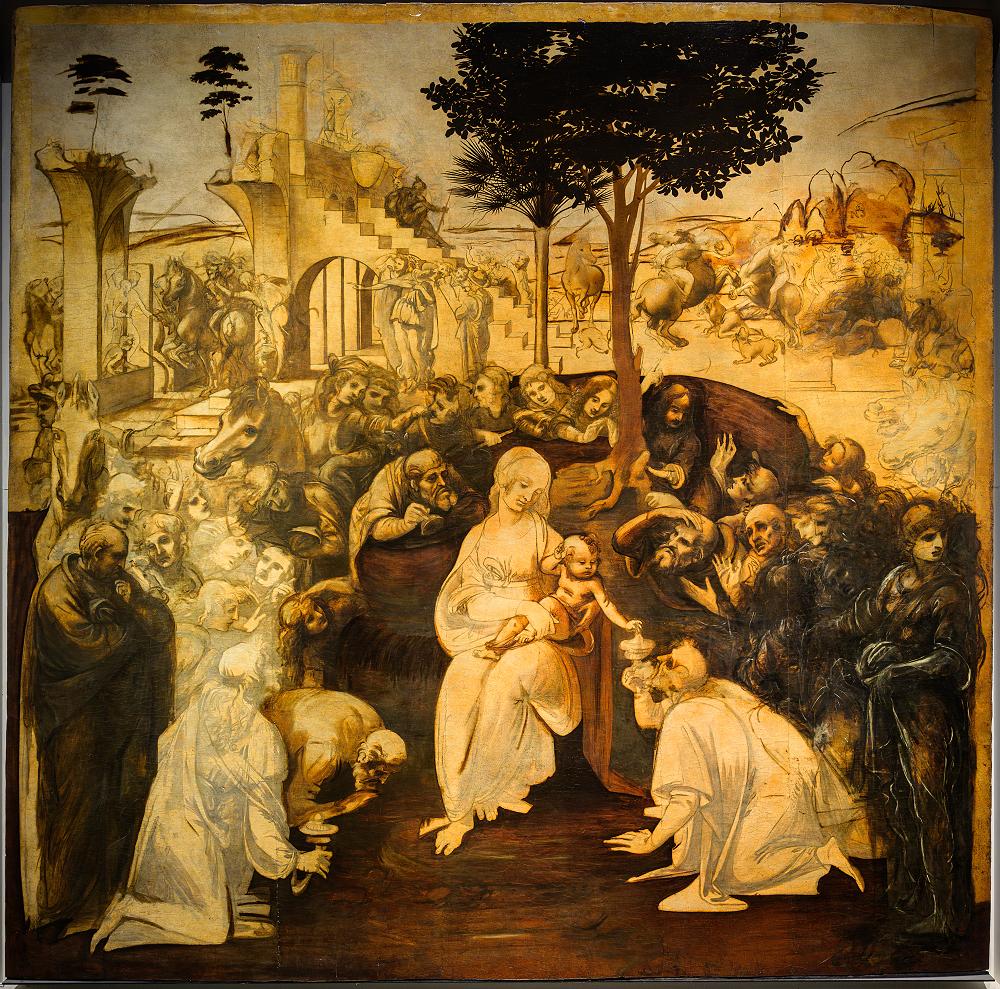
Leonardo da Vinci’s unfinished painting “The Adoration of the Magi” was commissioned by the monks of San Donato a Scopeto, Florence in 1481. Central in the painting are five characters placed within a triangle. Mary is at the apex holding the child Jesus whose left hand reaches to touch the gift offered by one of the magi. Two other magi are on the opposite side. In a semicircle watching down on this scene are other people and crumbling buildings and men fighting on horseback are in the background.
Da Vinci captures what other artists miss: Jesus the Messiah is born into a world of chaos which needs transformation. If the Epiphany were to be staged today, what chaos — what busyness, conflict and destruction — would we sketch in its background?
II Magi — Not Kings
Bethlehem in the province of Judea was an insignificant village about 8 kms south of Jerusalem. It was the ancestral home of David and where he was anointed king by the prophet Samuel. Matthew states that Jesus, son of David, was born there “in the days of King Herod” (Mt 1:1,17,20).
The most accurate way to name the visitors from the East to Jesus is to call them “magi". Though common, to name them “wise men” is too wide a term. “Kings” is incorrect. And although “astrologers” is nearly correct, it is confusing because of today’s meaning of that term.
At the time, magi were a high-ranking priestly class of political-religious advisors who served the rulers of Median and what later became the Persian Empire. While they had access to the centres of power, they were often also seen as a threat to royal power because of their influence in predicting future events and their astrological knowledge. They were renowned as being able to recognise the signs of the times.
II Other Ways of Knowing
Herod is frightened that the magi are seeking a newborn king of Jews, so he calls in the Jewish leaders, who were subservient to Rome, to search and interpret the Scriptures for such an event. They tell him that according to the prophet Micah, a ruler will be born in Bethlehem (Micah 5:2).
Herod sends the magi to Bethlehem with the instruction to return to him after they find the child. The magi set out from Jerusalem, the centre of Jewish history and tradition, to find the newborn king. Although they are Gentiles and do not know the Hebrew Scriptures, they have alternative ways of knowing. They interpret the star as a guide to find Jesus and dreams to “take a different way” and so avoid Herod. This story of God using unexpected means shows that all do not come to Jesus by the same way.
II “Where the Child Was”
The magi see the star ahead of them and follow it until “it stopped over the place where the child was.” Here, as for the first of eight times in Mt 2:1-23, Jesus is referred to as “the child,” not by name. This is significant for children were often viewed with suspicion and seen as a threat to adult male civic order. They were weak, vulnerable and marginal as are Jesus and the children massacred (Mt 2:15, 18).
“Overwhelmed by joy”, the magi enter “the household” (Mt 2:10-11). Their prostrating themselves and paying Jesus homage evoke many Scripture references: Gentiles journey to Jerusalem to worship God (Mic 4:1-2) and their coming is part of the vision of God’s justice being restored on Earth (Isaiah 60:14). On such journeys, Gentile kings bring gifts (Psalm 72:10).
Matthew subverts these biblical traditions because kings like Herod do not come to welcome Jesus, let alone worship him. Rulers of this world assemble against God’s anointed One (Ps 2:2). The marginal magi, advisors to kings and not kings themselves, come not to Jerusalem or the Temple but to insignificant Bethlehem. The new-born king will “shepherd my people Israel” (Mt 2:6; cf. Mic 5:2). This suggests a different model and function of power.
II Transforming Our Context
The chaos of today would rival, if not exceed, the ruin and conflict of da Vinci’s painting. Diarmuid O'Murchu, however, in Divine Radiance in Human Evolution (2025) argues for a new understanding of the human story — including our human-made chaos and conflict. He describes how the Agricultural Revolution of about 10,000 BCE saw us make a prehistoric shift from hunting and gathering to settled agriculture. The outcome was anthropocentric (human-centred) civilisations in which land became a commodity. Patriarchy, empire and warfare emerged at this time.
O’Murchu writes that incorporating these insights about our human origins “has revolutionary implications for our understanding of the incarnation and God’s embodied presence with humans and our ancestors throughout our entire seven million years.” Throughout time, human beings have shown a resilient creativity which both reflects and illuminates the creativity of God. We are God’s co-creators with all creatures. This offers a new way to seek spiritual meaning — more reflective and closer to nature. We are creative Earthlings, beloved by the God who made all things.
II “A Different Way…”
O'Murchu explores how our deep evolutionary past can teach us how to flourish in harmony with all of creation. He calls us to live in joy and creativity as part of the long history of humanity's relationship with the creative Spirit of God. He asks: “What if our true human story began with original blessing?” In Matthew, the magi “opening their treasure chest” offered “gifts of gold, frankincense and myrrh” — gifts from Earth. What if our true nature is one that thrives in healthy relationships with one another and all of creation?” Could we, like the magi, take a “different way” — a way that leads not to destruction but to creation?
Tui Motu Magazine. Issue 310 December 2025: 24-25