
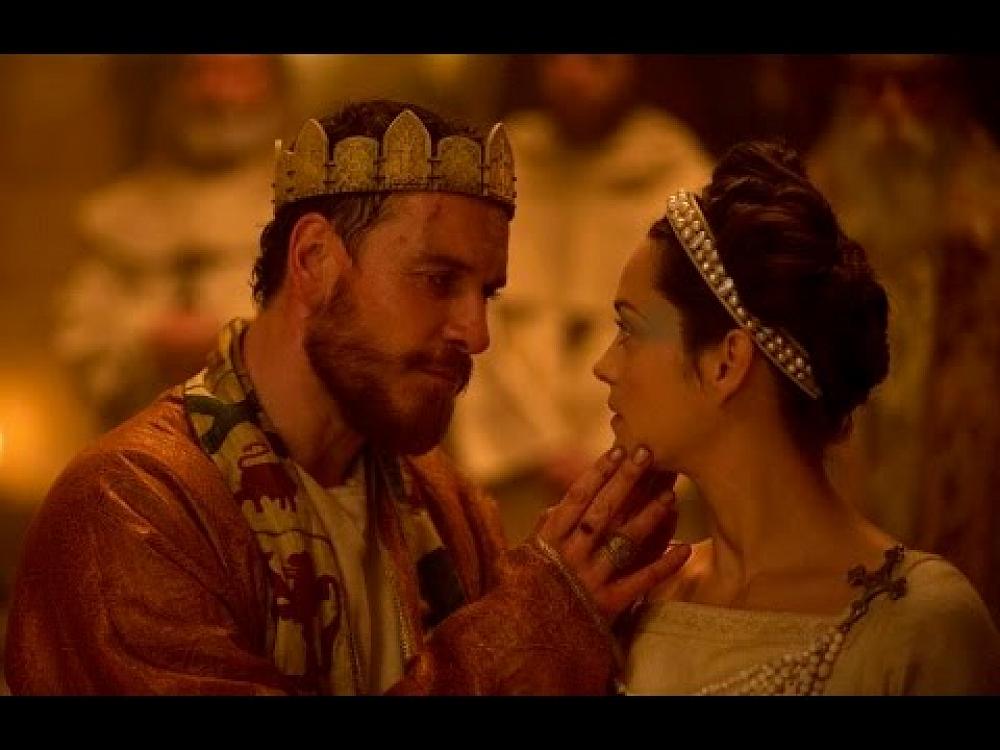
Film Review: MacBeth (2015)
Directed by Justin Kurzel. Reviewed by Paul Sorrell
This latest attempt to bring Shakespeare’s Scottish tragedy to the big screen is a mixed bag, but with the accent on the positive.
While the acting is (mostly) fine and the "atmospherics" terrific, there is too much blood and too little poetry. The numerous knifings and throat-slittings may be too much even for those not normally of a squeamish disposition. More seriously, the combination of Renaissance verse and broad Scottish accents means that the Sassenach viewer has to strain to catch the dialogue. This is compounded by the director’s decision – laudable in itself — to go for a conversational rather than a declamatory style of delivery, meaning that many lines are effectively thrown away.
Although the text has been deftly trimmed, the moral and psychological elements of Shakespeare’s story of monstrous ambition and ensuing madness come across powerfully. While at first Macbeth (Michael Fassbender) struggles between his supernaturally fuelled desires and his loyalty to good King Duncan, his wife (Marion Cotillard) shows no such scruples. Abduring the softness proper to her sex, she berates her wavering husband for his unmanly inability to act. Unhinged by the weird sisters’ promises of future glory and power, she wants to annihilate the troublesome gap between present and future.
If the play’s major concerns are dealt with effectively, the film is also visually ravishing. Kurzel’s use of magnificent and brooding settings — from misty highland landscapes to cavernous stone castles — are the hallmark of this production. He makes striking use of figures viewed en masse, whether a set-piece battle, Macbeth’s rousing coronation scene, or the feast, where a dark and bloodied Banquo returns to haunt his murderer. Repeated tableaux of impassive clansfolk draped in blanket-like cloaks have a strange visual power. Costumes and architectural detailing provide much to distract the eye, but are always part of the film’s wider vision.
When, at the end of the film, Burnham Wood’s foretold advance on Macbeth’s stronghold of Dunsinane occurs in a manner unsanctioned by the text, at first I felt cheated. But Kurzel’s innovation provides a stunning backdrop for the final scenes of the film, artistically and emotionally, and his cinematographer (Adam Arkapaw) is given free rein.
If you can set aside the lingusitic issues — I was constantly longing for subtitles — and brace yourself for the gory bits, then Kurzel’s Macbeth delivers a stunning cinematic experience.