Palestinian and Israeli Women Wage Peace
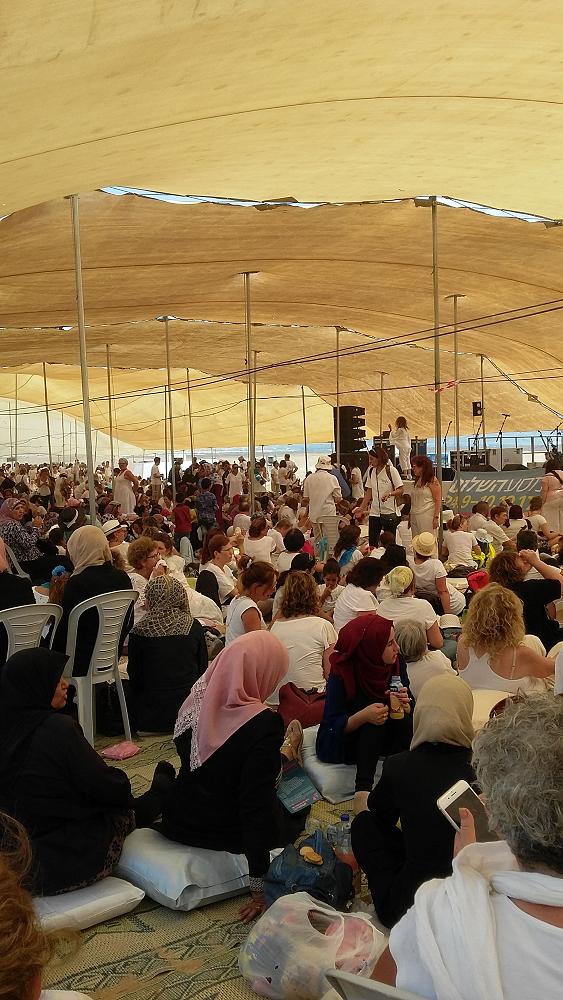
We were all different — women in hats, in Muslim headscarves, in long dresses, in singlets, with short hair, long hair, in trousers, in dresses. We were women waging peace! The basic idea of Women Wage Peace is: "We will not stop until there is a Political Agreement". All women can join – Jewish, Muslim, Christian, Israeli, Arab, secular, observant, whoever. We all agree that there is no peace in the violent, military “solution”.
We women recognise that we do not have to come up with a solution to our situation in Israel-Palestine, even to have our criticism of the current situation taken seriously. The politicians must take that responsibility and come to agreement and sign it into peace. We say that any agreement must promote not only peace but also freedom, equality (especially for women) and security for all.
Our approach also understands that the hate, fear and mistrust in our region is partly because we never really have a chance to get together with the “other”. So that is a big part of Women Wage Peace — just to let women wander round and meet one another and listen to music and speeches and dance together.
Events Along the March to Jerusalem
Three years ago Women Wage Peace began to have events in different places during the Jewish holidays of Pessach and Succot because they are times when there are several consecutive days of semi-holiday. It's not "walking all the way" to Jerusalem which is impossible for most women anyway. As well, it is impossible to keep secure. But stopping in different places for events and short marches so women can go to something near home is a feasible model.
I first went to the evening event in Tiberias (our nearby town). Seven local women who had each made a particular contribution to regional life spoke — such as a woman who was a well-known teacher in town, a doctor who set up a sexual assault clinic at a regional hospital (with medical, police, legal and psychological personnel), and a woman who set up an independent living place for over-21 special education "graduates".
Then we all sang, danced, hugged and demanded a peace agreement and sustainable peace.
The next day started at Naharayim (about 10 km from home) at the Garden of the Flowers Picked Too Soon. In 1997 six schoolgirls and a teacher were shot dead by a Jordanian soldier while visiting the area (which was the site of a 1920s hydro-electricity generation station and a part of the pre-state Zionist enterprise). King Hussein of Jordan at that time visited the homes of each of the bereaved families, and the memorial park was built with their names spelled out in flowers. At the event we heard from someone who was there that day and then we met in small groups to talk and share food.
Desert Event
On the 8th of October special buses from all over the region were organised to go to the main events in the desert by Jericho at midday and then in Jerusalem that evening.
There were thousands of women at the meeting point and we went by buses a few kilometres into the desert. Those who came individually just got on the special buses with spare seats. It was very 50 shades of beige and sand and it felt like the middle of nowhere (in a good way).
We gathered in a gigantic tent and listened to welcome speeches and then 5,000 women, led by a group of drummers, walked about a kilometre to three even bigger tents (100m x 50m) called collectively as the Peace Camp of Hagar and Sarah (ref Gen 16). They were open, marquee-like tents which allow a breeze to circulate and with a cooling system of high-pressure fine-mist-generating thin hose winding through the whole area. There were large tanks of drinking water, enormous mats covering the sand and hundreds of big cushions. So it was comfortable with a nice temperature.
I wandered about and talked to many women. Women had bused from the Palestinian Authority (Bethlehem, Hebron, etc.), Arab villages, as well as cities and towns and kibbutzim all over Israel. Everyone made great efforts to communicate and share food (I took dates stuffed with almonds and walnuts). There was lots of eye contact, nods and smiles.
I drew a map showing my house and some other women drew maps of their houses in my notebook. (I found that not everyone understands "maps" which was interesting in itself.) I met women from Hebron, Bethlehem, Dir Assad, Klil, Jerusalem and even more places than I recorded in my little turquoise notebook. I told them about how I met Alon and came here, about my children and also about Alon's conscientious objection in 1989. I asked about their lives with my good Hebrew, good English and 147 words of Arabic.
It was an amazing event, full of hope, singing, dancing and speeches with all we needed to hear to keep our courage up and our vision clear. President Mahmoud Abbas (Abu Mazen) of the Palestinian Authority even sent a letter which was read out in all three languages. (Everything was in Arabic, Hebrew and English). The Israeli Prime Minister was probably too busy!
Individual women from many overseas countries joined in too! They were invited to go to the front and it was announced where they had come from.
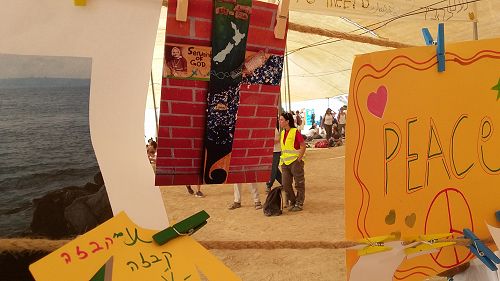
We could peg little drawings, poems, etc. on a line. I pegged up a card from the Sisters of Compassion with a not-too-obvious cross, a picture of Suzanne Aubert, a map of Aotearoa New Zealand and also a photo I took at Acco of a dove flying over the sea — all blues and tranquillity.
We heard from a group of youth speaking fluently in the three languages about the hope-less, divisive world they had inherited and their feeling of needing to make a better future.
About 5 per cent of the crowd were sympathetic men, allies with us, aware of the spirit of a women's march and pleased to help when and where they were really needed.
More singing followed led by a terrific band of women and musicians and drummers. We were all singing, dancing, smiling and holding hands. The band would sing a line and we all sang it back.
Then we had a prayerful affirmation ritual at the end with everyone holding hands. It was on the theme of peace in ourselves, between individuals and the sense of human wholeness that would surely come from the end of our conflict. We recognised that women’s power and strength is crucial in overcoming the male intransigence that has got us into this mess.
Longing for Peace
This desert experience gave me a feeling of meeting the "sheep of the other flock".
"I am the Good Shepherd. I know my own sheep and my own sheep know me. You need to know that I have other sheep in addition to those in this pen. I need to gather and bring them too. Then it will be one Shepherd and one flock" (John 10:16. The Message translation, paraphrased).
I can hardly describe the feeling of looking wide-eyed into the eyes of women from all over who were looking equally wide-eyed into my eyes. "So that's what you look like on the other side of the fence! I am really here! You are really here! Here we are together! Look we are doing peace!”
Gallery