First Will Be Last — Luke 14:7-14
Katheen Rushton tells of how the Parable of the Wedding Banquet in Luke 14: 7-14 challenges our ideas of hierarchies and hospitality in discipleship.
In Luke’s Gospel many of Jesus’s challenges and teachings about discipleship happen in meal settings. We hear about whether or not to wash before eating (Lk 11:38), about how a host should act towards guests (Lk 7:38, 49), about who is a suitable dining companion (Lk 15:2) and about who in society should eat first (Lk 17:7-8). In Luke 14:7-14 Jesus gives specific instructions about who should be invited to eat and where people should sit.
In the ancient world, meals were important social occasions. Anthropologists refer to them as “ceremonies” because how a diner participated in mealtimes was dictated by their status and rank. The rich and the influential would curry favour with citizens in return for support and respect and to ensure they fulfilled their obligations. And to promote their influence, groups, such as the Pharisees would invite notable dignitaries and less distinguished guests to their lavish banquets. They expected payback in return — loyalty, mutual benefits and reciprocal invitations.
Jesus Is Invited to a Meal
At the beginning of Luke 14, Jesus is at yet another meal. It is the Sabbath, and Jesus is going to the house of a leader of the Pharisees. The others in the house watch him closely. He encounters a man with dropsy, a disease caused by a build-up of fluids. Jesus asks his watchers: “Is it lawful to cure people on the Sabbath, or not?" Silence. Jesus heals the man. Still there is silence. This silence is strange: in legal matters “to remain silent” was generally understood as giving consent. This silence does not feel
like agreement.
Jesus Tells a Parable
Jesus is perceptive. He observes that the behaviour of the host and guests as they settle into the meal is not about hospitality but more about self-aggrandisement. Some guests immediately choose the places of honour at the table. He tells them a parable indicating there is more at stake here than advice about how to behave at banquets.
Jesus’s story does not uphold the status quo. Parables are puzzling world-turning-upside-down stories with unexpected twists. There are no neat or easy conclusions. Situations from ordinary life niggle and tease the hearer to imagine God and the reign of God in profound new ways. Jesus disturbs. He taps into the concepts of honour and shame which predominated ancient society.
Jesus tells of guests who have taken a higher place at table and then are asked by the host to move to a lower place. Being asked to move down is humiliating. But to be invited by the host to move to a higher place is to have honour bestowed upon you. So, “those who exalt themselves will be humbled, and those who humble themselves will be exalted (Lk 14:11).
Table Seating in the Ancient World
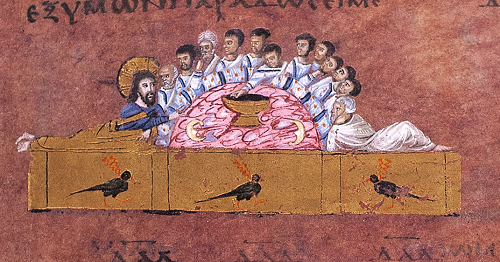
The illumination in the sixth-century Rossano Gospels of Jesus and the disciples at the Last Supper (see below) helps us to imagine the dining table and the seating arrangements of Jesus’s time. These do not resemble the medieval depictions, like Leonardo Da Vinci’s Last Supper of Jesus seated at the centre of a long table. Nor are they like the round tables surrounded by chairs which today we find at ceremonial meals such as at weddings. We take our places according to name cards which group the guests appropriately. None of us would dare seat ourselves uninvited at the bridal table.
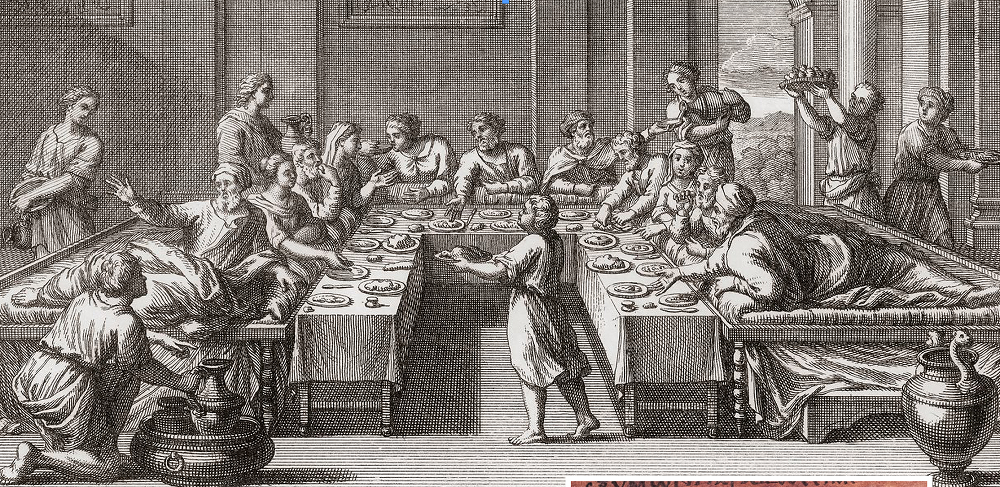
In the ancient Mediterranean world the usual way of dining was to recline on couches or mats arranged in a horseshoe-shape around a table. The diners lay on their left sides and supported themselves on their left elbows. Their right hand was free to take food — as shown by the diners in the illumination who are reaching into bowls (see illustrations above and below).
If there were nine diners they would be arranged in threes on three couches or mats around three sections of the table. The couch in the middle at the top of the U-shape was the most honourable place. Of the three places on that couch, the one to the left was the most honourable place, then the place in the middle and then the place on the right. So the most honourable place at table was the left position of this middle section. This was the place of honour which was given to the most honoured guest. On that couch, no one reclined behind this guest. The couch next in honour was the one on that person’s left. The couch on the right side was held in least esteem. There the host and his family lay.
When we match this description with illustrations of the Last Supper in the Rossano Gospels we see Jesus is in the least honourable place — the right side of the couch on the right side of the table. He is shown as the host. Ancient art, like the parable, turns our expectations upside down — expectations formed by medieval depictions where Jesus is at the centre of the table in an assumed place of honour.
The Great Reversal
Jesus’s parable recalls the great reversal which is at the heart of the reign of God. Mary proclaims in the Magnificat that the lowly are lifted up and the mighty are cast from their thrones (Lk 1:52-53) and the Beatitudes (Lk 6:20-26) present the reign of God in this light. Jesus’s ministry focuses on the poor. In Luke 14, Jesus says not to invite your family, friends or rich neighbours who can return your hospitality. Instead invite the poor, the crippled, the lame and the blind who cannot reciprocate. By offering such hospitality beyond our familiar circle we are bringing about the vision of God where everyone is included because God has an option for the poor.
Jesus’s parable is challenging to Christians, who need to find ways to give hospitality to those in poverty, those suffering preventable illness or without stable homes — those deemed the lowly. In a world which honours affluence and elitism, honouring and respecting every person seems foolish. But, as the Gospel reminds us, such is the reign of God.
Tui Motu Magazine. Issue 306 August 2025: 24-25
Gallery