
Giving Youth and Energy
Gillian Southey tells of how young refugees from the Camp in Lebanon contributed to the clean up after the Beirut explosions.
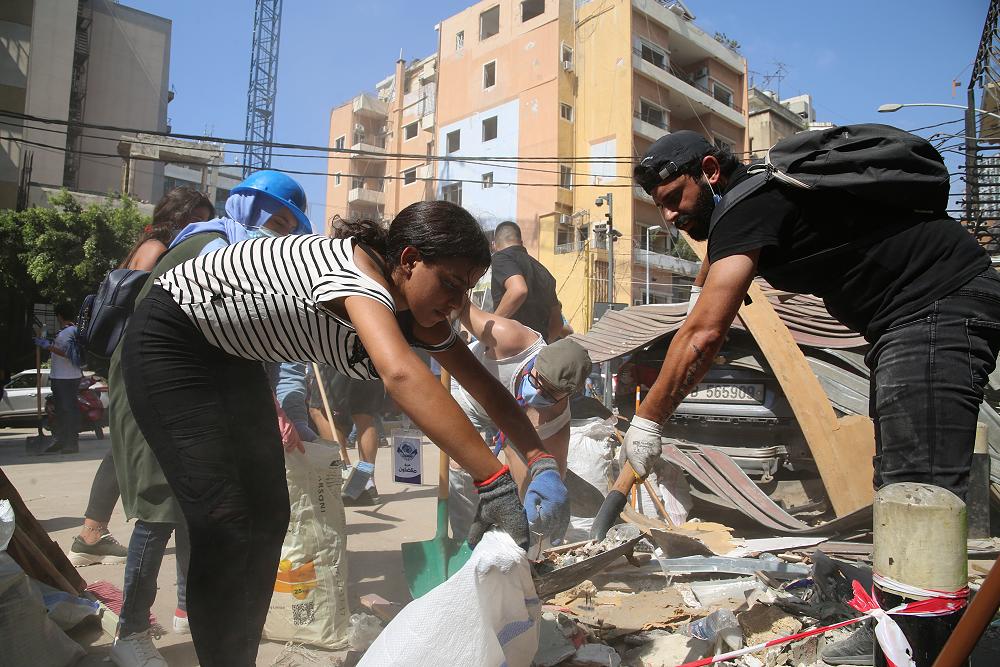
A story from Lebanon after the August 2020 explosion in Beirut turned the tables on the usual portrayal of disasters. It was not of a large-scale relief effort by international aid agencies, but a group of 16-24 year-olds wielding brooms, shovels, gloves and masks. They were refugees — many having fled Syria years before. Eager to help after the dreadful disaster, the 20 or so young people climbed thousands of steps in multi-storeyed apartments without electricity to respond in whatever way they could.
This group made hope into a verb — they were “doing hope”, something they have learned in the community they have created with Christian World Service partner, the Department of Service to Palestinian Refugees (DSPR), Lebanon.
Becoming Volunteers
In August 2020, a massive explosion at Beirut’s port rocked the city. Some 2,750 tons of ammonium nitrate killed more than 200 people, injured over 5,000 and left 300,000 homeless.
Immediately after the catastrophe, a member of a DSPR youth group contacted their leader Elias Habib, and insisted that he take them to help in the cleanup. Within an hour, with shock still written on their faces, they began making plans.
Elias dreaded the sights that awaited the young people. He had grown up during Lebanon’s vicious 16-year civil war and had worked as a foreman on construction sites. He knew the group was not prepared for what they would soon see.
A few days later they headed to a tiny destroyed restaurant which would become their base. Elias picked up a broom and began to work. The young people quietly followed suit.
Once the restaurant was cleared, the young people with Elias volunteered with hundreds of others in Beirut's marathon cleanup effort. Month after month, the young people helped those who needed them.
Giving to Community
Reem Haddad, from the Joint Christian Committee for Social Services in Lebanon, describes the way the young people helped. What follows is Reem's account.
A group of DSPR teenagers was carrying debris down to street level. It was arduous work — a task that only the very young can do and still have the energy to run up the road to the next shambled house with equal zest while joking. "Hey, Rawad!" cried out Jubran, 18. "Look at your shoes. Still pristine white. Mine are dark. Ha! I guess it means I was working harder."
Rawad, 19, stopped in his tracks to think of a retort. Finally, he grinned at his tormentor: "Well, maybe my shoes are just made better than yours!"
Laughing, the teenagers made their way to their "rest stop" — a restaurant in the middle of the destroyed Mar Mikhael Street. Carole, 16, quickly set about distributing much-needed water bottles. It was here that the various groups met several times a day to rest, drink, eat and take on new assignments from their leader, Elias.
For the past few weeks, the teenagers have been sweeping glass shards, setting aside torn doors and windows and scrubbing blood off walls and floors. Since Lebanese government officials were absent from the field, it was up to the volunteers to help the distraught victims and salvage whatever they could from the debris.
At first, the devastated area was swarming with volunteer workers. But as universities and schools prepared to reopen their doors, the number of volunteers dwindled considerably.
“I think there is only us and another group or two now remaining,” Elias observed. "But there is a lot of work to be done. People still need us here."
We don’t have money to help. All we can offer is our youth. Our ability to clean and carry things for all these people. If we don’t, who will?
As if on cue, a woman in her mid-60s entered the base. She greeted the teenagers warmly. "Hello, Auntie Norma," they responded, "how are you today?"
Norma Irani took a seat among them. "I am well, darlings," she responded, obviously trying to sound cheerful. "I am well."
But suddenly she erupted into tears. She addressed Elias, the only adult in the group: "I want my home like it was, I want my life back." She looked at him pleadingly as her tears intensified. The young people lapsed into silence as they listened to their new friend. One handed her a tissue.
Norma's home was on Alexander Fleming Street — a quaint area, known only a month before for its busy boutique-like restaurants. Irani herself owned one of the tiny restaurants. It was her only source of income.
"I have nothing now," she continued to cry. "My home is gone. My shop is gone. It was my only source of money. What do I do now?"
When the blast hit, Norma was in her home, tending to her 96-year-old father. Her two brothers were in the next room. She watched in horror as blood began to seep from her father’s forehead. Glass shards had covered them both. In an attempt to stop the profuse bleeding, she pressed on her father’s head, calling for her brothers. Were they even alive? She continued to scream but to no avail.
She finally managed to guide her disoriented father to the street below, practically carrying him over rubble and glass which was blocking her building’s staircase. Relieved to see her brothers alive and well, she ran to help other blood-soaked neighbours descend the stairs.
The teenagers listened in subdued silence. Finally, 17-year-old Vanessa Al Akl broke the silence: "I was there that same day," she said quietly. "I was with my family going to Damour (south of Beirut). We had crossed the port when the explosion happened. We got out of the car. There were people covered in blood everywhere. Some people were dead. I tried to help. There was so much blood."
Miguel, 17, looked at her. "My father was there too. He had work to do. He didn’t come home and wasn’t answering his phone. We thought he had been killed," he said. "But he made it out somehow and came home."
Next to him, Oliver added quietly: "That’s why I come here every day with DSPR. I want these people to go home as well."
Another silence ensued as young and old delved into their thoughts.
“I was there too," said Mark Abu Sleiman, 19. "There were people dead in the cars. I wanted to help them. I couldn’t. That’s also why I am here now. I want to feel that I can help."
The youngsters looked at each other. "I didn’t come," said Elie Boulos, 19, looking shamefaced. "I didn’t realise how much devastation there was. Not until we came here."
These teenagers had grown up together in their hillside Palestinian residences, known as the "Dbayeh camp". As Palestinian refugees, their futures are bleak. Palestinians are barred from acquiring Lebanese citizenship and thus acquiring Lebanese identity cards, which would entitle them to government services, such as health and education. They are also legally barred from owning property and prohibited from working in over 60 skilled jobs.
“Even if we are Palestinians," said Jubran, "we live here. We must help."
“We kids cannot rebuild Norma's home," said Rudolph Habib, 16. "We don’t have money to help. All we can offer is our youth. Our ability to clean and carry things for all these people. If we don’t, who will?"
Beirut Now
It is now eight months since the Beirut explosion and efforts to repair and rebuild the destroyed area of the city continue but progress is slow. Unemployment has surged across the country. The government is at an impasse and provides little leadership. COVID-19 has spread rapidly.
DSPR Lebanon continues to support refugees, like the young volunteers, through its all-age education programme and, as well, by delivering relief assistance.
Tui Motu Magazine. Issue 258 April 2021: 6-7