
Listen to Women
Imagine my amazement discovering a book in a religious library called Autobiography of Our Lady by Father Superior (I’ve forgotten his name). Admittedly the book was old but it set my teeth on edge to think that the priest presumed to speak for Mary — autobiography no less — in pious lectures to Catholic women.
The feminist movement has helped us analyse institutions and societies and shown the gender inequality operating in them — to the detriment of women and girls. When liberation theology was introducing God as having a preferential option for the poor and challenging the socio-political systems that kept the poor in poverty, feminists highlighted the reality that women and children were the bottom of the heap, the poorest of the poor. Whereas earlier men had done theology for everyone assuming that God could be spoken of only from their point of view, feminism encouraged women to engage in theology beginning with their own experience. We have now a rich variety of theologies by women across the world — black womanist theology, Asian, African, Latina, biblical, queer, contextual feminist theologies — discussing their insights of God from their experience and scholarship. This theological engagement soon shone the light on behaviours which were impoverishing the planet and so women included care of Earth as God’s concern and as integral to liberation, gratitude and respect for life.
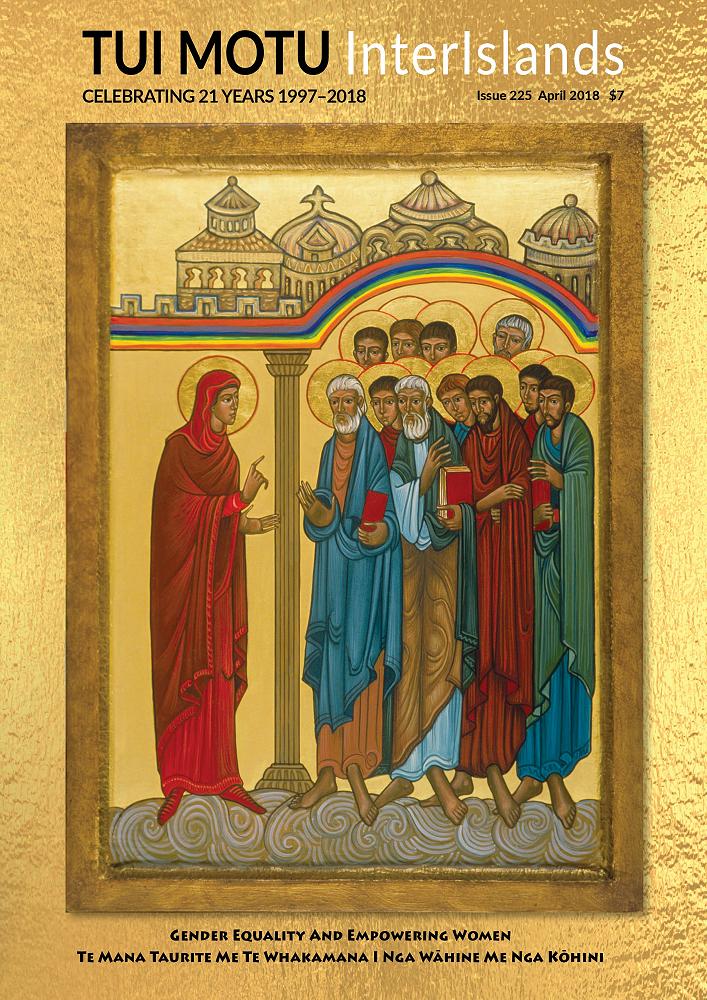
In our Easter issue women have a lot to say. Our cover is an icon of Mary Magdalene announcing to the apostles the incredible news that Jesus is risen and, as Janet Soskice points out, that means we all belong to a new family, we’re kin with God. Page by page we are introduced to discussions about the fullness of life intended by the UN global goal of gender equality and empowerment of women and girls in every society, institution (including Church) and country. Ann Hassan, Elaine Wainwright, Mary McAleese and Rena MacLeod recommend changes we need right now for the common good of our human and Earth communities. And Gina Bradley, Nikki Mariner Peseta and Deborah Brosnahan tell about works of development, art and education involving women and girls. Individually and together our contributors give voice to challenge, love and hope for women and girls at home and around the world.
We are grateful to all who by sharing their writing, faith, reflection, research, art and craft have given us a thoughtful magazine.
We are delighted to announce that Kaaren Mathias is the guest speaker at our Subscribers’ Evening
in Wellington, Friday 11 May. Details are on our website.
As is our custom our last word is of blessing.
Tui Motu Magazine. Issue 225, April 2018: 2