
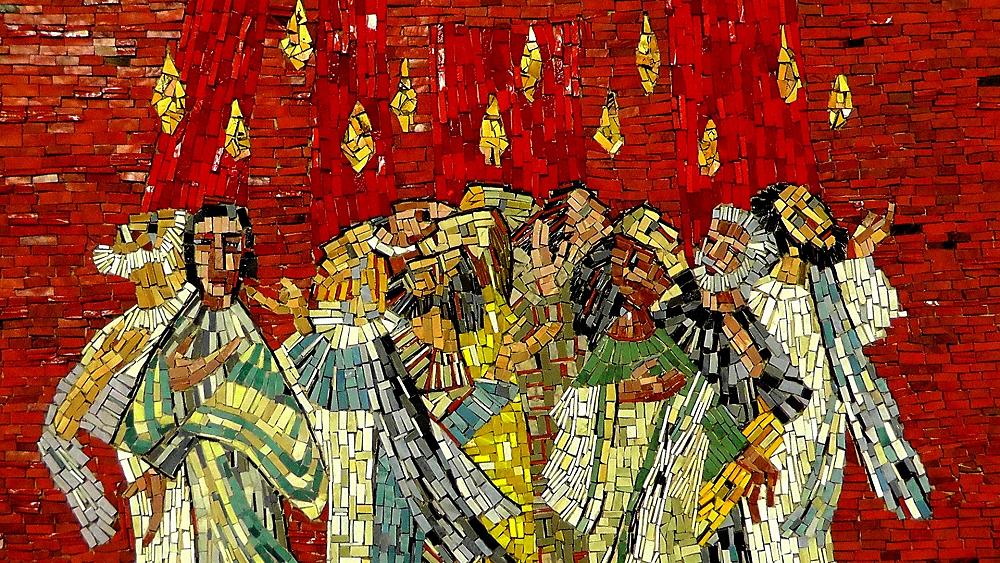
When the Spirit of Truth Comes — John 16:12-15
Katheen Rushton discusses what the Spirit is doing in our time as a continuation of Jesus’s teaching in his time in John 16:12-15.
In John the Evangelist’s farewell discourse (Jn 13:1-16:33), Jesus’s teachings are presented in terms of both the present and the future. The first time frame is the last supper and the end of Jesus’s life on Earth. At this time Jesus talked to the disciples of “going away” — departing from his present life through his suffering and death. He would “return” to them as the Risen Jesus. The second time frame is Jesus assuring the disciples, then and always, that though he has departed Earth they will not be left alone.
Earlier in the farewell discourse, Jesus speaks of knowing not only that the disciples’ hearts were troubled but that future disciples might also be troubled (Jn 14:1, 27). In this third section of the discourse (Jn 16:4b‒33) Jesus assures disciples — those of his own time and us today — that he will remain through the work of the Holy Spirit (Jn 16:12-15) as we complete the works of God.
“I have said these things to you” (Jn 16:1)
John 16 moves between the present and future indicating the beginning of a new age. Jesus states that his disciples are to remember his words when the hard times come. He repeats three times: “I have said these things/this to you” (Jn 16:6, 25, 33). But we know that more will be revealed because Jesus also says: “I still have many things to say to you, but you cannot bear them now” (Jn 16:12).
“But you cannot bear them now” (Jn 16:12)
In John 16:13–15, when Jesus speaks about action of the Holy Spirit in the future, he repeats the verb “declare” (NRSV) or “tell” (JB) three times. In the Greek Old Testament, this verb (anangellō) has the sense of re-announcing what has been heard previously — mysteries already communicated are described. Jesus is encouraging the disciples to face the hard times ahead by seeking deeper meaning in what they have already heard, seen and experienced.
When they, and we today, can bear it, the Spirit will re-announce and re-proclaim what the disciples received from Jesus who was sent by God. Jesus links his departure with the coming of the Spirit of truth. He has already told the disciples that his going is to their advantage — otherwise, the Advocate will not come (Jn 16:7). Jesus describes that the twofold role of the Spirit is to expose (Jn 16:8–11) and to guide (Jn 16:12–15).
Raymond Brown explains: “The declaration of the things to come consists in interpreting in relation to each coming generation the contemporary significance of what Jesus has said and done. The best Christian preparation is not an exact knowledge of the future but a deep understanding of what Jesus means for one’s own time.” The ministry and trial of Jesus are over, but the implications of Jesus’s death-resurrection for disciples of all generations and for all creation need to be worked out in every generation, in every time and in every place.
God, Jesus and the Spirit
The identity of Jesus and his relationship with God are central. Jesus is “the way” because he is “the word made flesh” who reveals that God is “truth”. When people come to believe into Jesus, they share in eternal life. In the work of guiding disciples, Jesus and the Spirit share similar titles. Jesus is “the truth” (Jn 14:6) and the Paraclete is the Spirit of Truth (Jn 14:17; 15:26; 16:13) who will “guide you into all truth”.
The Greek word for Spirit (pneuma) is used throughout the Scriptures for the Hebrew ruah, the “wind”. Sometimes ruah is translated as the “breath” of life. The images of wind and breath indicate the unseen wonder of the Spirit whom we know through its actions, effect and how it feels. The Spirit flows through all creation bringing life and love.
Both Jesus and the Paraclete teach and guide the disciples (Jn 6:59; 7:14, 8:20; 16:13; 14:26). The Paraclete’s teaching glorifies Jesus (Jn 16:14) and Jesus glorifies God (Jn 14:13; 17:4). Jesus named the Spirit as his successor — a bridge between the past of his historical life and the post-Easter life of the church in this world God loves (Jn 3:16). As Raymond Brown says: “The one who Jesus calls ‘another Paraclete’ is really another Jesus. Since the Paraclete can only come when Jesus departs, the Paraclete is the presence of Jesus when Jesus is absent.”
Jesus said: “I still have many things to say to you, but you cannot bear them now” (Jn 16:12). As disciples, when we can bear it, the Spirit will re-announce, re-proclaim and remind us what has been received from Jesus who was sent by God.
In Our Generation and Place
As pilgrims of hope in this Jubilee Year, we are invited to move into the “not yet”, into a new vision of life which Jesus calls us to live into, sustained by his words and guided by the Spirit who re-announces to us the contemporary significance of the truth of God already communicated in what Jesus has said and done.
We are also reminded that we are in the second time frame John describes — the future. We are called to complete the works of God with the Spirit as our guide. And with the death of Pope Francis and the election of Pope Leo XIV, we have an example in the papacy of this ongoing renewal: each pope, like all of us, must listen with the Church to Jesus’s message and participate in God’s mission for our own time.
This is work we do “not on my own authority” (Jn 14:9); rather, it is the continuity of discipleship presented in John’s farewell discourse: we work, despite our troubled hearts, not alone but with the Spirit as our guide.
Tui Motu Magazine. Issue 304 June 2025: 24-25