
A Road Less Travelled: Entering Religious Life
Lee Tan shares her journey of “love of neighbour” in God’s mission along Buddhist-Taoist pathways to Christianity and Josephite religious life.
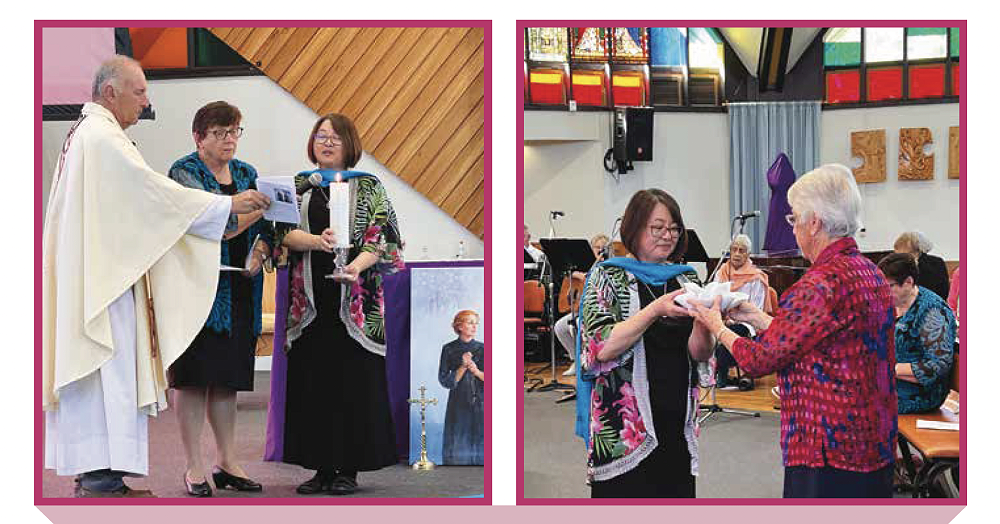
ON SATURDAY 29 March 2025 at St Mary’s Catholic Church in Whanganui, I publicly professed my life commitment as a Sister of Saint Joseph of the Sacred Heart. The powerful karanga/summons of whaea/aunty Frances Huwyler resonated deeply as I walked towards the altar, following the cross and flanked by my brothers and the Josephite leadership teams.
Eucharist commenced with the renewal of baptismal vows and the sprinkling of water as a reminder of the rebirth and cleansing we experience through Baptism into Christ's family.
It has been a long journey to this life commitment.
It Began in Malaysia
Even before I understood the concept of God, I was drawn to the horizon — that vibrant edge where the familiar world met the unknown. From my childhood home, the sunsets spoke of an immense reality beyond my comprehension, a silent prelude to the path I would eventually take. My initial understanding of the divine blossomed from the untamed beauty of nature, the rhythms of family life and the diverse tapestry of my Malaysian upbringing.
I would kneel with my mother, preparing offerings for the Goddess of Mercy, Buddha and the many deities and ancestors we revered. My mother, the heart of our Buddhist-Taoist practice, instilled in me the essence of "love thy neighbour" not through religious texts, but through daily expressions of boundless love, generous hospitality and quiet acts of giving.
To University in Aotearoa
My move to New Zealand to study at Massey University in Palmerston North broadened my horizons, particularly through my involvement as an international student officer. There, I gained profound insights beyond academic learning, especially regarding the impact of colonisation on Māori students and those from Asia, Africa and Oceania. A deep sense of calling drew me back to Malaysia, specifically to Sarawak, East Malaysia — a region unfamiliar to me — to work alongside Indigenous communities.
On to Sarawak
Through an ecumenical Christian organisation, I engaged in practical, compassionate work in remote rural areas with the Dayak people. I witnessed their struggles with the lack of reliable clean drinking water, adequate sanitation, the burden of mothers, the prevalence of tropical diseases like malaria, dengue fever and dysentery. We focused on rural development: implementing critical sanitation projects, clean water supply, women’s literacy, pastoral care. Firsthand I was exposed to profound suffering caused by poverty, deforestation and the violation of Indigenous land rights.
A pivotal moment arrived with an invitation from a co-worker to a Good Friday service at the local Catholic church. During the Gospel, I, non-Christian at the time, felt a powerful connection with the “wounded Jesus” carrying the cross.
Joining with Catholic Friends
Upon my return to Aotearoa, friendships with Catholics became my primary connection to Catholic faith. In my early Christian formation, the Young Christian Workers' "See, Judge, Act" method guided my reflection on my daily work through the lens of the Gospel and Catholic Social Teaching. Theological reflection further deepened my understanding of Jesus and biblical figures, applying their wisdom to my life.
To Baptism & Ongoing Discernment
Baptised in 2001, I soon felt a stirring towards religious life, an inclination ignited at a Vocation Weekend in Wellington. After more than a decade of discernment, I joined the Sisters of Saint Joseph of the Sacred Heart. I was deeply moved when, on a Josephite Spirituality workshop in Whanganui in 2012, I learnt about our founders, Julian Tenison Woods and Mary MacKillop, and their vision of responding to the world's “wounded heartbeat”.
The Sisters' dedication inspired me to explore their charism. I made a remarkable discovery: priest and scientist Julian Tenison Woods had visited my hometown of Pahang, Malaya in 1884, when he was exploring and documenting the region's geography. This felt like an extraordinary and divine connection to my heritage, predating my birth — far beyond mere coincidence.
Recognising the limitations of traditional family life for my calling, I was seeking a life of service and discipleship within the Josephite community. This path offers the opportunity to live out my faith meaningfully and contribute to a more just and compassionate world in the spirit of St Mary MacKillop and Julian Tenison Woods.
Guiding My Direction
Prior to formally entering religious life, I regularly engaged in spiritual direction, including occasional "retreats in daily life" guided by the Cenacle Sisters, which helped me connect my life experiences to a deepening relationship with God. I am particularly drawn to Ignatian spirituality, which has been invaluable in my discernment, fostering both my relationship with Jesus and God and enabling me to transform life's challenges into life-giving choices.
Participating in Liturgies
Lent and Easter continue to profoundly touch me each year, reminding me of the Paschal Mystery of Jesus Christ's life, saving death and resurrection. The richness of the Eucharist occasionally brings unexpected spiritual experiences. I also find deep meaning in specific liturgies such as funerals, Baptisms and Māori Miha.
Profound Interconnection
The digital age has expanded our awareness of the interconnected universe, shaping my understanding of God beyond the confines of religious buildings.
This interconnected world, with its explosion of digital creativity and technical knowledge, presents new avenues for evangelisation beyond traditional institutions. I now have a deeper appreciation for the interconnectedness of all creation to the Source-God. Through Christ, we are connected to every star, every atom, to all that exists, and to my very being as I continue to seek deeper meaning and wisdom as a missionary disciple.
Participating in Mission
Through my formation experiences and work over these last few years with Māori health organisations outside the main centres I have come to see clearly critical issues for Aotearoa.
First, our wealth inequality is staggering. The richest 10 per cent hold over half the country's wealth while the poorest 50 per cent hold a mere 2 per cent. This raises serious issues including increasing poverty, inequality, homelessness, early mortality and the prevalence of mental and chronic illnesses, particularly within Indigenous communities.
Second, misinformation is rife — and it divides families and incites violence. I was struck by the truth of a RNZ headline: “There are two deadly viruses working their way around the world right now. One is Covid-19, and the other is misinformation. Unfortunately, there's only a vaccine for one of them.”
And third, climate events hit the poor the hardest. Cyclone Gabrielle brought devastating floods and damage to homes and the environment in Tairāwhiti and the East Coast, revealing how climate events disproportionately affect vulnerable communities.
I see these events rooted in a “market economy” built on greed and individualism. They challenge me to listen to God’s voice in our world — the voice which, as Gaudium et Spes acknowledges, can be heard both within the Church and beyond. This need to engage with our world infuences my response to the call to religious life. I am in full-time ministry with Te Oranganui Trust, a local Māori social and health organisation in Whanganui. This ministry allows me to provide analytical insights for health and social policy, coaching local staff and work alongside the community. It is about being a positive Christian presence in the workplace and beyond.
These encounters nourish my vowed life and my connection to faith, following Christ and belonging to the Josephites and the Church.
Tui Motu Magazine. Issue 303 May 2025: 12-13