
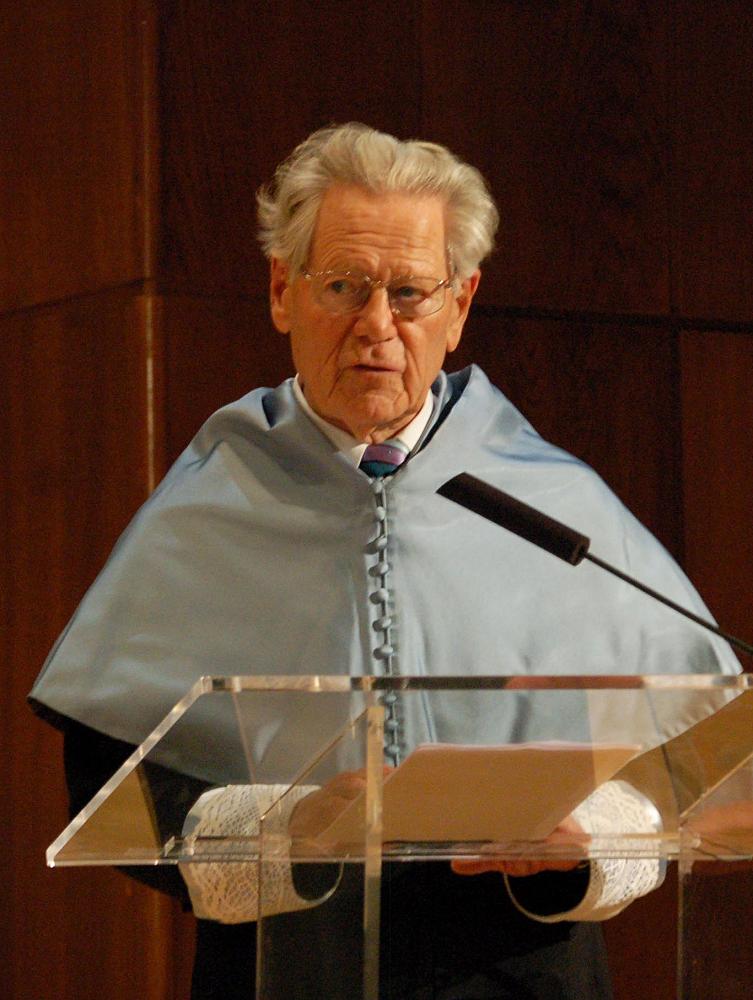
Hans Küng — Celebrated and Controversial Theologian
Thomas Lamb remembers the impact of his meeting with priest, theologian and author Hans Küng, whose work has been influential in contemporary theology. He spoke of a new vision of Church which lay people could understand and engage with.
Hans Küng died on 6 April 2021 at the age of 93 years. His death feels like a personal loss.
In Christchurch in the mid-1970s Redemptorist Cess Dennehy invited people along to lively evening Eucharists at the Redemptorist Monastery in North New Brighton. At this time people were being drawn to prayer groups in homes. The Holy Spirit was nudging people as Vatican II was beginning to influence the wider Church. A new wave of enthusiasm encouraged people to give more attention to prayer and the study of the bible.
A notice circulated advertising a daytime meeting open to all with theologian Hans Küng. Quietly spoken Küng from Switzerland, but teaching in Germany, completely held our attention. He spoke in easily understandable language about the vision he felt was emerging for the Catholic Church. His ideas were completely new but they filled us with excitement because of their simplicity and the possibility that we too could envisage the Church becoming.
During his long life Kung lectured for 40 years in Germany, often holding dialogues with representatives of other Faiths, including Buddhism, Chinese religions, Hinduism, Islam and Judaism.
His most popular book, On Being a Christian, (more than 200,000 hard covers sold in German alone when it was released in 1974), could well have been the basis for his talk to us in Christchurch. He wrote with clarity and honesty so that people could understand. He wrote what he thought needed to be aired in his search for the truth.
Patricia Lefevere wrote: “Küng said he studied theological issues that are of concern to any educated person. He wrote for the people, those ‘who believe, but feel insecure’, those who used to believe ‘but are not satisfied with their unbelief’ and those outside the church who are unwilling to approach ‘the fundamental questions of human existence with mere feelings, personal prejudices and apparently plausible explanations’."
Küng talked openly about contraception, sexuality, infallibility, celibacy, married priesthood open to both women and men, the ecumenical movement and other topics many in the Church considered to be set in stone.
He was banned from lecturing at a Catholic university by Pope John Paul II in 1979 who also silenced 90 other theologians. Küng continued to lecture at the University of Tubingen but in the Institute for Ecumenical Research which was under the jurisdiction of the university senate. He also remained "a priest in good standing”, which upset those who sought his excommunication. Despite his outspokenness, Rome recognised his lifelong devotion to the Church and allowed Küng to preach and to publish until illness and disability slowed him in 2013.
Hans Küng will be sadly missed by many around the world including members of world Faiths. However his books live on and will command a wide readership for years to come. Küng was a pioneer and a prophet.
Peter Stanford wrote in Küng's obituary in The Guardian: "When challenged about his maverick role in the history of modern Catholicism, Küng remained fond to the end of quoting one of his heroes, Pope Gregory the Great: 'If scandal is taken as the truth, then it is better to allow scandal to arise than to abandon the truth'.”
Thank you and — rest in peace Hans Küng.