
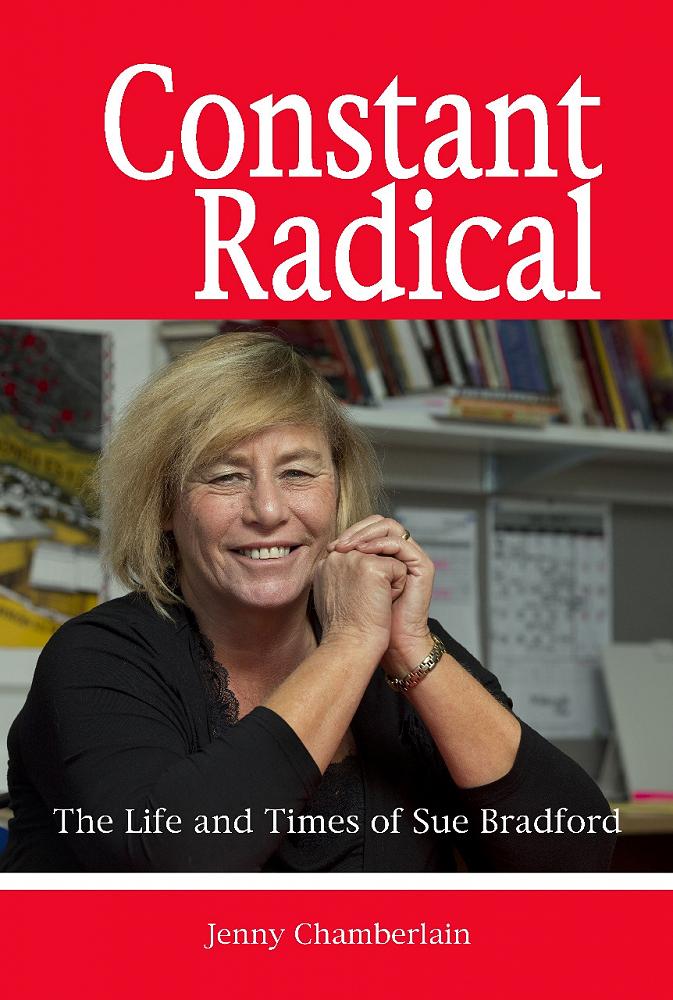
Constant Radical: The Life and Times of Sue Bradford
By Jenny Chamberlain. Published by Fraser Books 2017. Reviewed by Michael Hill IC
This fascinating biography of one of the most controversial characters of our time also provides a commentary on our recent social and political history. A prophet has been defined as one who comforts the afflicted and afflicts the comfortable. This precisely describes the life of Sue Bradford.
During the period of the Lange and Rowling governments of the 1980s, unemployment, which had hardly existed in the 1970s, soared to over 100,000. Being without work fosters a sense of hopelessness, chronic poverty and declining health. The classless society of earlier times evolved into the rich-and-poor divide that persists today. Throughout, Sue Bradford provided a strident voice, often a lonely one, of constant protest.
At the height of the revolution brought about by Rogernomics in the 1980s, Sue led a series of public demonstrations against government policies: they “earned Sue maximum support and admiration among the dispossessed and voiceless and, simultaneously, the unalloyed, lasting hatred of a thin but powerful layer of well-heeled conservative New Zealanders” (p 215).
For 16 years Sue and her husband Bill strove tirelessly for people out of work. First, they founded the Auckland Unemployed Workers’ Rights Centre, out of which later grew the Auckland People’s Centre. These provided a focus where the unemployed — maliciously labeled “dole bludgers” — could find support and advocacy: explaining their rights, legal entitlements, and helping them find a place to live. Later, they would even receive free medical and dental services as well as counselling.
Sue’s life changed abruptly in 2000 when she became a Green MP. Now she was on the inside and although the Greens were not in government she was in a position to make a difference. In her maiden speech she declared: “There are two New Zealands living side by side — one of poverty and addictions, unemployment, guns, alcohol, abuse, sickness despair and suicide — the other of people who have nice clothes and high-paid jobs and cars, and know little and care less about the rest.”
As an MP Sue is remembered as the prime mover of the so-called “anti-smacking legislation” — an unfair misnomer. She argued simply that it was inhuman to deny protection to children, while it was against the law to assault one’s partner or to be cruel to one’s dog. Her courageous advocacy eventually won her almost unanimous support in parliament. Sue Bradford would not see herself as a “religious” woman — yet she is reflective and spiritual in the best sense. Significantly, for several years she and Bill lived in community with two Josephite Sisters and a Marist priest at Kingfisher farm near Warkworth. This townswoman was actively tilling the soil and “living Green”.
Sue’s life has been a ceaseless labour for the disempowered, whether they be children in violent households or economic victims of the new Right. This book documents thoroughly her struggle against this flawed economic system. May her prophetic voice continue to be heard for years to come.
Copies available from Nationwide Book Distributors,
P O Box 65, Oxford, North Canterbury
Tui Motu Magazine. Issue 222. December 2017:28.