
Speak Out!
Kevin Clements reflects on his recent visit to Dachau concentration camp.
It was a fine day in Munich. We could have visited the Stadtmuseum, Nymphenburg or the Residenz. But we decided that we should go to Dachau instead. Neither my wife Valerie nor I had visited a Concentration camp and since Dachau was Himmler’s 1933 prototype for all the other Nazi concentration camps, we thought that we should start where the violence began.
We took a train from Munich to Dachau (a sweet Bavarian village that dates back to the Middle Ages) and from there a bus to the camp. In this our arrival was in stark contrast to the former inmates who were frogmarched from Dachau station to the camp under the watchful eye of the Schutzstaffel (SS). Those who stumbled or looked weak were often beaten and shot. The entrance to Dachau is now a bookshop and a cafeteria. Before heading into the camp proper we had some lasagne and a coffee, two things which the prisoners would never have had before entering the gates.
Thus fortified we moved towards the actual gate which had the chilling words Arbeit Macht Frei above the door. “Work Makes One Free” was a cruel slogan for everyone, but especially for those who died or were killed in the camp.
Intentionally Punitive Camp
Dachau was built in 1933 to house political opponents of fascism — communists, social democrats and dissidents who opposed the Hitler regime. A large number of Catholic priests were arrested for their opposition. In a chilling echo of this barbarous past Donald Trump has promised to “deal” with his political opponents on the first day of his presidency.
The primary purpose of Dachau was to provide forced labour for munitions factories. After Kristallnacht, the Nazi Party’s November 1938 pogroms, thousands of Jews and Romani were also imprisoned at Dachau. German and Austrian criminals were also detained, which meant that the camp was initially divided into political and Jewish prisoners and ordinary criminals. The latter soon gave way exclusively to Jews and the political opponents of Hitler.
Confrontation with Brutality
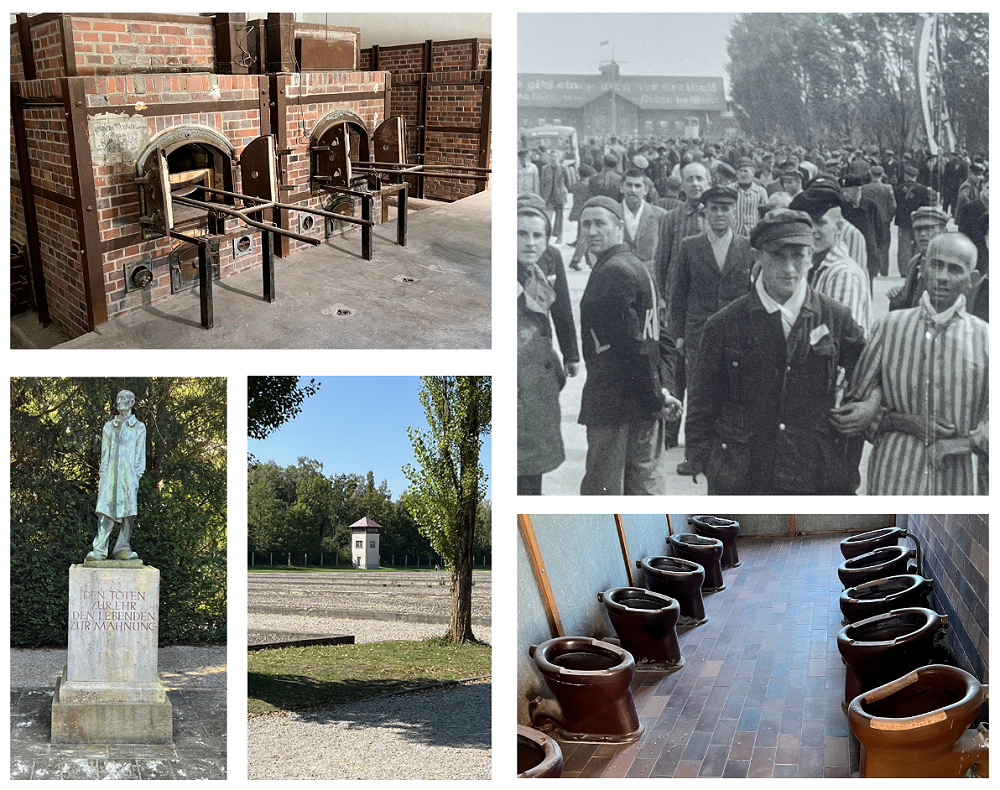
Entering the compound we were surrounded by the remnants of the barbed wire fences, watchtowers and the SS quarters (which now double as a museum), as well as a swift-flowing river alongside the perimeter fence. Of the 200,000 people imprisoned at Dachau, at least 43,000 were killed, or died of typhus.
Prisoners lived in constant fear of brutal treatment and terror detention, which included standing cells, floggings, tree and pole hangings. The prisoners were demonised, dehumanised and brutalised. One burly SS guard, for example, specialised in killing the sick or infirm by having them lie on the ground so that he could jump on their rib cages.
There were multiple medical experiments that ended in death. The first gas chamber was tested at Dachau. The SS perfected interrogation and torture techniques on the inmates. There was a crematorium that disposed of the bodies killed. As shown in the 2023 film Zone of Interest (reviewed in TM, April 2024) life went on as normal in the village of Dachau and the SS had areas beside the camp where they lived with their families. One of those areas is now a Carmelite Centre.
Overall, though, Dachau was a centre of forced labour for a range of munitions factories and a killing machine for people scheduled for death or who had the temerity to oppose those in charge.
Attitude of Staff
As SS member Johann von Malsen-Ponickau said when the camp was opened in 1933:
“Comrades of the SS! You all know what the Fuehrer has called us to do. We have not come here for human encounters with those pigs in there. We do not consider them human beings, as we are, but as second-class people. For years they have been able to continue their criminal existence. But now we are in power. If those pigs had come to power they would have cut off all our heads. Therefore, we have no room for sentimentalism. If anyone here cannot bear to see the blood of comrades, he does not belong and had better leave. The more of these pig dogs we strike down, the fewer we need to feed.”
This statement leaves no doubt about what a concentration camp was for. It was a place to exploit prisoners for as long as possible and was the “final solution” for those considered second-rate citizens or opponents of the regime.
Dachau an Insult to Common Humanity
Dachau has now been completely sanitised. After reading all about industrial-level slaughter and viewing stomach-churning photographs, we went out in the sunshine, saw the barracks that people slept in and walked down a tree-lined avenue to the gas chambers and crematoria.
Right beside these killing sites there are now a variety of Jewish and Christian chapels at the end of the camp. These provide places to sit in and reflect on the organised slaughter and the unnecessary deaths of thousands.
Even though these chapels are a welcome respite from the slaughter houses, they don’t really deal with the constant, ongoing stain and dark cloud of Nazi brutality and suffering. There are now lawns where there were prisoner parade grounds and a museum where the SS decided who would live and who would die.
Dachau remains an insult to our common humanity. Not even the sun could remove the fact that we were walking through a place of horror and unimaginable terror.
What Can We Do Now?
I’m still trying to process what it means to visit such a place. It’s very different from visiting an ordinary museum, art gallery or a prince’s palace. Nearly 80 years after the war’s end, we were tourists trying to make sense of the incomprehensible. And in some curious way, we were also belated bystanders to torture and death. We could come and go as we pleased. We felt disgusted by the brutality but I wonder whether we would have been passive bystanders or critics of fascism given the high costs of dissent.
Pastor Martin Neimoller was imprisoned in Dachau as a special prisoner of Hitler. As he said after the war: “First they came for the socialists, and I did not speak out — because I was not a socialist. Then they came for the trade unionists, and I did not speak out — because I was not a trade unionist. Then they came for the Jews, and I did not speak out — because I was not a Jew. Then they came for me — and there was no one left to speak for me.”
So maybe this is the point of visiting Dachau. We honour the memory of those imprisoned and dead not by being a tourist and a bystander but an active and engaged member of the human race; willing to speak out against evil whenever we see it and willing to stand up to brutality and oppression and speak truth to power no matter the consequences.
Tui Motu Magazine. Issue 298 November 2024: 8-9