
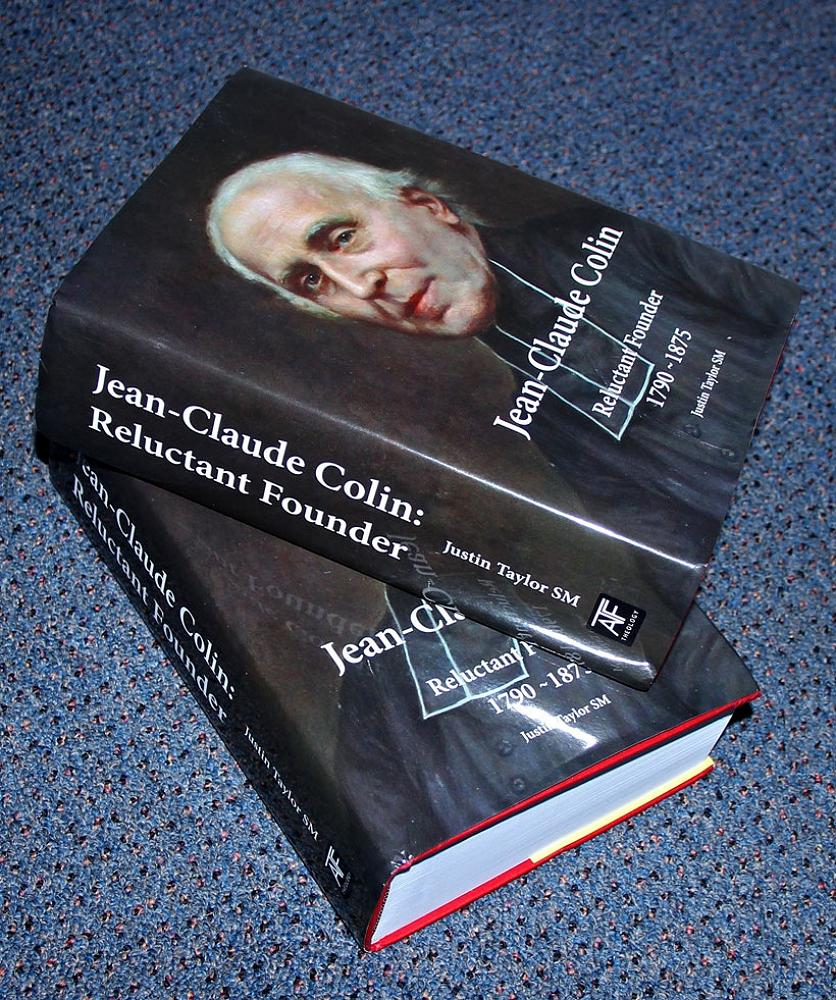
Jean-Claude Colin: Reluctant Founder
By Justin Taylor SM. Published by ATF Press, 2018. Reviewed by Kevin Toomey
Jean-Claude Colin’s life spanned the greater part of the 19th century, a unique period of ferment, political turmoil and spiritual courage in France. His personal development culminating in the founding of the Marist Fathers is researched meticulously, pondered lovingly and expertly presented in this book. As a stone dropped into a still pond sends out ripples that flow effortlessly outward, so too Colin’s life rippled deeply into the culture of the Church in France, on the way to finding itself again after the French Revolution.
We read:
§ Of the early years of obtaining diocesan and papal recognition of the Society of Mary, until Christmas Eve 1836 when Jean Baptiste Pompallier set off with 4 priests and three brothers from Le Havre for Aotearoa. This was the first of fifteen bands of men, sent on mission over 20 years — some with very familiar names like Bataillon, Viard and Moreau.
§ Of the fascinating beginnings of the Catholic Church in Oceania: New Zealand, Tonga, Samoa, Fiji, New Caledonia, Wallis and Futuna, Rotuma, Melanesia and Micronesia as well as Australia. The mission in the Solomons soon foundered, and it was only after Colin’s death that this mission was restarted.
§ Of the inevitable conflicts that arose in leading a mission and of supplying confreres in the Pacific — when communications were so poor that letters sometimes took more than a year to reach their destination and the reply, when it arrived, was already months out of date.
§ Of the demands of the Roman congregations of Propaganda Fide and Bishops and Regulars (now the Congregation for Bishops and the Congregation for Religious), and the French Catholics’ singular devotion to the person of the Pope.
§ Of the enormous courage of the first missionaries, often alone and lonely; of those who were murdered like St Peter Chanel, and those who died from tropical diseases.
§ Around all of this, the parallel development of the congregation within France in setting up secondary schools staffed by Marist priests. By 1854 there were 211 priests working in these schools.
§ Of the contemporaneous growth of other branches of the Marist "tree" which grew under Colin’s influence, until at Propaganda’s direction, some branches were broken off. From these, the Marist Sisters, the Marist Brothers, and the Blessed Sacrament Society took possession of their own charisms and work.
Underlying all is the painstaking work that Colin undertook with the Marist Sisters and Brothers over decades to write their constitutions, as well as the delicate and often painful fifty years of work which Colin put into the formulation of the Marist Fathers’ charism, finally recognised by Pius IX in February 1873.
That one man could accomplish all this, even with the help of good colleagues, is staggering. Moreover, the respect, verging on awe, shown to Jean-Claude Colin by his confreres is well portrayed. Colin, in himself, models the spirituality that is to be the Marists’ defining feature: that the congregation’s work, shown in the life of Mary our Mother, is to be carried out in humility: “hidden and unknown”.
This book carries you along at an easy, comfortable speed often belying the depth of what is being shown us. The story is told with humour and meticulous judgment over 1065 pages. We owe Justin Taylor a great debt of gratitude for the scholarly and respectful way in which he has portrayed Father Colin as the reluctant founder of the Marist Fathers. For anyone who truly wishes to understand how the Church in New Zealand and Oceania developed, this book is compulsory reading. Every serious library should possess a copy.