
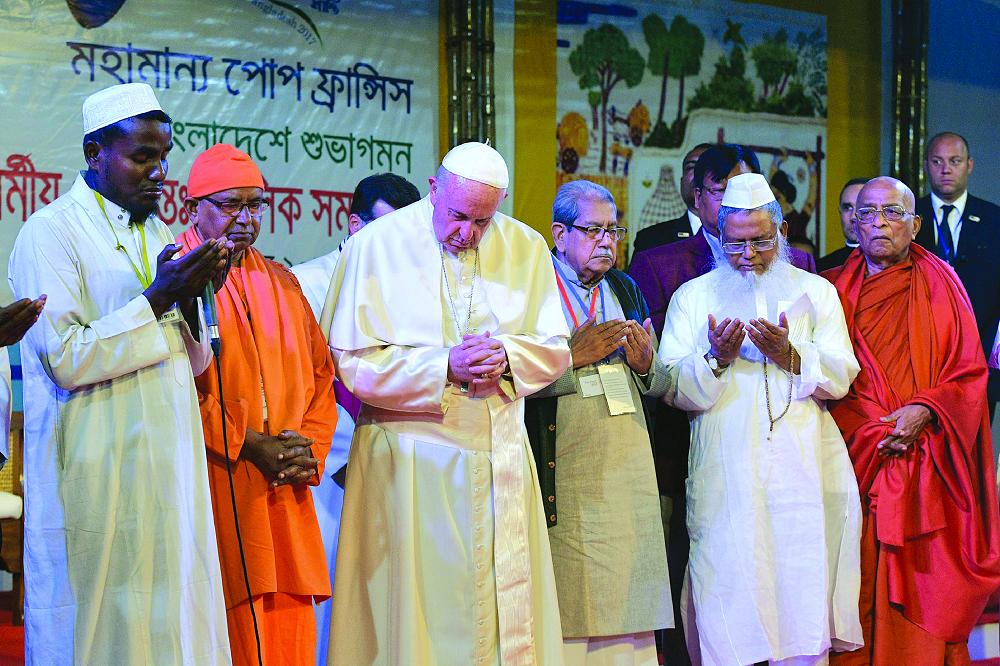
Praying Together
Bringing unity among a divided humanity is the goal of all religions. One of the steps towards that unity is interreligious spirituality, a practice championed by Catholic lay monk Wayne Robert Teasdale. The keystone of interreligious spirituality is praying together. Prayer is the ultimate spiritual act as it initiates a rapport with God and other spiritual beings through intentional engagement. When people of different faiths pray together, they intimately unite in mind, heart, and soul. They are in spiritual communion.
Pope Francis showed how easy this was to do when he stood alongside Grand Mufti Rahmi Yaran of Istanbul inside Istanbul’s Sultan Ahmed Mosque with his head bowed together with the Mufti in prayer facing Mecca. Yet for many religious people, this is not such an easy practice.
Interfaith Prayers
Over 30 years ago, the following prayer was composed by Muslims, Christians and Jews and used at inter-religious meetings around the time of the 1991 Gulf War:
Eternal God, Creator of the universe, there is no God but You.
Great and wonderful are Your works, wondrous are Your ways.
Thank You for the splendoured variety of Your creation.
Thank You for the many ways we affirm Your presence and purpose,
and the freedom to do so.
Forgive our violation of Your creation.
Forgive our violence towards each other.
We stand in awe and gratitude for Your persistent love
for each and all of Your children:
Christian, Jew, Muslim,
as well as those with other faiths.
Grant to all and our leaders attributes of the strong;
mutual respect in words and deed,
restraint in the exercise of power, and
the will for peace with justice, for all.
Similarly, the Anglican Book of Common Worship contains the following prayer:
Eternal God, you are the one God to be worshipped by all,
the one called Allah by your Muslim children,
descendants of Abraham as we are.
Give us grace to hear your truth
in the teachings of Mohammed, the prophet,
and to show your love as disciples of Jesus Christ,
that Christians and Muslims together
may serve you in faith and friendship.
For religious persons of non-Abrahamic faiths, surely that “one God to be worshipped by all” is the supreme existence and absolute reality, despite all constructed theological descriptions.
Pray "With", Not Just "For"
Today, in the liturgy of Catholicism’s Roman Rite, as well as praying “for the Jewish people, that they may continue to grow in the love of God’s name and in faithfulness to God’s covenant”, an interfaith spiritual approach would pray “with” the Jewish people, that together “we” may continue to grow in love and faithfulness. Spiritual inclusion when possible is key.
More Inclusive Prayer
The universality of the Qur’ān’s first surah, Al-Fātiḥa (The Opening), permits all believers of the Abrahamic faiths to pray together in the name of the “Entirely Merciful God”.
All praise be to You, the abundantly Merciful,
Sovereign Lord of the Universe.
It is You we worship
and You we ask for help.
Guide us to the straight path.
Praying Brings Us into Communion
When religiously diverse people pray together, the long history of religious disunity is momentarily mended and the goal of religious unity is closer.
In practice, praying together goes beyond interreligious dialogue. It is the highest form of interfaith relations as it forms part of the realm of interspiritual communion which can trigger interior transformation.
According to Pā Henare Tate, “persons in communion are changed in the act of knowing and loving each other. They are mutually enhanced, restored and empowered.” This would bring about communal conversion towards the unity and harmony that must have existed before all human divisions.
At the heart of this relationship is the spiritual side of whanaungatanga, according to Pā Henare, “the overcoming of separation, and the enjoyment of the presence of the other, or others, in union.” Such union cannot be restricted to only one religious tradition. It must extend to all humankind because we are all members of te whānau o te Atua.
When people of different faiths pray together, they are expressing unity and practising mutual respect. And because unity and respect are the purpose and the function of interreligious prayer, there is neither desire nor need to debate theological points or to worry about compromising personal beliefs.
Praying Together Helps Dialogue
It is true that practice follows belief, but the practice of interreligious prayer would not alter the unique ways religiously diverse people understand God. In other words, interreligious prayer does not discard doctrinal differences. Instead, it momentarily sets them aside to be later explored. Dialogue allows for that exploration. It gives priority to the cognitive side (dia-logos) of interfaith relations. Praying together prioritises the spiritual dimension of those relations.
When people of different faiths pray together, as Pope Francis demonstrated inside Istanbul’s Sultan Ahmed Mosque, a space of spiritual common ground is created while maintaining our uniqueness across religious borders.
While knowing how and why we differ, in that space we supplicate God for the common and greater good. After all, the reality of religious unity in Earth must be greater than its heavenly idea when we will form part of that “great multitude that no one could number, from every nation, from all tribes and peoples and languages” (Revelation 7:9).
Even when theologies differ, or are contradictory, common prayer forms the soul of the global interfaith movement. Which means it is an expression of interspiritual love and aroha noa, the undercurrent that gives life and adds vigour to spiritual unity.
Praying Together Deepens Unity
In this way, praying together becomes, as Pā Henare said: “the motive power by which persons yearn for (pūaroha), create, and renew communion.” It is as simple as intentionally saying the prayers (at the beginning of this article) with someone of another faith tradition. However, it is as difficult as gaining the courage and humility to do so.
When we pray together, we show aroha noa and thereby deepen our communion. This means that praying together is not the end of dialogue, but rather dialogue’s prep-work leading to a more successful dialogue.
Even when the prayer is not offered for unity, praying together is an expression and confirmation of that unity. In other words, praying together, by virtue of what prayer is, will trigger a greater desire for unity.
Pope John Paul II said that “every authentic prayer is prompted by the divine Spirit, mysteriously present in every human heart.” If prayer is prompted by the divine Spirit, which is the source of unity, then praying together as a religiously diverse community tends towards that source, becoming more like it. This must be true because in the fellowship of prayer, the divine Spirit is “with us” and “in us”. That Spirit is capable of resolving any shortcomings in what is believed. Such a remarkable fix foreshadows that future moment when we all form part of the innumerable, intercultural, inter-iwi, translingual multitude described by John in the Book of Revelation (7:9).
Tui Motu Magazine. Issue 267 November 2022: 18-19