Young Offenders Offered Hope
Michael Fitzsimons speaks to Andrew Becroft, newly-appointed Children’s Commissioner, on youth offending and his time as Principal Youth Court Judge.
Everyone has a worldview. For Andrew Becroft, former Principal Youth Court Judge, that worldview is Christian. He quotes C. S. Lewis: “I believe in Christ as I believe in the sun, not because I see it but because by it I see everything else.”
“My perspective is that of a Christian, it shapes my worldview. I am a man who realises that there but for the grace of God go I. As a Youth Court Judge, I was always very aware that the people we were dealing with (youth offenders) face challenges that not many of us do. I hope I acted with integrity and care but of course Christians don’t have a mortgage on that approach by any means.”
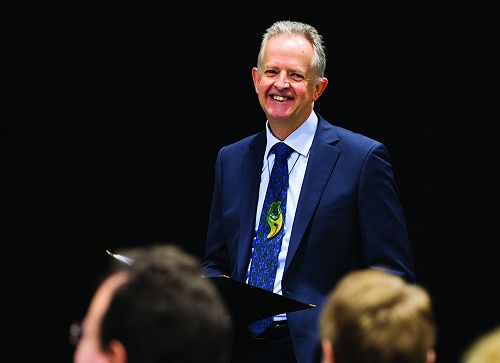
A tall, lean, highly articulate Andrew Becroft sits in a small corner office in the heart of the Wellington bureaucracy. He has been Children’s Commissioner for 22 days and is brimming with enthusiasm about his new role as advocate for the 1.12 million New Zealanders under the age of 18 — 24 per cent of the population — whom he describes as “ largely voiceless and disenfranchised”.
He brings to his new job 15 years’ experience as Principal Youth Court Judge. That job “gave me a front row seat in the grandstand, seeing up close the problems of youth offending and its consequences. I’ve been in that sense an ambulance at the bottom of the cliff. My new role is an opportunity to erect some fences at the top of the cliff.”
Formative Years Critical
“We know from the Youth Court that so much offending goes back to experiences in early childhood. As St Ignatius of Loyola said: ‘Give me a child until the age of seven and I’ll give you the adult.’ All the science tells us how true that is. The early years are the formative years. In the Youth Court we were undoing the damage. Now I have the chance to try and prevent it.”
New Process for Youth
New Zealand’s Youth Justice System involves an entirely different process from the adult justice system and is widely regarded as a world leader. The Children, Young Persons and Their Families Act (CYPTFA), introduced in 1989, signalled a shift to justice administered in the context of family and community, away from the courts whenever possible.
“The two key principles are accountability and addressing underlying causes,” says Andrew Becroft. “The Youth Justice System doesn’t send a message that young offenders won’t be held to account because they will.
“But the hope the Youth Justice System provides is that by addressing the underlying causes, we can get them out of a life of crime, out of the criminal justice pipeline. We don’t charge them unless the public interest demands it and there is no other course of action.”
Police Cooperation
Andrew Becroft is quick to acknowledge the pivotal role the Police play in this new approach.
“This was the first time that a statute has said to the Police: ‘Don’t charge.’ And the Police have bought into this approach spectacularly well. So about 80 per cent of youth offenders are not charged, aren’t brought to court but are dealt with individually in the context of the community. That’s worked really well.
“Almost all teenage offenders offend only as teenagers. With good, prompt, community-based intervention, they can be helped out of a life of crime very quickly.”
Two hundred and fifty Police Youth Aid are at the centre of this community-based system, which might involve family conferences, home visits, putting in place reparation, apology letters, community work and counselling.
“For the 80 per cent of youth offenders who are not charged, this system works incredibly well. About 80 per cent of these young offenders never offend again. It’s a system that operates under the radar; its great strengths are not well known.”
Process is Working
The statistics tell a surprising story, totally at odds with impressions gained from media headlines. In 2015, the number of children (10–13) and young people (14–16) charged in court was the lowest in over a decade and had decreased by 41 per cent since 2011.
The system works so well that it should be extended to include 17-year-olds, says Andrew Becroft.
“Sadly it stops at a person’s 17th birthday. It should include 17-year-olds; most of the world does. It’s the right thing to do. We’ve signed up to it and it wouldn’t mean that 17-year-old serious offenders would escape. They would still get prison sentences but for the moderate-to-minor offenders, we would have the chance of using non-court processes to get them out of the system.”
The Young are Works in Progress
What we have to appreciate is that young people are “a work in progress”, says Andrew Becroft. Literally, their frontal lobe is still developing, the part of the brain that deals with commonsense, impulse control, wired decision-making under pressure. Development doesn’t finish until the early 20s.
“So teenagers make some spectacularly silly, sometimes reckless, sometimes tragic decisions. But all the research is that when the frontal lobe work is completed, they’ll probably leave that offending behind. So the fundamental approach of the Youth Court is that we are just about dealing with a different species of human being and we need a quite different approach.”
There are those of course who think the Youth Justice System is a soft touch. This is not true, he insists. Serious young offenders are held to account before the Court. The striking thing though is that the number of these serious offenders is very small — 1,801 last year. In the case of these offenders, the Court has a number of options open to it but seldom are they sent to prison. Only 15 were sent to prison last year.
The fact that the number is very small is encouraging because prisons are not great at rehabilitation.
Hope for Rehabilitation
“I think we all know that while this side of heaven prisons are necessary, segregating our most serious offenders and aggregating them together in a semi-concrete warehouse is not a recipe for enduring rehabilitation and success. The stats show the reoffending rate for those who go to prison is about 50 per cent — which tells its own story.”
Andrew Becroft believes rehabilitation is always possible.
“I am committed to that: we believe all young people can change. A youth worker speaking recently at a training session for youth court judges, commented that ‘young people need people who can model hope. You have to be merchants of hope.’
“Judges have to provide hope. In our decisions, we have to make clear that change is possible. We never know who in the group we are dealing with will be able to make the changes. Even among the tough group, we know 35 per cent won’t reoffend again and another 15–20 per cent will age and grow out of it gradually.”
Churches to be Involved
There’s a huge opportunity for Churches to get involved in the rehabilitation of young people, says Andrew Becroft. Young people need good adult role models. Churches can get these young people involved in community and youth activities and working bees.
“There’s a sign outside Blenheim airport that says: ‘A kid in sport stays out of court’. There’s more than a grain of truth in that. It might be a youth group, a church group, a kapa haka group, an outdoor adventure group. These young people need good adult role models and the chance to be part of a group and develop self-confidence.
“Police run a programme called ‘big brother, big sister’ and are always looking for mentors. You are never too old to be a mentor. The youth justice system is all about harnessing community resources and faith groups have enormous resources.”
Andrew Becroft’s new job will be a difficult balancing act. He needs to be a fearless public advocate for the rights of children and at the same time collaborate effectively with government agencies behind the scenes to bring about change. To be successful, he needs to keep faith with the public and with government.
“I need a lot of advice and help and I hope that good community people, including your readers, will be telling me if I’m getting it wrong. That’s an invitation.”
Published in Tui Motu magazine. Issue 208 Sept 2016:10-11.
Gallery