
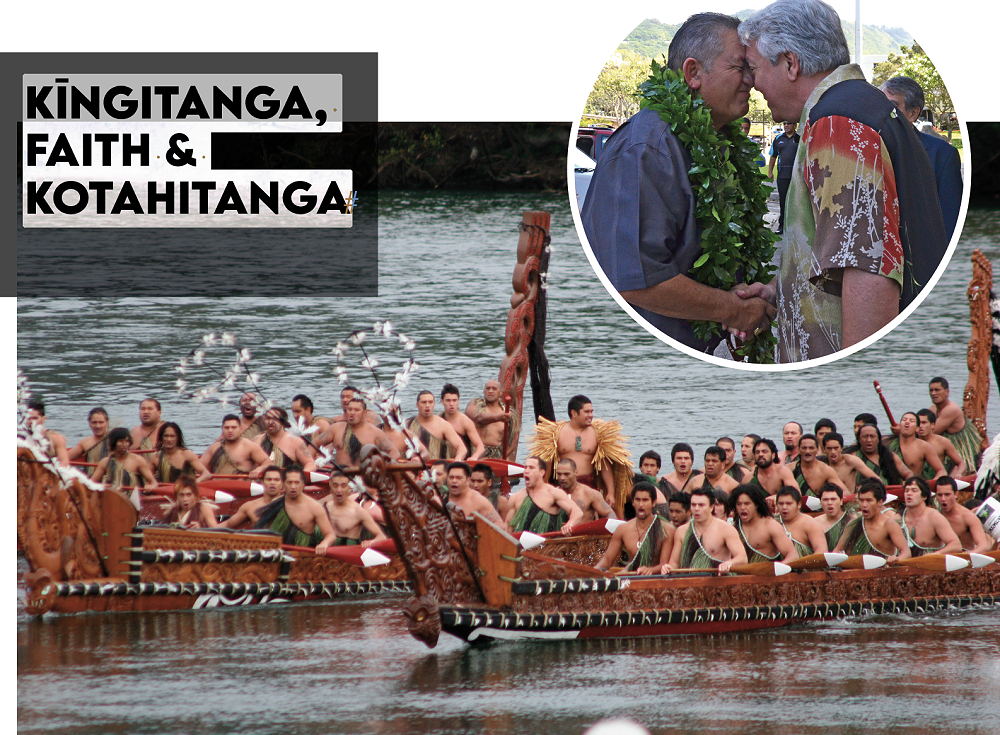
KīNGiTANGA, FAiTH & KOTAHiTANGA
The recent death of Kīngi Tūheitia Potatau Te Wherowhero VII saw a flood of memories, tributes and tears from tens of thousands of people who arrived at Tūrangawaewae marae to mourn him. During his 18 years on the throne I was privileged to share his company on a number of occasions as a mentor and as a friend.
The first Māori Kīngi Pōtatau (1858-1860) aligned Kīngitanga with Christianity. At his coronation Te Heuheu, the paramount chief of Tūwharetoa said to Pōtatau: “Let the religion of Jesus Christ be what unites us.” Pōtatau responded with the words: “Through the eye of the needle pass the white thread, the black thread and the red thread, hold fast to charity, the law and to the faith, forsake all else.”
Pōtatau further grounded the place of Christianity when he stated to his people before his death: “Prior to me your God was Uenuku Kaitangata, after me your God will be Ihowa o ngā mano, the God of the Bible”.
Tāwhiao, the second Māori Kīngi (1860-1894), was associated with the prophet Te Ua Haumēne of the Pai Marire faith, an expression of independent Māori Christianity begun in Tāranaki, based on goodness and peace. Tāwhiao developed his own version of Pai Mārire calling it Tariao, the morning star. It combined Pai Mārire karakia/prayer with new forms of ritual. The late Kīngi Tūheitia was not only Kīngi but he was also the titular head of the Tariao faith.
BiBLE AS WORD OF GOD
Faith and the Bible are important to Kīngitanga. During the coronation of Kīngi Pōtatau, the Holy Bible was placed upon his head. The Māori monarch is the only monarch in the world to be crowned with the Bible. Other monarchs have a crown made of gold and jewels — diamonds, rubies and sapphires — but the crown of the Māori kīngi or kuīni is the Bible. The same Bible has been used for every Māori monarch since the first coronation.
FAiTH iN PRACTiCE
Every monarch has their own flag or standard that is flown at the Kīngitanga marae. The flag designed by Kīngi Tuheitia has the cross of Jesus Christ in a prominent position. Faith and spiritual matters such as karakia and the Bible were important to Kīngi Tūheitia. Every week he would spend time in karakia with his whānau and he often would discuss questions of faith. Before he travelled on international business, Tūheitia would gather his people for karakia. The people would gather for prayers for the Kīngi’s health at those times when he suffered illness. When he was in residence at Tūrangawaewae marae the day would begin at 7am with karakia during which time his flag was raised. Each evening karakia would ring out over the marae as the flag was lowered.
When Kīngi Tūheitia was working through his reforms of Kīngitanga, he asked me to establish his Kahui Wairua — a Council of Spiritual Advisors consisting of church leaders. The Kīngi felt it was important that the first voice he heard when needing advice was the voice of God. The responsibility to reflect and articulate the word to the Kīngi was given to the church leaders of the Kahui Wairua. Tūheitia asked for there to be a Roman Catholic voice on this Council. During the reign of Tūheitia’s mother Te Atairangikaahu, Catholic Bishop Takuira Mariu, until his death, delivered the homily at each anniversary of the Kuīni’s coronation. At Te Atairangikaahu’s request Bishop Mariu baptised her granddaughter Ngawai hono i te po, signifying the union in faith of Kīngitanga and the Roman Catholic Church. After Bishop Mariu’s death Pā Hemi Hekiera SM took the Catholic seat on the Kahui Wairua until his untimely passing.
CARE OF THE POOR
A pillar of Kīngitanga is the Poukai. It is the annual series of visits by the Kīngi or Queen to the various Kīngitanga marae in the Waikato region and beyond. Kīngi Tāwhiao was concerned about the state of his people after their land confiscations which had caused widespread poverty and hunger. He reflected that biblical passages spoke of the king’s duty to care for the least in society — the widow, the orphan and the poor — and he committed to this as the work of kīngitanga.
In 1885 Tāwhiao instituted the Poukai to provide for people living without proper support and necessities. He introduced the biblical concept of tithing. All food was donated, nothing was brought, and those who could gave a monetary donation.
The Kīngi received 10 per cent of the donated money and food to support the objectives of Kīngitanga. The remaining 90 per cent of food and money was given to support the least in society. The food was divided among the people and the money used for the practical support of the people.
KOTAHiTANGA
Embedded in the principles of the Poukai is the concept of kotahitanga, unity. Tawhiao foresaw that for the Kīngitanga movement to be successful it was crucial that there was unity among his Waikato-Tainui people. The Poukai is a conversation and it is held on over 30 marae during the year. Whenever something is considered important to the people, the issue is brought to a Poukai where it is robustly discussed and debated in a public forum at which the people have a say.
In this last year of his reign, Kīngi Tūheitia called for kotahitanga in response to government policies that many considered would have a negative impact not only on Māori but on all people. Tūheitia’s call for kotahitanga went beyond being a rallying call for Māori to unite. He extended the call to Pākehā as Tangata Tiriti/people of the Treaty and Pasifika as Tangata Moana/People of the Ocean to stand together. Amazingly, thousands of Tangata Tiriti and Tangata Moana have heeded his call to unity, signing petitions, writing letters, taking part in hīkoi, protest marches, publicity and educational awareness-raising events. For once, Tangata Whenua, Tangata Tiriti and Tangata Moana are united in a common cause to honour te Tiriti o Waitangi and te reo Māori.
During the celebrations of his 18th coronation anniversary at Tūrangawaewae marae, Kīngi Tūheitia spoke publicly about kotahitanga. He encouraged all people to be positive, not to be afraid of the storm, reminding us that we are stronger together with kotahitanga as the wind in our sails. Then the following week on 30 August aged just 69, after suffering years of ill health, Tūheitia’s heart stopped beating.
CORONATiON OF THE QUEEN
Before Kīngi Tūheitia was buried we saw the coronation of his 27-year-old daughter Ngawai hono i te po as the new monarch, Arikinui and Kuīni. (She is the late Kuīni’s granddaughter who was baptised in the Catholic Church.) While this is a major generational shift, the principles of Kīngitanga remain unchanged and will continue into the next generation, although they may be expressed in new ways. At the heart of Kīngitanga is faith in God and Jesus Christ, the Bible, prayer, abidance to the law and care for the least in society, the widow, the orphan and the poor. Forsake all else.
Tui Motu Magazine. Issue 297 October 2024:4-5.