
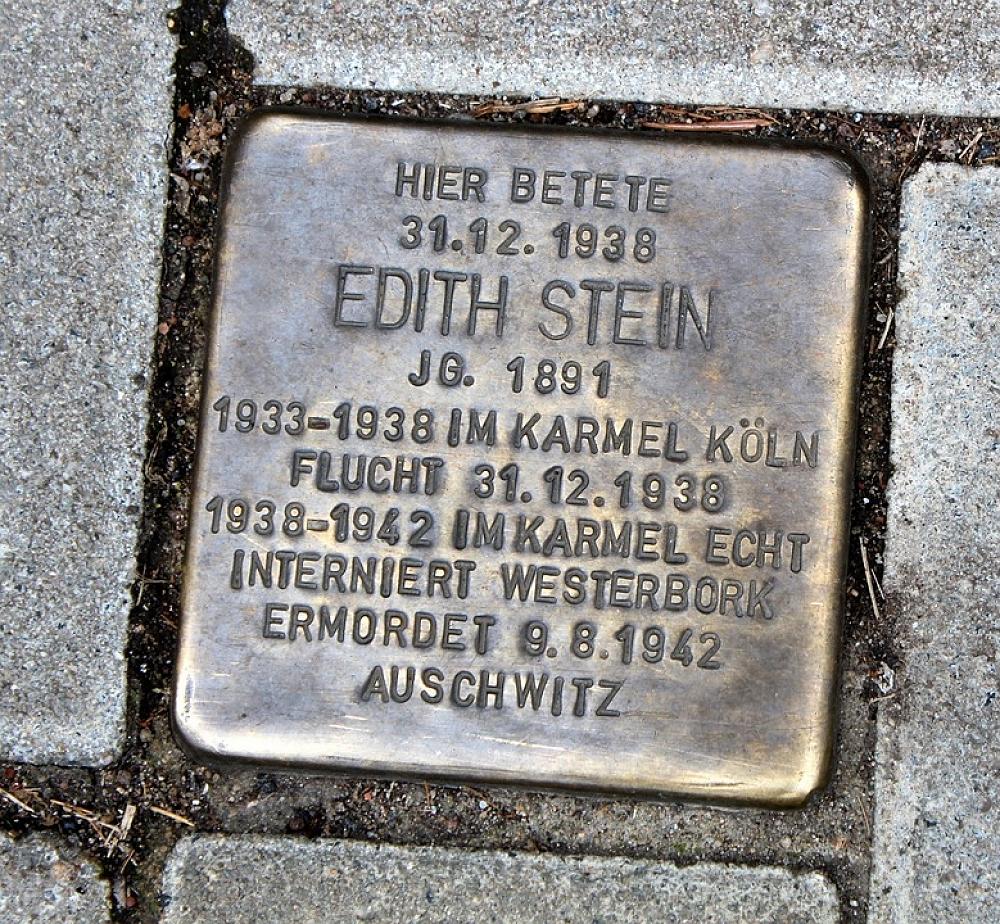
A Life in the Chaos of War
ANN NOLAN introduces the extraordinary life of contemplative Edith Stein who was killed in the Holocaust because of her Jewish heritage.
This year is the 75th anniversary of the death of Edith Stein (1891-1942), so a good occasion to reflect on her extraordinary life. She went from Judaism to atheism, from atheism to Catholicism, from being an admired philosopher and author to the obscurity of a life of solitude and contemplation as a Carmelite nun in Cologne, Germany and later in Echt, Holland where she was arrested by the Nazis. She died aged 51 in the gas chambers at Auschwitz on 9 August 1942.
In her writings we see her growing courage and depth of prayer as she journeyed from conversion to death — the culmination of a life lived saying “yes” to God.
Edith was canonised by Pope John Paul II on 11 October 1998, and the following year he made her one of the six patron saints of Europe. Edith’s feast day is 9 August.
Judaism, Atheism, Christianity
Born into a Jewish family in Breslau, Prussia (now Wroclaw in Poland), Edith wrote that as a teenager she “deliberately and consciously gave up prayer” and faith in Judaism. She had had no experience of God as personal and felt no encouragement to seek such a relationship. She maintained an intellectual acceptance of the possibility of the existence of God and of eternal life, but had no confidence in them. She considered herself an atheist until the age of 21.
By then the cracks in her atheism were starting to show as various encounters with Christianity affected her — the most dramatic of which was her reading of the Life of St Teresa of Avila. After that she exclaimed: “That is the truth.” The truth she’d discovered was that a personal relationship with God was possible, as evidenced in Teresa’s honest first-hand account of her spiritual experiences in her struggle towards union with God. This confirmed to Edith that God is a God of love and not just a God of knowledge.
Then Edith took the courageous step of becoming a Catholic — knowing the pain and perplexity it would cause her mother to see her leave Judaism definitively. It was difficult for Edith to explain that her conversion was not a reflection on Judaism but that God was inviting her somewhere else. She was baptised on New Year’s Day 1922.
Leaving University for High School Teaching
In her poem “Holy Night”, Edith reflects on the momentous step of her conversion:
“My Lord and God
You have guided me on a long dark road,
Stony and hard. How often the strength has gone from me,
And I almost hoped never to see the light.
Yet when my heart sickened in the depths of sorrow
A star rose before me, gentle and clear.
Steadily it guided me — and I followed.”
Edith “followed” to the altar, baptism and to a deliberate focus on deepening her relationship with God through prayer.
Edith left her university position to teach German and Literature at a Dominican-run girls’ high school at Speyer. She thought that Speyer would be a good context for growth in prayer as well as providing an opportunity to share in the routine and religious life of the Dominican Sisters. And understanding her teaching as an apostolate nourished by prayer as well as knowledge, Edith gave freely of her skills to the pupils and Sisters as well as to others who sought her philosophical and spiritual wisdom.
Call to the Contemplative Life
Describing her early years as a Catholic, Edith wrote that she saw her spirituality and prayer life as unbalanced at that time. She had believed that “living a devout life meant giving up material and earthly things in order to live in contemplation of only heavenly things”. At Speyer she began to experience the meaning of religious life and went frequently to the Benedictine Abbey at Beuron where she immersed herself more and more into the contemplative life she desired. It was here that the hidden life of Carmel attracted her in a way that the teaching apostolate could not sustain her spiritual leanings. She became a Carmelite nun, a “yes” to God that came at a great cost.
Goodbye to Her Mother
Edith Stein visited Breslau for the last time to say goodbye to her mother and other family members. The last day of this visit was 12 October, also Edith’s birthday and the last day of the Jewish Feast of Tabernacles. Edith accompanied her mother to the synagogue, which was a sad time for them both as her mother had a limited understanding of Christianity and of religious life.
The next day after a painful parting Edith left for Cologne, Germany to enter the Carmelite monastery there. She took the name Sister Teresa Benedicta of the Cross. Edith later reflected that although this visit to Breslau brought her no joy, her “yes” to God let her feel “a profound peace — in the safe haven of God’s will”.
Living as Carmelite Nun
The sharp contrast between her early years as a Catholic and her life in the Carmelite monastery marks the dramatic shift in Edith’s understanding of the spiritual life. We find a powerful example in her final philosophical work, Finite and Eternal Being, which she wrote in Carmel in 1936. In it Edith concludes that finite beings are dependent on the eternal being who is being itself.
Her description of this central insight reads more like a prayer than a philosophical insight: “I know myself held in peace and security. Not the self-assured security of one who stands in her own strength and on firm ground, but the peace and blissful security of one who knows she is held by a strong arm . . . Hence in my being I meet another who is not mine but the support and ground of my unsupported and groundless being.”
Edith now understands this “other” to be the Trinitarian God whom we can discover and relate to at all levels of prayer and experience.
We find Edith’s mature spiritual depth, deepened faith, openness to God’s will and love, and joy in her relationship with God expressed powerfully in her prayer written during her final few years in Carmel:
“Who are you kindly light that fills me now,
And brightens all the darkness of my heart?
You guide me forward like a mother’s hand.
And if you let me go,
I could not take a single step alone.
You are the space embracing all my being, hidden in it.
Loosened from you, I fall into the abyss of nothingness
From which you draw my life.
Nearer to me than I myself am,
And more within me than my inmost self,
You are outside my grasp, beyond my reach,
And what name can contain you?
You Holy Spirit, you, eternal Love!”
Death in the Holocaust
Carmelite nun or not, Edith was still of Jewish descent. She and her sister, also a Catholic and Carmelite tertiary who acted as an extern, were sent from the German Carmel to the Carmelite monastery in the Netherlands for safety, but they were eventually arrested there in 1942 and made their final journey to Auschwitz, Edith as prisoner number 44074 in sealed wagon number 34.
St Edith Stein, may your courage inspire us.
Tui Motu Magazine. Issue 220, October 2017: 14-15.