
Mount Tabor – Community of Transformation
JUDITH WILLIAMS traces the evolvement of the Mount Tabor community in Auckland and its membership of the International Federation of L’Arche Communities.
For anyone travelling through Helensville, the sight of a small farm — really just a collection of buildings and an orchard — wouldn’t normally warrant a second glance.
Helensville, on the northwest outskirts of Auckland City, is one of the less affluent of the rural townships surrounding Auckland. But it is blessed instead in the number of community and welfare enterprises it supports, and the strength of its ecumenical and charitable interactions.
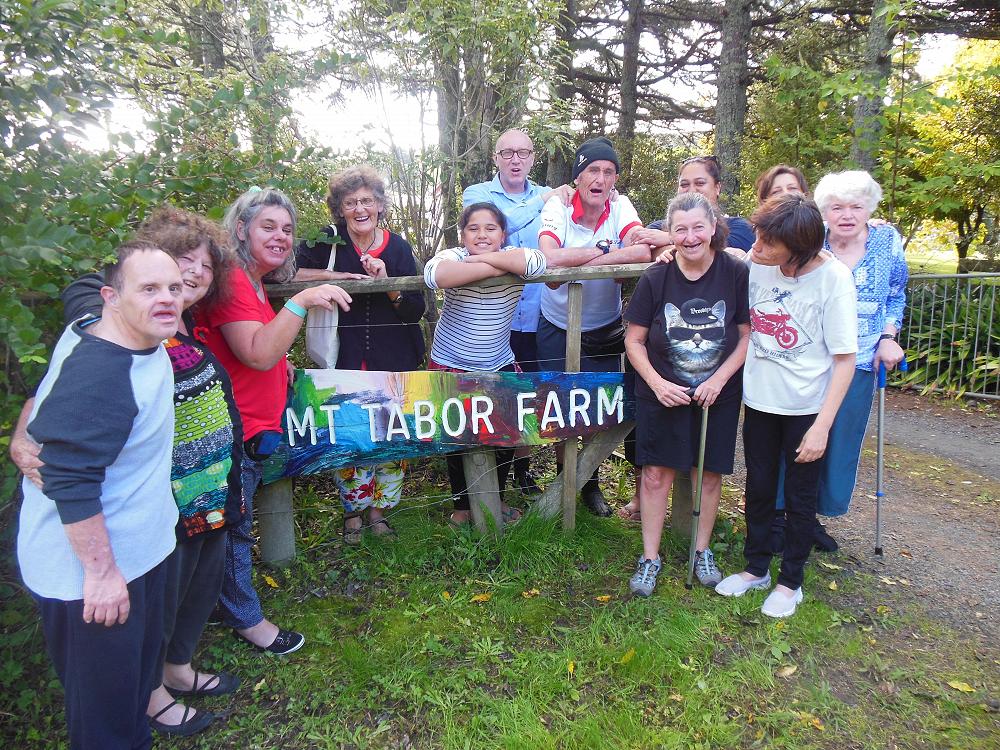
One of the most closely integrated with local life, after four decades in the area, is Mount Tabor, a special community whose core members are intellectually disabled adults.
The community is today supported by trustees, neighbours, caregivers, friends and families, local churches and community organisations from a variety of beliefs and backgrounds. The Mount Tabor ethos is rooted in the 1970s, a time when the Auckland Catholic Diocese was rich in lay and clerical personalities, many of whom are still celebrated today for their social justice work.
Some of these iconic figures, including Irene Hogan and Lorraine Popple (products of the Catholic Lay Training Centre established by Jocelyn Franklin), were encouraged by Fr Brian Arahill of St Patrick’s Cathedral parish to establish a house to accommodate the homeless. Between them they had nursing, midwifery and teaching training, Volunteer Service Abroad and Catholic Volunteers experiences, and had belonged to meditation groups and the Catholic Worker Movement.
Influence of Jean Vanier
In 1977, French Canadian Jean Vanier, a Catholic layman, philosophy lecturer and 1964 founder of international L’Arche communities, visited New Zealand and encouraged Irene and Lorraine to advocate for and work with the intellectually disabled overseas. Inspired by the ideal of living, working and praying together like a family, in the spirit of the Gospels, particularly the Beatitudes, their Charter was eventually adopted as part of the trust deed of the later Mount Tabor communities.
But instead of following Vanier overseas, the two women asked themselves who such poor in New Zealand might be. They concluded they were those under the care of the Mental Health Act, who had no rights, who were forcibly medicated and sometimes mistreated, who were isolated and powerless.
First Community Started
In 1978, before the large-scale closure of pyschiatric facilities across the country, Lorraine, Irene and John Hill invited seven men and women from St John’s Psychopaedic Hostel in Papatoetoe to share a rented villa with them in Grey Lynn.
To this day, all but one of the seven — Janet Quinn, Sandra Sturgess, Jane Hannam, Stuart Leydon and Ian and Robin Sangster — are still living together in the house in Grey Lynn and expect to be able to do so for the rest of their lives. The other member, Sally McCormack, has died.
Ian Tells His Story
Lorraine has been helping Ian Sangster to write his life story, including coming to live in Helensville’s Mount Tabor community.
“I was born in Taihape and I lived on my Dad’s farm,” Ian told Lorraine. “I had Mum and Dad and my three sisters and my big brother, Robin. Dad was a good worker on the farm. He took me to the Taihape races. I remember going to the beach — my last trip. It was two days before Mum drove me to St John’s.
“Life was horrible after that. Robby was already at St John’s. I don’t know why Mum and Dad put us there. I was a teenager. Mum would visit once a year with my sisters on Christmas Day.
“The first people from St John’s who came and stayed in the Mount Tabor Trust were Janet and Sally. I thought: ‘I want to come too’. Next were Sandy and then Jane. I wanted to come straight away. Stuart and I came on the same day, on a Monday in 1979.”
Community Homes Grow
The number of Grey Lynn residences increased and the Trust spread to West Auckland and Helensville, with the farmlet and community buildings on the edge of town, two Housing New Zealand residences, and the administration centre in the latter’s main street. There is also a L’Arche community at Kapiti, Wellington.
“Mount Tabor wanted to be a sign of hope, seeking to respond to the distress of those who are too often rejected and to give them a valid place in society,” say its founders.
“It aims to create a place of welcome, a community of faith and love, trusting in God, and seeking to be guided by God, its members living simply and discovering and living their spiritual life according to their particular faith and cultural traditions.”
Affiliation to L’Arche
In 1986 Irene spent a year visiting L’Arche communities in England, Canada, India, Australia, Europe and North America. This was the beginning of a movement which in 2016, after a thorough discernment process involving all the New Zealand communities, saw the Trust finalise its decision to apply to become part of the International Federation of L’Arche Communities.
In June, current New Zealand Mount Tabor communities leader, Janine Felton, and Narelle (known as Nellie) Pemberton embarked on a wonderful journey together.
Last year the Mount Tabor communities were accepted as probationary members of L’Arche International and two leaders were invited to the International Assembly in Belfast, June 2017. The Mount Tabor communities chose Nellie to accompany Janine.
Nellie Understands Community
Nellie came to Mount Tabor as a teenager through the L’Arche Faith and Life Movement. Recently, her community, family and friends celebrated together when Nellie and Richard Swingler pledged their commitment to each other as a couple.
Nellie trained in the gym to lose weight for the trip and rehearsed for her address of a small congregation at Mass — a public speaking opportunity organised by Irene’s teacher sister, Doreen, also from Helensville.
“Why was Nellie chosen?” I asked Janine. “Nellie has a deep understanding of community,” she replied. “She is a wonderful welcomer, networker and public speaker, she can sing and has matured in Mount Tabor communities.”
Experiencing Mount Tabor
And what about the personal meaning of Janine’s work? “It means to think about, hold in your heart and plan for around 80 people, the 32 core members and their carers. It is a calling to lead people in community as helper and facilitator through relationship problems and other difficult times.
“There is enormous joy and challenge in being a leader in such a community and the willingness to grow in relationships is extraordinary.”
As I was winding up my time with Janine, two quite distressed people were bustled into her central Helensville office. Lorraine’s lovely, white-bearded husband, Mike Popple, was as upset as Lisa, the former Mount Tabor resident he was bringing in with a splinter in her finger. They had been working out at the Mount Tabor farm, renovating a separate dwelling for an elderly core person.
As the splinter was carefully removed I watched this living example of all that Mount Tabor homes stand for in our often troubled country. The homes are places of peace warmed and surprised by grace — they are well named. In them adults with limited intellectual abilities, who, by the world’s standards, might not always be honoured with the dignity they deserve, can live secure and fulfilled lives. I felt included and transformed in God’s love shining through them.
Tui Motu magazine. Issue 217 July 2017: 12-13