
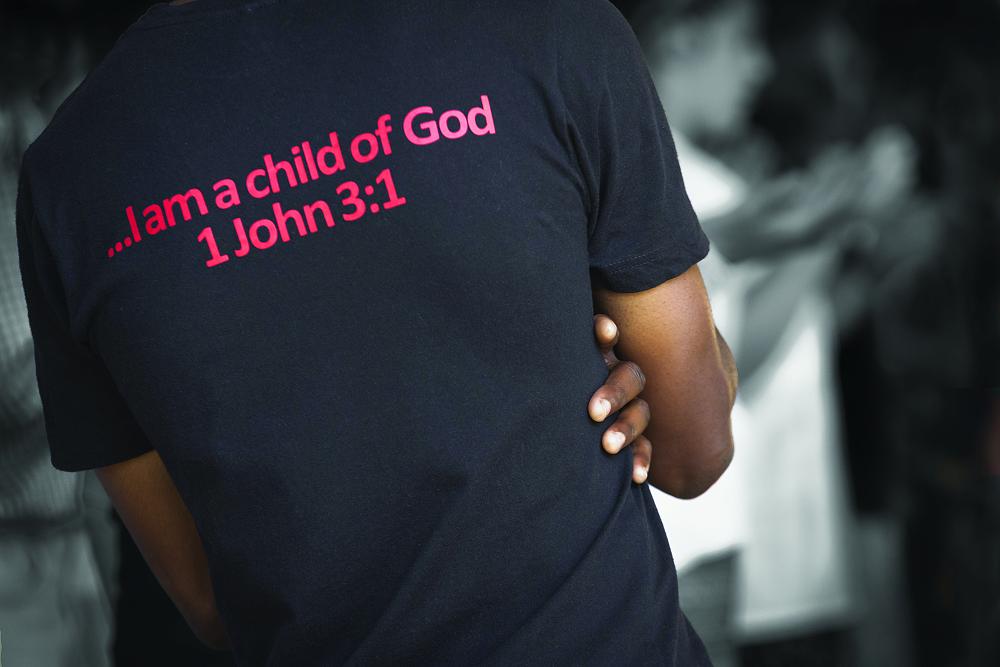
The Dignity of Being in God’s Image
HELEN BERGIN reflects on why we need to acknowledge the dignity of every human person and what we learn about God when we respect human dignity.
In today’s world the meaning of the word “human” is being expanded and sometimes challenged through scientific developments. Mechanical apparatus implanted in human bodies has enabled millions to benefit from stronger hearts, better hips, more flexible knees, improved hearing or eyesight. Modern drugs and technology enable some humans to run faster, jump higher and cycle further thanks to “other-than-human” elements being consumed or imbibed. There is a fine line between “solely” human success and success which is greatly enhanced by medicinal and technological support. The list goes on.
However, this article has another focus. It examines the dignity which every adult, youth and child possesses in light of the biblical understanding that all are created “in the image of God” (Gen 1:27).
We will look first at the giftedness yet fragility of all human beings, then at the document Made in God’s Image (1980) which explored the situation of Catholic women in the Church of Aotearoa New Zealand. Finally, we will turn to the biblical and theological tradition to underline the importance in Catholic Social Teaching of the principle of “human dignity” or of being “made in God’s image.”
Gift and Fragility of Humanness
While all creatures are gifts, we often hold that human beings have distinctive gifts such as capacities to be creative, make decisions, assume responsibility and show love — for good and for ill. However, humans are also born vulnerable and dependent as tiny infants. And many elderly persons spend their final years dependent on the goodwill and support of others. In between, many humans flourish through using all their gifts — caring for family and neighbours, being involved in satisfying employment and, in using personal gifts, they make others’ lives more “human”.
Yet there is more. Humans contemplate the world. They wonder about the beginnings of their particular lives as well as the origin of the planets and stars. They yearn to love and be loved — and not just temporarily. While many forebears risked leaving their countries of origin in search of peace, food and a place to stand, their descendents reflect on their own existence now, believe in life’s goodness and sense that life is fundamentally “given” to be shared. Others contemplate stars, oceans or even tiny insects — and are deeply thankful. They experience a sense of graciousness arising from elsewhere.
At the same time, too many people today know only fear, poverty, war, being trafficked or being trapped within abusive or oppressive family, social, political or financial situations. They long for communities of safety, acceptance and freedom. In all of this I suggest that many desire a sense of human worth as well as recognition from others. It is especially in such circumstances that a Christian understanding of human beings as having been “made in God’s image” can offer some insights.
Fundamentally, when we describe children, women and men as “imaging God” we do not suggest that they reveal God literally or in some artistic form. Christian tradition has always understood God to be “Other” than any created reality, including the human. Yet, at the same time, God became one with humanity in Jesus who assumed finite flesh as a child, and God’s Spirit still nudges and befriends creation. Humans possess immense dignity thanks to the ancient biblical belief that they are made in God’s image.
Research on Women in Church
In 1980, local laywoman, Christine Cheyne presented a report entitled Made in God’s Image to the NZ Catholic bishops. The report was based on significant research regarding sexism in the Catholic Church in Aotearoa New Zealand. The views of many women contributed to this report and the initial study was then followed up by theological reflection from a group of NZ Catholic women. Finally the NZ Catholic bishops offered their response. While numbers of helpful initiatives were taken to ensure that women’s presence and voices were more widely included in local Catholic parishes and on national Catholic committees, the possibility of Catholic women exercising “real” authority in dioceses was precluded by the situation of ministerial priesthood and ultimate decision-making being closed to women. It seems that the consultation of women rather than inclusion in major decision-making is the lot of Catholic women.
Women are Made in God’s Image
For our purposes, therefore, one question arising from this might be: “Does such a situation preclude women from being ‘made in God’s image’”? My response, and the response from many in our Christian tradition, would suggest not. Let’s focus on one significant voice from our biblical tradition and four voices from our theological tradition.
Genesis 1:27 states: “So, God created humankind in his image, in the image of God, God created them: male and female God created them.”
Thomas Aquinas, theologian of the 13th century, understands “the image of God” as best reflected when human beings use their intellects — a gift offered to women and men, to youth and to children.
John Macquarrie, 20th-century theologian, describes “the image of God” as being exercised when adults and the young express responsibility, creativity and love.
Mary Catherine Hilkert, 21st-century theologian, discerns “the image of God” as present when people are called into and live in right relationships with one another.
And, Elizabeth Johnson, significant 21st-century theologian, expresses a pivotal understanding of “the image of God” as reflected when women, men, children and the earth are all in community with one another.
Insights into Dignity of All
If one links the above understandings of “being made in God’s image” with an appreciation of human dignity, one might highlight the following aspects.
First, women and men, adults and children can and do reveal God’s image. Second, when women and men use their intellectual gifts to seek truth at depth, they reflect God’s image. Third, when children and adults, male and female act responsibly, are creative and love truthfully, they reveal God’s image. Fourth, when human beings foster community relationships, the image of God is made manifest. Finally, when human beings recognise and treat Earth as an inter-dependent reality, they reflect God’s image.
Each of the above situations invites human beings to express God’s image by seeking to discover and honour truth, and by honouring and loving human beings in their diversity of sex, gender, ethnicity, age, religious affiliation and social position.
And the final scenario reminds human beings not simply to honour the earth but to take pro-active measures as communities towards the long-term gift of planet Earth. When Earth is honoured, humans also reveal God’s image in relation to the whole of creation.
One corollary to the above is that if every human being whether frail or strong, male or female, young or elderly, atheistic or religious, Afghani or Kiwi, reveals “the image of God,” every person is fundamentally worthy of respect, of a “hearing,” of inclusion and of community support. Even the seemingly most abject person deserves dignity and respect precisely because they bear within themselves “the image of God” their Creator.
Nelson Mandela’s words from his 1994 Inaugural Speech fittingly remind us of the innate human dignity of all people. He says: “We were born to make manifest the glory of God that is within us. It’s not just in some of us, it’s in everyone.”
Published in Tui Motu Magazine. Issue 213 March 2017: 4-5.