
The King Is a Member Not Head of the Church
Peter Matheson traces the history of the relationship of the Presbyterian Church to the monarchy.
In the wake of the French Revolution (1789-1799), Irish Catholics and Presbyterians joined hands in the Society of United Irishmen. Theirs was a struggle for democratic rights and the overthrow of the Anglican Ascendancy in Ireland. This is an interesting, often forgotten, chapter in our history. Their rebellion was easily crushed at the time but the recent coronation of Charles III reminds us that Catholics and Presbyterians have often shared a similarly conflicted relationship to the monarchy.
Christ Is Head of the Church
The 16th-century English Reformation began with Henry VIII elbowing out the Pope to pronounce himself the “Head of the Church” by Divine Right. In retrospect how ridiculous this was! In Scotland the Reformation was a grassroots movement which broke with the papacy and developed a predominantly Calvinist national Kirk but owed nothing to regal support. In the vivid language of the day Andrew Melville argued: "Thair is twa Kings and twa Kingdomes in Scotland... Chryst Jesus the King and his Kingdome the Kirk.“ The secular kingdom was ruled by King James. But within the Kingdom of the Church James was a mere subject. Fighting talk!
Resistance to Royal Interference
A foolish attempt in 1638 by Charles I to impose English patterns of worship and governance on Scotland led to thousands of Scots signing a famous National Covenant opposing the interference of the Stuart kings in the affairs of the Presbyterian Church of Scotland. Following the wider Calvinist tradition, the National Covenant emphasised the need for the Church to retain its spiritual independence from the monarchy. As the Covenanters (those who’d signed the Covenant) held, Christ should be the sole Head of the Church.
The King persisted and the Covenanters became involved in the grim English Civil War on the side of the Commonwealth (Parliamentarians) against the Royalists. However, they did not approve of the execution of Charles I when the Parliamentarians won.
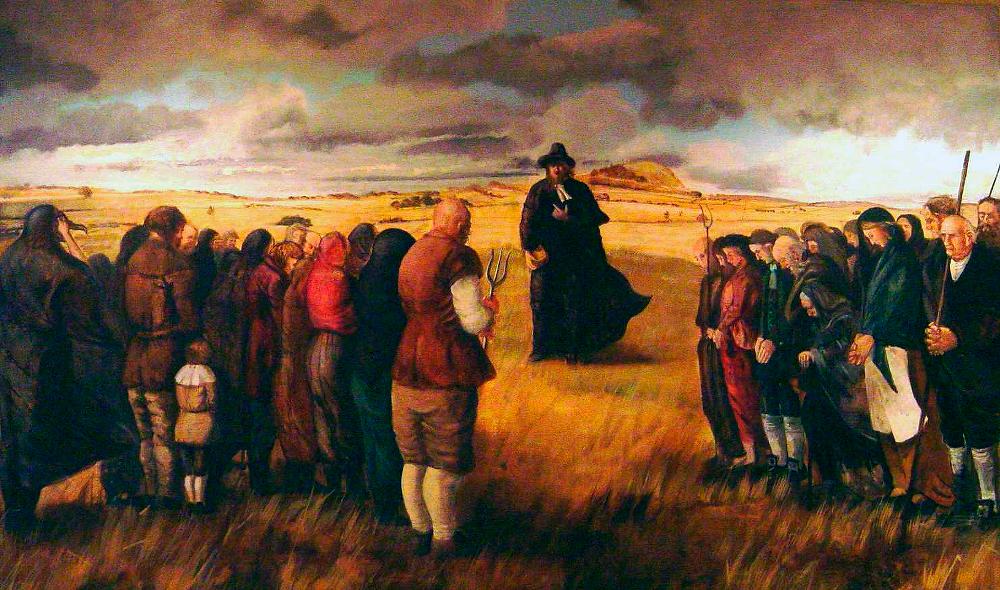
After the Restoration of Charles II in I660 a time of persecution of the Presbyterians was ushered in. Hundreds of Scottish ministers were dismissed for refusing to renounce the National Covenant. It became common for services to be held in secret out-of-the-way places like barns or in the fields, as parishioners shunned the new ministers imposed on them. Unbelievably, attendance at these “conventicles” could be punishable by death and hundreds of sincere worshippers were also deported overseas.
During these “killing times” some Covenanters renounced the monarchy altogether. Certainly, the bitter experience of persecution by the Stuart monarchy during the Covenanting period, of the 17th century, ensured that the Church of Scotland has wanted nothing to do with a monarch as Head of their Church. Equally unacceptable was the Lutheran idea of the ruler as the Supreme Bishop.
Preserving the Autonomy of Church
In this period of history the Church was different from today’s worshipping and pastoral communities. At that time the Church controlled just about everything in society: education, poor relief, family life. For all the folly of the Stuart kings, with their fantasies about Divine Rule — a political doctrine in defense of monarchial absolutism — we need to remember that the motives of the Covenanters were not always saintly either. There were power grabs on all sides!
Presbyterians have not been anti-monarchical in principle. Similar to the Catholic Church in the Middle Ages, experience had taught them that the integrity of worship and doctrine could only be safeguarded if the autonomy of the Church
was preserved.
Today we can see the disastrous results when church leadership takes its cues from the state as in Putin’s Russia. Russian Orthodox Patriarch Kirill appears to endorse Putin’s war on Ukraine and has no critical independence of thought. (We need to remember that Orthodoxy, for all its wonderful liturgical and theological resources, was untouched both by the Reformation and by the Enlightenment.)
Those conservative US evangelicals who hang on to the coat-tails of Donald Trump’s “America First” populism similarly fail to keep Church and State separate. So achieving proper church-state relations is not an abstract or theoretical question. When Erastianism runs riot — when the Church simply does what it is told by the state — the consequences can be dire.
I suspect we will have a range of opinions about the significance of Charles III’s coronation. When we consider that the first Charles was beheaded and that Charles II was feckless, the very name “Charles” is not inspiring. And we may think that there are more important issues pressing upon us at this time than a coronation.
Church to Uphold the Common Good of All
To sum up. The monarch does not have a role in the Church of Scotland or the Catholic Church. When the Church of Scotland’s national assembly or synod meets, the royal representative may attend and sit in the gallery, but cannot take part in the proceedings. The monarchy as a decorative ornament, perhaps. The Anabaptist tradition, seen in contemporary Mennonites — which champions a separatist ecclesiology, often pacifist and unworldly — may seem attractive. But there remains something compelling about the mainline Catholic and Calvinist view that the Church has a prophetic calling which goes beyond the parish gate to embrace the whole of life.
For a long time, of course, Catholics in Aotearoa were discriminated against because of their Irish ancestry and allegiance to the Pope as head of the Church rather than the monarch.
It is interesting to reflect that initially most of the Otago Presbyterians were from the Free Church of Scotland, formed in the Disruption of 1843 when a third of the ministers broke away from the Church of Scotland to form the Free Church. Denied the right to call their own ministers, and lorded over by aristocratic patrons, they walked out of their traditional churches and challenged the law of the land, a sort of re-run of the 17th-century Covenanters. Like Catholics, then, Presbyterians have been accustomed to being at odds with the powers that be.
I imagine that Catholics and Presbyterians in Aotearoa today rarely give much thought to church-state issues as we have no “state church” here — although the Anglican Church can take precedence on public occasions. The real “monarch” today may be the social media, allied to free market economics. Maybe the more pertinent issue in New Zealand is the role of the Church in society in upholding the common good for all and critiquing populist conspiracy theories. The Salvation Army’s 2023 State of the Nation report is a sobering reminder of the need for the prophetic role of the Church. And to take action on child poverty, ethnic discrimination, racism — open and subterranean — and disinformation.
Words alone will not overcome these blights on our national life. Maybe we need a National Covenant around the human dignity of everyone despite our differences in gender, race, social economic status, religion, health and political affiliation. Maybe we could recover the revolutionary élan of the United Irish men and women and take action together.
Tui Motu Magazine. Issue 281 May 2023: 10-11