
New Reason for Seeking Refuge
Ioane Teitiota is from Kiribati which is sinking as the Pacific waters rise. He came to New Zealand seeking status as a cli-mate change “refugee”. Binoy Kampmark follows his case through the courts and suggests that this new category of refu-gee will be accepted in law.
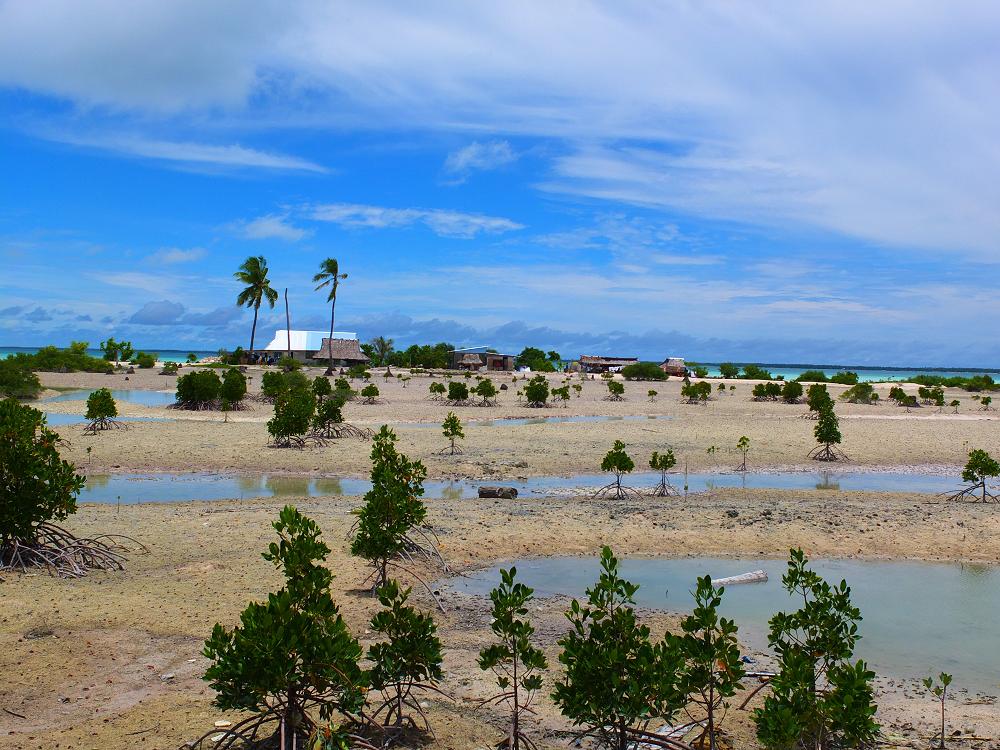
The Pacific island of Kiribati is doomed to disappear. Its people are fated to become a generation of climate change refugees. What direction jurisprudence takes on this issue will be of more than just academic interest. The term “climate change refugees” is coming into vogue and even Australia, whose politicians resist accepting the gloomy and turbulent realities of climate change, risks producing its very own. In the words of climatologist Michael Mann: “It is conceivable that much of Australia simply becomes too hot and dry for human habitation. In that case, yes, unfortunately we could see Australians join the ranks of the world’s climate change refugees.”
Suing Governments and Businesses
At the legal level, the debate about culpability for climate change inaction has found form in some 1,300 legal actions across 28 countries, the vast majority of them being lodged in that land of litigation, the United States. As Joana Setzer of the Grantham Institute and the London School of Economics pointed out last year: “Holding governments and businesses to account for failing to combat climate change has become a global phenomenon.”
Expanding Refugee Category
In the legal field, the idea of expanding the categories of refugees that arise from climactic disaster is as bold as any, and has generated its share of supporters and sceptics. A remarkable effort to do so came in the New Zealand case of Teitiota v Chief Executive Ministry of Business, Innovation and Employment [2014], the first recorded instance of climate change being cited as a basis for refugee status, though the man in question, Ioane Teitiota, failed to convince the courts. New Zealand’s various judicial channels found against the Kiribati national, claiming that he did not satisfy the definition of “refugee” within the conventional understanding of international law. This was a different sort of threat to his livelihood, rooted neither in political oppression nor tyrannical cruelty.
Appeal to Supreme Court
At stages of the appeal process, however, there was acceptance on the part of various judicial officers that climate change was a serious matter affecting Kiribati. The Immigration and Protection Tribunal, for instance, acknowledged that “the limited capacity of South Tarawa to carry its population is significantly compromised by the effects of population growth, urbanisation, and limited infrastructure development, particularly in relation to sanitation.” These effects had been “exacerbated by the effects of both sudden onset environmental events (storms) and slow-onset processes (sea-level rise).”
Appeal Failed
Ultimately, the Supreme Court found that, in being returned to Kiribati, the applicant did not face the prospect of “serious harm” and could not be granted asylum. Nor was there evidence that the Kiribati state had failed to take adequate steps to combat the effects of environmental degradation. Teitiota was subsequently deported.
Appeal to UN Human Rights Committee
The last option open to Teitiota was the United Nations Human Rights Committee, a body not always governed by the rigidity of black letter law. In its decision last month, the majority of the HRC did not find the deportation unlawful, there being no immediate danger to Teitiota’s life on account of climate change. They also noted that “the timeframe of 10 to 15 years, as suggested by the author, could allow for intervening acts by the Republic of Kiribati [ . . . ] to take affirmative measures to protect and, where necessary, to relocate the population.”
Warning for Future
That said, it was incumbent upon decision-makers to take the degrading nature of climate change into account when examining future deportation appeals. In the majority’s words of warning: “Without robust national and international efforts, the effects of climate change in receiving states may expose individuals to a violation of their rights under Articles 6 [the inherent right to life] or 7 [the right not to be tortured or subjected to cruel, inhuman or degrading treatment or punishment] of the [International Convention on Civil and Political Rights], thereby triggering the non-refoulement obligations of sending states.” That is, States had to be on guard not to return future applicants to places of imminent danger.
Criticism has been heaped from across the spectrum. Former Fleet Street editor Damian Wilson was one. “Irresponsibly, the UN Human Rights Committee, in claiming that ‘something must be done’ in its deliberations over the Kiribati family, has ducked out of directly helping them in any practical way, burnished its woke credentials and simply piled on the misery in the climate change mess.” Others see the issue of climate change as merely one feature in forced migration, though there is an acceptance by President Bill Clinton’s former White House Chief of Staff John Podesta that current legal standards are “not equipped to protect climate change migrants, as there are no legally binding agreements obliging countries to support climate migrants.”
Movement Towards New Category
Even the UNHCR has preferred the tag of “environmental migrants” rather than refugees. But words and categories change. Definitions can be stretched. The Human Rights Committee, albeit modestly, has done so. Those intent on building walls will find little cheer in it. Those wishing to see breaches in the barriers of receiving states will take encouragement from the words of one of the two dissenting members of the HRC, Duncan Laki Muhumuza of Uganda, who openly found for Teitiota. The effects of climate change in Kiribati “are significantly grave, pose a real, personal and reasonably foreseeable risk of a threat to life under Article 6(1) [of the ICCPR]. Moreover, the Committee needs to handle critical and significantly irreversible issues of climate change, with the approach that seeks to uphold the sanctity of human life.”
Where the law requires a more than capable handmaiden will be in the measures undertaken by states and international institutions to address such a category of refugee and the conditions that produce it.
Efforts to “Climate Proof”
The focus now is less on relocation programmes than building resilience at the vulnerable points — a point emphasised by the United Nations Human Settlements Programme, UN-Habitat. The World Bank, for instance, is assisting Samoa to develop “climate proof” transport infrastructure. In Vanuatu, the same institution has established a joint venture with the European Union to “encourage farmers to introduce climate resilient livestock and crops”.
Ultimately, the issue of relocation is inescapable; no measure of legal redress escapes that vital point. Former Australian Prime Minister Kevin Rudd has suggested “constitutional condominiums” as a possibility, an arrangement that would permit Tuvalu, Kiribati and Nauru to cede control to Australia responsibility “for their territorial seas, their vast Exclusive Economic Zones, including the preservation of their precious fishing reserves”. The trade-off here is relocating the citizens of all three states to Australia, where they would be granted the rights of Australian citizens after the disappearance of their countries. Such plans tend to suffer from the stigma of colonial presumption. As Kiribati’s former president Anote Tong has noted, the country “must not relocate as climate refugees but as people who would migrate with dignity.”
Tui Motu Magazine. Issue 246 March 2020: 18-19