
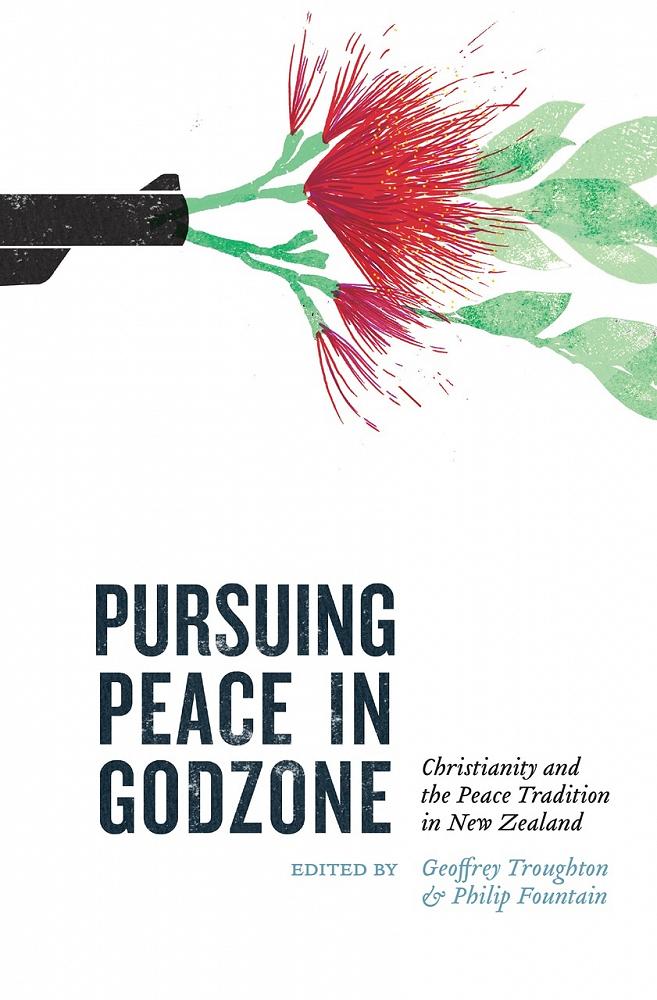
Pursuing Peace in Godzone: Christianity and the Peace Tradition in New Zealand
Edited by Geoffrey Troughton and Philip Fountain. Published by Victoria University Press, 2018. Reviewed by Mike Kelly
Pursuing Peace in Godzone follows Geoffrey Troughton’s previous title: Saints and Stirrers: Christianity and Peacemaking in New Zealand 1814-1945. It tells recent and contemporary stories and poses questions for our time when we face the tension of pacifist versus martial and religious versus secular. The authors stress that peace is not merely the opposite of war — it is “fundamentally about flourishing, wholeness and well-being”.
The book is a collection — mostly stories — about peacemaking efforts. Some deal with big issues such as the beginnings of the Christian Pacifist Society and the wide-ranging participation in the decolonisation of southern Africa. Readers may be surprised at just how much New Zealanders and Churches were involved. Garfield Todd, Michael Lapsley and John Osmers were Kiwis and there was widespread involvement in the 1981 Springbok Tour.
I found the stories of individuals most enjoyable. I loved George Armstrong’s account of the development of the peace movement, especially the anti-nuclear crusade. He described the gradual evolution of the mainstream Churches from seeing themselves as “chaplains to the nation” to “prophets at the gate”. As a consequence of the debate in churches, the evangelical focus began to change to Jesus’s attitude to peace in the Gospels, and to embrace a wider community including the “un-churched”. So the Peace Movement, though still linked to Christian foundations, encompassed a broader range of values than expected.
Adi Leason’s account of the Ploughshares Movement’s attack on the spy mechanism at Waihopai in 2008 is fearless, gently humorous and steeped in Catholic theology. At the time not everyone felt comfortable with the three men’s protest and claim that their action came from following Jesus and their commitment to justice and peace. Maybe it is still a bone of contention in some places. But Adi’s account certainly challenges us to ask questions about peace.
John Chote’s story about the community at St Joseph’s Catholic Church in Wellington with it’s Suzanne Aubert chapel is a fascinating exploration of how architecture, history, art, faith and the commitment of a brave community were brought together in a deeply Christian icon of peace.
As well as the stories, three scholars discuss the questions: Do Christian New Zealanders accept immigrants more readily that non-Christians do? Do they accept Arabs more readily than non-Christians?
Do they accept same-sex marriage more readily than non-Christians? Are they more committed to peace even at times of war?
The book is worth reading just for the discussion of those questions!
Tui Motu Magazine. Issue 230 September 2018: 29