
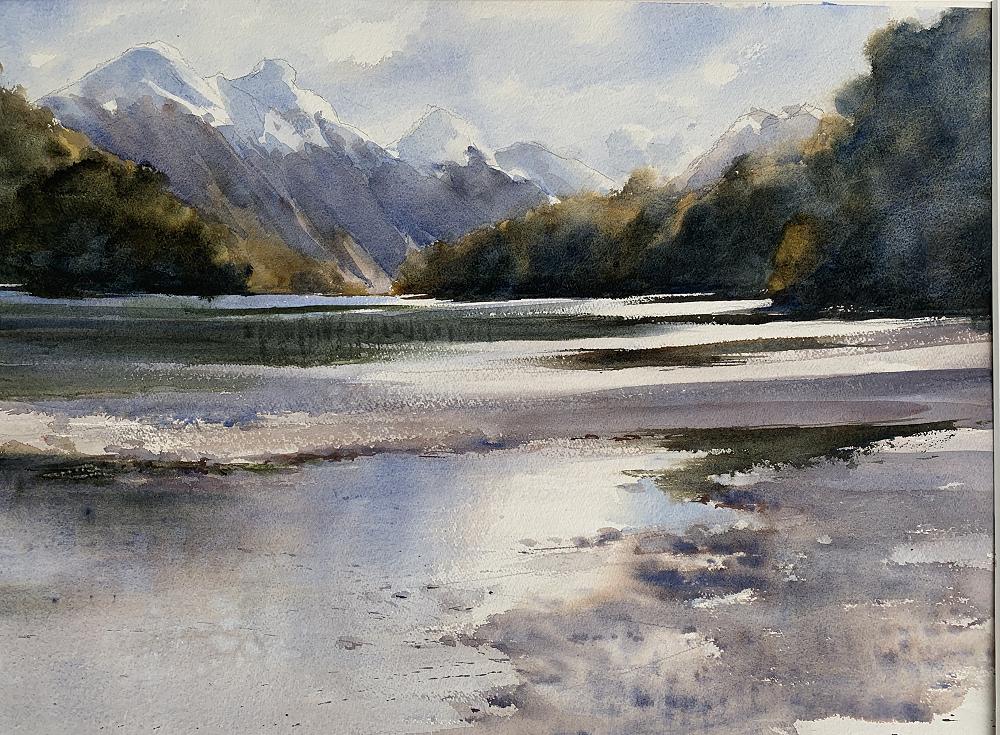
Water of Life
Mary Betz discusses how developing an understanding of our kinship with water transforms our care of Earth.
E tū Waitī e
He wai whakaata
He wai Māori
He wai oranga e
Behold Waitī
Reflecting water
Freshwater
Water that brings life.
Ministry for the Environment, 14 April 2022
All creatures live by the grace of water. It is as essential for microbes as for highly complex plants and animals. For humans, water is not only necessary for washing and drinking (our bodies are about 65 per cent water) but is a significant part of our appreciation and awe of nature. Water quenches the thirst of souls as well as bodies.
Fresh water, a mere three per cent of the waters on Earth, exists in an amazing array of solid, liquid and gas forms like snow, hail, glacial ice, rain, lakes, reservoirs, ponds, wetlands, rivers, streams, groundwater and clouds.
For something so vital to our survival, we spend little time thinking about water. Like air, like people we are close to, we take water for granted until it is in short supply or badly damaged.
Threats to Water in Aotearoa
Because of overdevelopment, polluted runoff and climate change, freshwater is under pressure in Aotearoa. We can no longer drink safely from streams or swim in the rivers of our childhoods, which now carry urban, industrial and agricultural pollutants. Too often piped drinking water can be contaminated by sewage leaks or fertiliser infiltration.
Climate change is altering precipitation patterns, drying already dry areas like the Canterbury plains, and causing water needs for aquatic life, farming and urban populations to collide. Excessive pumping of groundwater — and eventually salt intrusion near the coast — could exacerbate conflicts.
Forest clear-cutting and urban paving prevent rainwater from being safely absorbed by soils, increasing erosion and flooding from the more intense storms of climate change. Only 10 per cent of our wetlands remain — vital for flood protection, cooling, and many native fish and birds. Glaciers are shrinking, threatening future drinking water supplies, irrigation, farming, and hydroelectric power.
Restoring Waitī
When waitī/fresh water is polluted, degraded, or becomes unavailable due to human alterations of landscape or climate, its mauri (life force, vitality, bond with the spiritual) is damaged, making it less able to support life. The Ministry of Environment, in its study and management of water, is beginning to embrace a holistic understanding of ecosytems, combining mātaranga Māori with current science.
Pa Henare Tate (in He Puna Iti i te Ao Mārama) spoke from this way of knowing. He used the image of Papatūānuku to explain a wider understanding of kinship — whanaungatanga among all living beings and their environment. To pollute water is whakanoa — a violation of te tapu i te whenua, the inherent sacredness which water, land and all creation possess.
Defiling water also violates te tapu o te whenua, the presence of the Creator in creation, as well as te tāngata who rely on water. Anything that diminishes tapu also impairs mana, and limits water’s ability to provide well-being for all.
To restore tapu and mana to awa/rivers, roto/lakes and groundwater requires hohou rongo, the restoration of right relationships among waitī, tāngata and Atua/God. It requires tāngata to stop exploitation and pollution, and to implement wise management of waitī, restoring spiritual and physical well-being to all who have been affected by acts of whakanoa.
Learning from Laudato Si’
The understanding by Māori — and many Indigenous peoples — of the interconnectedness of God, people and all creation, is reflected in Pope Francis’s 2015 encyclical on care for our common home. In Laudato Si’, Francis comes very close to Māori concepts of whakanoa and hohou rongo when he (using Orthodox Patriarch Bartholomew’s words) acknowledges the need to repent for the ways we have violated or sinned against creation.
“Patriarch Bartholomew has spoken … of the need for each of us to repent of the ways we have harmed the planet: ‘for human beings to degrade the integrity of the earth by causing changes in its climate, by stripping the earth of its natural forests or destroying its wetlands; for human beings to contaminate the earth’s waters, its land, its air, and its life — these are sins’” (LS par 8).
Pope Francis similarly feels the sacredness of all creation: “The entire material universe speaks of God’s love, his [sic] boundless affection for us. Soil, water, mountains: everything is, as it were, a caress of God (LS par 84). In the tradition of Hildegard, who said: “It is God whom human beings see in every creature”, and others like St Francis, Bonaventure and Daniel O’Leary, Pope Francis recognises
the inherent tapu in every created thing: “It is not enough … to think of different species merely as potential ‘resources’ to be exploited, while overlooking the fact that they have value in themselves” (LS par 33).
Living Our Whanaungatanga with Water
Metanoia (repentance) calls Christians to change and turn toward God’s ways — which we are slowly understanding as treating all creation as kin, as brothers and sisters.
This is the way of St Francis and the way charted long ago by Indigenous peoples all over the world, including ancestors of Māori — and the Celts and other ancestors of Pākehā. When we meet each created thing as a brother or sister and, like Hildegard, see God in every creature, we begin to respect the tapu and mana of water, air, land, flora and fauna.
Restoring our relationship with water means changing our attitudes and behaviours. The 2021 Laudato Si’ Action Platform (www.laudatosiactionplatform.org) suggests ways to contemplate creation, simplify our lifestyles, invest ethically, learn about ecology and better respond to the cries of Earth and our poor.
To relate to water as sacred kin is easy to do out in nature, but can we also do that when we turn on our taps? In Aotearoa we use an average of 255 litres of water per person each day, while in water-stressed countries like Niger (learnz.org.nz) individuals use only 10 litres.
We could audit home water use: Auckland Public Libraries have free audit kits and www.ecomatters.org.nz has online instructions.
We can install rainwater tanks for watering gardens and — with plumbing help — for flushing our toilets.
We can gift our vegetable washwater to the garden, and while we wait for taps to give us hot or cold water, we can collect the rest in a kettle or bucket for watering plants.
We can volunteer with regional parks, councils or A Rocha (www.arocha.org.nz) to help restore streams.
Large systemic water issues need our advocacy at government, council and corporate level, for example, managing infrastructure to ensure water quality and prevent leaks (to which we lose 20 per cent of our drinking water), finding solutions for water use in dry areas and, of course, greater action on climate change and biodiversity.
Perhaps more water should be given tupuna status in law, like the Whanganui River, and more funding allocated to trusts and volunteer groups who are re-establishing wetlands around the country.
When We Gather
Lastly, we can bring our kinship with water into liturgy. Baptism used to be in “living (moving) water" and we can reflect on how we can better signify that now. We can ask forgiveness for our whakanoa of water.
We can use the asperges rite— sprinkling with water — more frequently. And when we bless or pray about water, let those blessings be thanksgivings for all waters, as holy kin who give of themselves to bring us life.
Tui Motu Magazine. Issue 272 July 2022: 10-11