
Touched By the Holy
Zain Ali describes visiting Jerusalem and being unexpectedly overwhelmed by the experience of sacredness even with the political divisions.
It’s 3.30 in the morning. The air is cool and the night sky is overcast. I am walking along King David Street in the heart of Jerusalem. I hope to make my way to the Temple Mount for Fajr, the morning prayer. The streets are silent. There’s a slight breeze. A few cars drive by. I walk past the King David Hotel where a few people are lingering at the front. I carry on walking, feeling slightly tense, after all I am a lone Muslim walking the streets of Jerusalem at an odd hour. As I walk further, a gentleman on a pushbike is zooming up behind me. He appears to be a Hasidic Jew. As he passes he shouts: “Shalom!” I breathe a sign of relief — “Shalom to you, too, my brother.”
I reach the ramp to the Old City and walk towards Jaffa Gate. I was at Jaffa Gate yesterday afternoon and the place was thronging with tourists. Now it is silent and empty. The souvenir stalls are closed. A few cats meander along the cobblestones. A crackling sound erupts to my left. I jerk my head around and see in the dark two police officers busy on their walkie talkies. They cast a brief glance toward me. I keep my head down and make my way through the Jaffa Gate and into the alleyways of the Old City. During the day the alleys are lined with stalls, most selling a combination of souvenirs, food, clothes, drinks, spices and, rather oddly, women’s undergarments of every imaginable colour.
As I follow the signs to the Temple Mount the call to prayer begins. It booms over the loud speakers. I wonder whether this bothers the Christian and Jewish residents of the Old City.
At one of the entrances that leads to the Dome of the Rock, I walk past Israeli officers, through a large archway and past a set of Muslim guards. The Muslim guards don’t notice me at first. They seem to be busy drinking their coffee. They eventually notice and half-heartedly call out: “Salaam Alaykum”. “Wa alykum as Salaam,” I reply. They go back to their coffee.
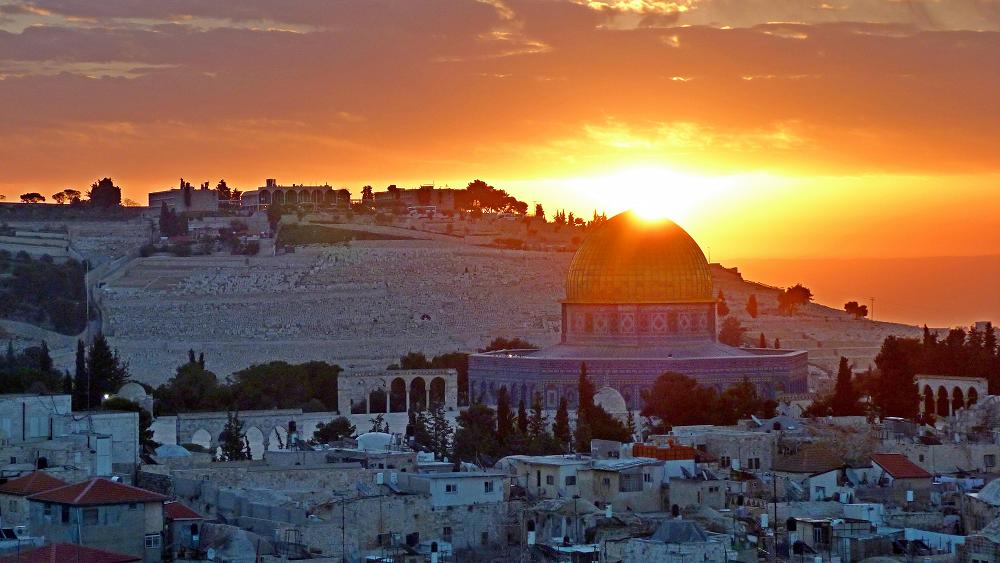
The Dome of the Rock is lit up. There are a number of folk walking through the surrounding courtyard heading to the Al Aqsa Mosque. A group of old men sit at the entrance to the mosque offering passers-by small cups of coffee and delicious medjool dates.
I had seen the Dome of the Rock and the Al Aqsa Mosque yesterday evening and it had taken my breath away. Now as I look upon both structures I am again completely overwhelmed. My intention was to meditate and pray in a quiet corner. Yet, here I am completely overwhelmed. I try to meditate and to pray, but find it almost impossible to do either.
It’s hard to put this experience into words. All I can say is, imagine trying to keep your eyes closed while knowing that in front of you is standing the most beautiful person you may ever see. I realised that it wasn’t the buildings that were beautiful — they were quite ordinary – I have seen Mosques that were far more aesthetically pleasing. It was more — a spiritual beauty that reached deep into my heart, mind, body and soul. A beauty I couldn’t close my eyes to. A beauty that made my eyes well up with tears. A beauty that took my breath away.
I had come to Israel-Palestine to broaden my cultural, intellectual and spiritual horizons and I wasn’t disappointed.
Culturally, I had the opportunity to have dinner with an Arab family and dinner with a Jewish family. At both the food and hospitality were heart-warming. I also had the opportunity to do some shopping in the alleyways of the Old City. This experience was both bewildering and exciting. I had to haggle with the shopkeepers who clearly relished the process and enjoyed it even more when I challenged them on the prices.
Intellectually, I had one question in mind: Why was there no peace between Israelis and Palestinians?
Fortunately, I encountered a variety of views. Some people clearly believed that it was the Palestinian leadership that was to blame, others placed the blame squarely at the feet of the Israeli leadership. There was a third view, that both the Israeli and Palestinian leaderships were the reason for the lack of peace. I grew increasingly sympathetic to this view.
The question of peace also raised a deeper issue, namely: What do we mean by peace? I discovered that “peace” can mean different things. For some it meant turning the clock back so that there is no Jewish state. For others it meant doing away with any notion of a Palestinian state. A sensible definition of peace may be something more basic, something we often take for granted. It is where each person or people can respect each other without seeing the other as an enemy. While this notion is relatively basic, it’s not something that you can easily conjure up into reality. It needs a change of heart.
Spiritually, I enjoyed visiting the holy sites, especially the Church of the Holy Sepulchre and the Wailing Wall. At first glance, the Holy Sepulchre looked unprepossessing. However, once you venture inside it opens up into a vast area that includes vivid murals, a number of alcoves, a mezzanine floor, and what feels like a never-ending series of beautifully decorated underground caverns. The Kotel, or Wailing Wall, is also extraordinary. The Wall itself is a high structure and I felt very small in front of it. I was struck by the Jewish worshippers who would lovingly place their foreheads against the wall. They showed genuine reverence for the structure and it was hard not to be touched by their devotion.
In addition to my cultural, intellectual and spiritual questions, I also came to Jerusalem with a deeply personal question: What does Jerusalem mean to me? A few years ago, I hosted a dialogue involving Jewish and Muslim students and I asked what Jerusalem had meant to them. An answer that struck me most came from a Jewish student, who said that to him Jerusalem was the beating heart of Judaism. So here I was in Jerusalem seeking to make sense of the place personally.
As a Muslim, I am aware that Jerusalem was once home to Muslim kings. It was also home to Jewish kings David and Solomon and home to Christians. Yet there I was, Kiwi Joe Blow, walking through the courtyard of the Temple Mount, the cool morning breeze blowing softly across my face and the sun now rising. I could see the Mount of Olives ahead of me, the golden domes of the Orthodox church beginning to sparkle in the morning sun. What does Jerusalem mean to me? It is beauty, an overwhelming beauty that lifts me beyond mere faith and human reason. It is beauty, the kind of beauty that confounds my being while also lifting me toward the heavens.
May God have mercy on the children of Abraham, may our hearts be opened to beauty and peace.
Tui Motu Magazine. Issue 244 December 2019: 18-19