
Looks After Us Like Children
MICHELE MADIGAN outlines the Australian Federal Government’s policies for Aboriginal people in the Northern Territory and agrees with Djiniyini Gondarra that the Government “just look after us like a little child”.
I’m a South Australian and on 21 June 2007 I was staying with the Lochivar Josephites in New South Wales more than 1,000 kms from home. As I knew only one person in the community I’d resolved to tread quietly. However, on the evening news the Prime Minister of the time, John Howard, and his Minister for Families and Community Services and Indigenous Affairs, Mal Brough, announced solemnly that things were so bad in the Aboriginal communities of the Northern Territory that the Government had to “intervene”. Forgetting my good intentions as a guest I reacted to this shocking news by flinging my alarm clock, which happened to be in my lap, in the direction of the TV.
To those of us who had been following the Federal Government’s attempts to take land from the Traditional Owners of the Northern Territory (NT), this announcement of the “Northern Territory National Emergency Response” (referred to as “the Intervention”) was a blatant tactic to gain control.
Land Lease or No Facilities
In 2010, the documentary Our Generation (see YouTube or TM website) provided the “back story” to the situation. Several months before the announcement, Minister Brough had visited the Yolgnu people of northeast Arnhem Land. One of the Galiwin’ku community leaders was Rev Djiniyini Gondarra of the Uniting Church, whom I knew to be a brilliant theologian. Brough, a former army man, walked through rapturous applause to sit with the Yolgnu community leaders. Among other long overdue needs, he promised the leaders the drastically required housing.
But then came the crunch. To gain these facilities, the leaders had to sign 99-year leases of their land to the Federal Government. They were shocked. No deal. The 1976 Aboriginal Land Rights (Northern Territory) Act had been won only through great hardship. Some people had sat on small pockets of land enduring adversities for up to 15 years, just waiting for their day in court. Brough walked away from the meeting empty-handed.
And payback came just months after the meeting with “the Intervention” announcement. The Prime Minister righteously said that the reason was the shocking “Little Children are Sacred” report which dealt with child abuse in the NT Aboriginal communities. There is no denying that child abuse is a terrible thing and as a member of the Catholic Church, I have some idea of its shameful and widespread damage in Australia.
No Consultation with People
However, the first of the report’s many recommendations was that consultation with community leaders was paramount in coming to the way forward. This recommendation was ignored then and still is to this day.
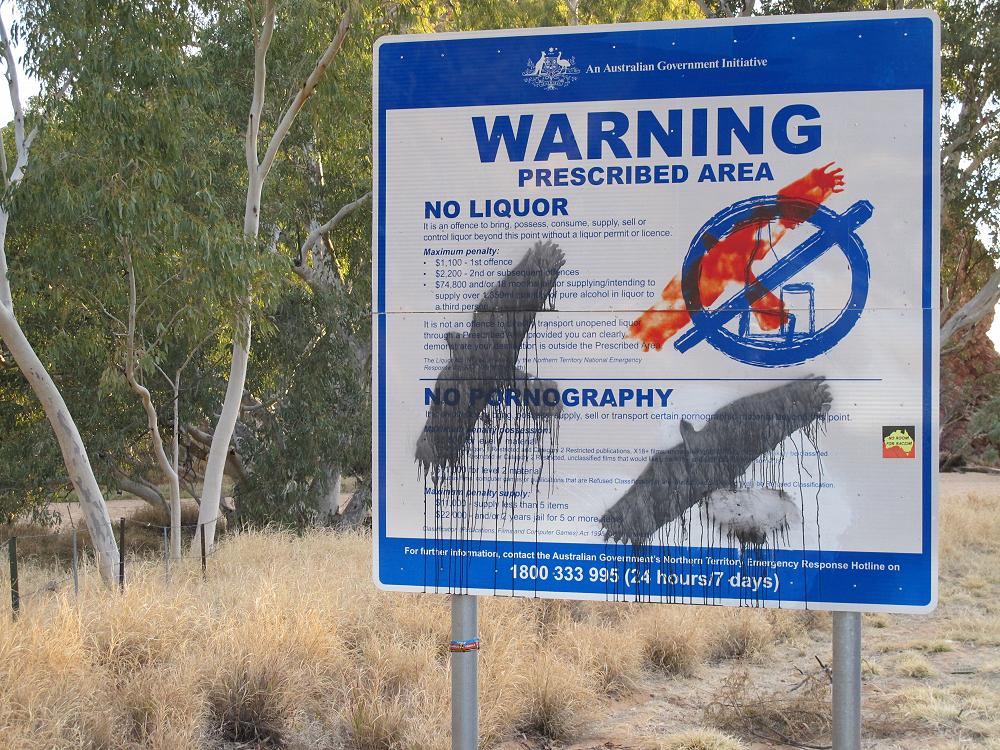
The Federal Government completely overrode the NT Government. The Australian Army was sent into communities. Children were to undergo invasive medical examinations. Huge billboards were placed at the entrance to each community forbidding alcohol, drugs and pornography to be brought into the community. The income of those on Social Security was to be “managed” by the government. Further, Aboriginal Community Councils were abolished and replaced by fly-in/fly-out Community Managers answerable only to the Government. Five-year leases of community land to the government were made compulsory and housing areas came under governmental jurisdiction.
It must be startling for Aotearoa New Zealand readers to discover that this whole shameful exercise is now in its shameful tenth year. It is an example of how successive Australian Governments have completely disregarded subsidiarity for the First Nations peoples of Australia. Today “the Intervention” continues almost unnoticed by most Australians.
There are many stories of the impact of “the Intervention”. When the Army came into communities, many of the women had flashbacks to the stark memories of the Stolen Generations years, and in fear ran off with their children. Because of protests by medical professionals, the intrusive medical examinations of children were stopped, and rightly deemed to constitute abuse themselves.
When the blue Community Entrance billboards went up, children and many adults were asking what “pornography” meant. I was in the NT capital, Darwin, on the first anniversary of “the Intervention” and people were still astounded at the gross discrimination. There were many shops stocking pornography in central Darwin — shops run by white people for whom selling pornography was (somehow) not an offence. Throughout the Territory and further, Aboriginal men felt the shame of being generally viewed as perpetrators.
Intervention Roll-Out
The government’s “income management” meant that thousands of Aboriginal people were given a BasicsCard which functioned like an EFTPOS card but only at approved stores and businesses. Half the user’s income was “quarantined” — accessed only via the BasicsCard which denied purchases of alcohol, drugs, tobacco and pornography. In practice, the Cards often malfunctioned and initially could be used only at the big stores. This meant that people had to travel huge distances at great cost to buy basic food and family requirements. Community adults and children were often stranded in the larger towns with nowhere safe to stay. The implementation cost taxpayers an average $6,000 per card.
Over the years during which Communities have been denied funding for basic necessities like housing, enormous pressure has been placed on Aboriginal communities to hand over their lands to the Government on 99-year leases.
Labor Fails the People
Perhaps the greatest shame of all, however, followed the 2007 Federal election. Both Prime Minister Howard and Minister Brough lost their seats and Labor won the election with predictably massive majorities in NT Aboriginal communities. Aboriginal voters confidently expected that the Intervention would be withdrawn. Instead successive Labor Prime Ministers, Rudd and Gillard, made only minor changes and then in 2012 actually extended the rebadged “the Intervention” for a further 10 years.
In separate legislations, the permit system into Aboriginal Lands was weakened, the nine remaining Aboriginal bilingual schools disallowed and the long-term Aboriginal Community Employment Scheme defunded. There is no space here to cite further areas of oppression, nor the regular denouncements by visiting, almost incredulous, United Nations officials. Djiniyini Gondarra OAM and Utopia Community’s Rosalie Kunoth-Monks OAM have been among the Intervention’s leading heroic opponents — nationally and internationally.
Kaurna/Narungga woman, Georgina Williams had explained to me back in 1978 how Aboriginal people are the first on the receiving end of governmental oppressive practices. When these policies are seen to “work”, they are then extended to other poor Australians. In 2012 the BasicsCard was introduced to five other areas of Australia — most with high Aboriginal populations but because of the Racial Discrimination Act (restored in a weakened form), the BasicsCard policies must also include non-Aboriginal Australians.
Shameful Policies Extended
In 2016, “Welfare” recipients in Ceduna, South Australia and East Kimberley, Western Australia (both areas with large Aboriginal populations) were placed under the “Cashless Card”, the brainchild of mining billionaire Andrew Forrest. Under the “Cashless Card”, 80 per cent of the user’s income is quarantined and certain expenses are debited directly. Indue, a for-profit organisation, operates these grey cards at the astounding cost to taxpayers of $10,000 per recipient.
Michele Harris and the advocacy group “Concerned Australians” have published several books documenting “the Intervention’s” continuing oppression. Even now, 10 years on, James Gaykamangu’s dignified image and powerful words are burned into my brain: “And now you have set up this Intervention amongst Australian Indigenous people. And we Indigenous people say we should be living together, one country, one Prime Minister, and seeing each other and treating each other equal. But nothing happens like that. You are dividing the nation in two . . . You should be shame for yourself for that.”
And where are we in the Australian Catholic Church in all this? With the notable exception of St Vincent de Paul Society’s John Falzon — not very visible.
But after so many years of being ignored and oppressed within their own country, First Nations peoples in Australia are looking further afield to their international friends (like the Kiwis) as they now call for a Treaty.
Tui Motu Magazine. Issue 2018, August 2017: 8-9.