
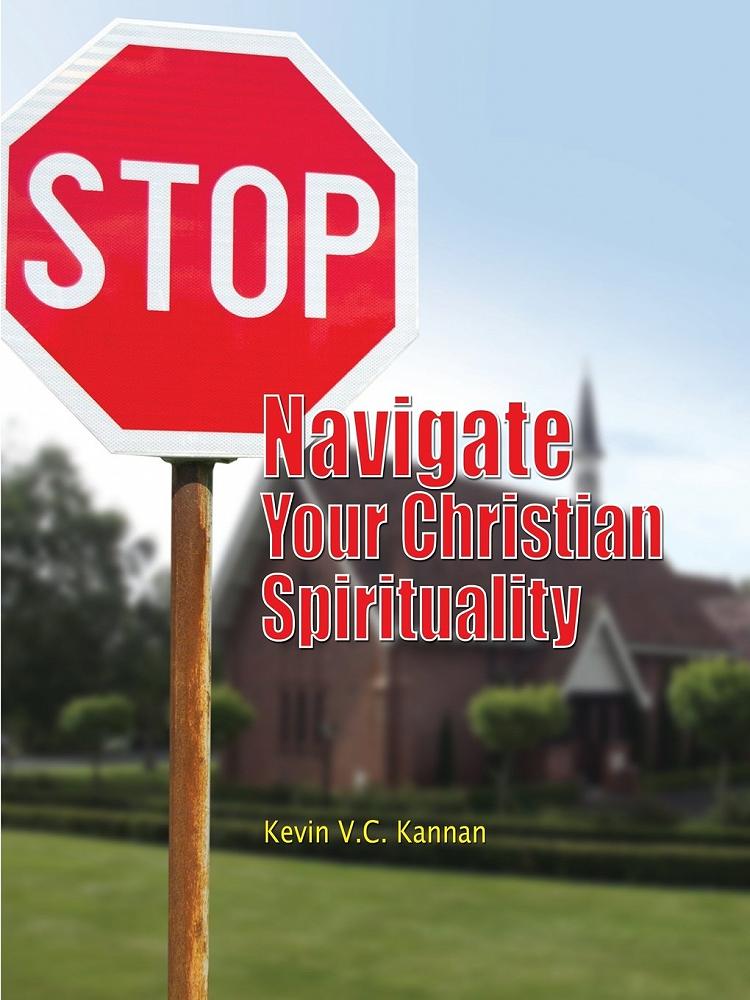
STOP - Navigate your Christian Spirituality
by Kevin V C Kannan. Published by Xulon Press, 2015. Reviewed by Anne Kennedy
This book is a self-help handbook for people interested in "seeking to understand" their spirituality within a Christian framework.
The book outlines the author’s "spiritual phase development theory" associated with the concept of spiritual imagination and people’s image of God. He describes a theory that will
“enable us to identify at what phase of spirituality we are presently at or experiencing. Once we have such an identification we can look at developing our spirituality further or deeper at an appropriate pace, in palatable amounts through the phases of life as one journeys from birth to the senior years” (p. 41).
The thesis of the book is an attempt by the author to synthesise the characteristics of his spiritual phase theory with types or phases (usually nine) of spiritual imagination, images of God, and what is referred to as areas of spiritual expression - prayer, scripture, worship, service and of sacramental love. As these are dealt with in each of the eight chapters the reader is offered scripture verses to ponder, explanatory reading material and reflective exercises with which to respond.
Towards the end of the book a summary of the phases of the spiritual expressions is included in Table 14 (p. 193) along with a "Spiritual Self-Assessment" Exercise. Guidance is given to enable the reader to get
“a rough indication of the phase of spirituality and associated spiritual imagination and the dominant image of God”
they may have at present
“to navigate them through this season” of their life.
For those attuned to the various nuances of their own spirituality the "seasons" they pass through are often less concrete than described, but for those seeking help in this area, this book may assist them to become more conscious of changes in their spiritual lives. The book views the whole concept of spirituality within a religious framework and focusses on people’s spiritual expressions within that framework.
Contemporary writers in this field are using a wider lens to view spirituality that recognises the importance of its place within religious expression but moves it beyond the monopoly that religion once held over it, especially in the language that was used to describe it. Spirituality is understood more as an awareness of the spirit alive in people, in who they are, how they relate to themselves, each other, the environment and, for many, how they relate to God.
The author has a definitive style of writing which attempts to simplify complex ideas but at the cost of a deeper understanding of the lived nature of spirituality. Perhaps, greater explanation and better referencing would help clarify some of his thinking for the reader.
While there may be some merit in using taxonomies as a guide to quantify one’s spiritual phases, the Spirit is unfettered as James K Baxter writes: “you blow where you wish to blow” and the Spirit cannot be tied down as Paul says: “Now the Lord is the Spirit, and where the Spirit of the Lord is, there is freedom” (II Cor 3:17).