
Love Is the Way Forward
Mary Thorne responds to Pope Francis's latest encyclical Dilexit Nos / Jesus Loved Us.
Dear Pope Francis,
I am a 72-year-old lay woman from Aotearoa New Zealand. My ancestry is Irish Catholic — I’m shaped by that tradition and by my family’s experience here in the South Pacific for seven generations. I think a great deal about how to communicate the deep truths of our Christian faith to the generations that follow, in ways that make sense to them. I have always experienced a hunger to study, explore and deepen my faith in God, the source of life and love.
Love Is the Centre of Global Community
I was pleased to learn that you were writing to the worldwide Catholic Church community about the centrality of love. It is a subject we need to ponder deeply at the moment. You describe the contemporary white Western worldview as dominated by insatiable consumption, in search for deep meaning and dulled by the frenetic pace of life (Dilexit Nos par 2). Our world is painfully torn by wars and aggressive division, suffering from ecological crises, and crushed by widespread depression and loss of hope. You warn us against “a dominant mindset that considers normal or reasonable what is merely selfishness and indifference.” This mindset “consolidates a ‘structure of sin’” (DN par 183).
I receive Dilexit Nos with gratitude and respect, and I have some questions. I know your recounting of the stories of many Catholic saints is motivated by love and will be welcome and meaningful to many. But I’m left asking how we can re-express our vision for the future — this is my most urgent and heartfelt question. I believe the answer is implicit in your words at the end of the document: “We are called to build a new civilisation of love” (DN par 182). “[God’s] love alone can bring about a new humanity” (DN par 219). Do we Catholics have to allow for that love to flow through many different channels?
"Sacred Heart" Paintings Have Lost Appeal
You acknowledge that some have questioned whether the heart as a symbol of love is still meaningful today (DN par 2). You trace the development of belief that the heart is the profound core of every human, where love and truth reside, from the ancient Greeks and Hebrew scriptures to the Gospels and Catholic devotion, and then to the Sacred Heart.
These days, though, medical science has changed the way we understand our bodies. I wonder whether articulating our belief in fresh ways that incorporate new understandings of science might be better received? Especially for those who are curious about both science and faith.
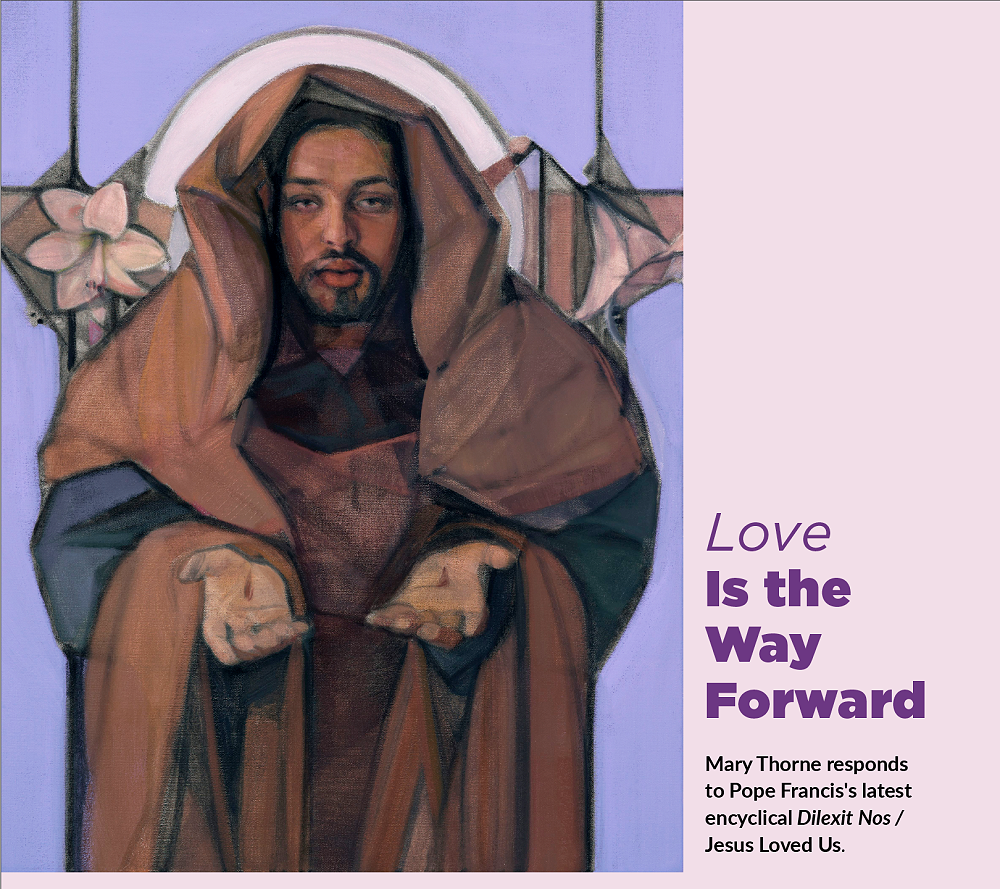
The image of the Sacred Heart was widespread in Catholic homes in Aotearoa New Zealand when I was growing up in the 1950s. But I wasn’t deeply affected by those pictures of a handsome, European-looking Jesus who pointed to his exposed heart surrounded by a crown of thorns, rays of light and sometimes even flames.
Love Inspires Discipleship
I attended Sacred Heart College in Whanganui and was taught by the Sisters of St Joseph of Nazareth. It is the teaching and care of those strong, intelligent women which influenced me and lives in my memory. Vatican II was taking place during this time and there was excitement about a dynamic church, seeing the signs of the times and moving meaningfully into the future.
The inspiration, strength and comfort of God with us, in the person of Jesus, as experienced through the gospels and throughout life lived with openness and love, is transformative.
A profound influence on my own understanding of the person of Jesus of Nazareth is Ched Myers’ commentary on Mark’s Gospel, Binding the Strong Man: A Political Reading of Mark’s Story of Jesus. Myers decribes Jesus as a resistance leader who confronts oppressive power without hate, heals, exorcises and liberates the crowds of poor and oppressed, and begins to build a restored community.
Love Invites Loving Action
In Dilexit Nos, you write: “All our actions need to be put under the 'political rule’ of the heart. In this way, our aggressiveness and obsessive desires will find rest in the greater good that the heart proposes and in the power of the heart to resist evil. The mind and the will are put at the service of the greater good by sensing and savouring truths, rather than seeking to master them as the sciences tend to do. The will desires the greater good that the heart recognises, while the imagination and emotions are themselves guided by the beating of the heart” (DN par 13).
In Aotearoa two young men, Philip McKibbin and Max Harris, have written of a politics of love. They invite us to explore a values-based politics which affirms the importance of all people, all non-human animals and the natural world within an actively inclusive framework.
Love is active in many contexts. Māori culture prioritises connection and care. The majority, coloniser community has much to learn about mutual relationships with tangata whenua. Your letter speaks to us of humility and reparation (DN par 189). This is a timely reminder to us in Aotearoa.
You are right that love is the only way forward (DN par 219). You join a great chorus of voices calling for this.
Empathy and Love
As long ago as 2013, Jonathon Porritt concluded his book The World We Made by asserting that none of the highly advanced social and technological systems that saved life on the planet in his imagined future would have made a difference without the careful cultivation of empathy.
The fostering of imagination — seeing someone else’s joy or suffering as if it were your own — lies at the heart of the education system in the world he describes. Empathy and love are close.
Thank you for acknowledging that. “The Church also needs love, lest the love of Christ be replaced with outdated structures and concerns, excessive attachment to our own ideas and opinions, and fanaticism in any number of forms, which end up taking the place of the gratuitous love of God that liberates, enlivens, brings joy to the heart and builds communities” (DN par 219). I have come to believe that an evolutionary worldview is necessary. Human thought and all of created reality is constantly evolving. We cannot afford to become stuck.
Love and Dignity
The celebration of Christmas draws near and the refrain of "peace on Earth and love of all" will resound again. Once again we ponder the mystery of “God with us, God as part of our lives, God as living in our midst” (DN par 34). We ask: If we are made of God-stuff, if God is life itself, do we live in God?
You remind us that “Jesus brought the great novelty of recognising the dignity of every person, especially those who were considered ‘unworthy’” (DN par 170). We try to be open to receive this incomprehensibly abundant love and allow it to flow through us and be medicine for our world.
Ngā mihi o te Kirihimete me te Tau Hou. Greetings for Christmas and the New Year Papa Francis and all your widespread community.
Tui Motu Magazine. Issue 299 December 2024: 8-9