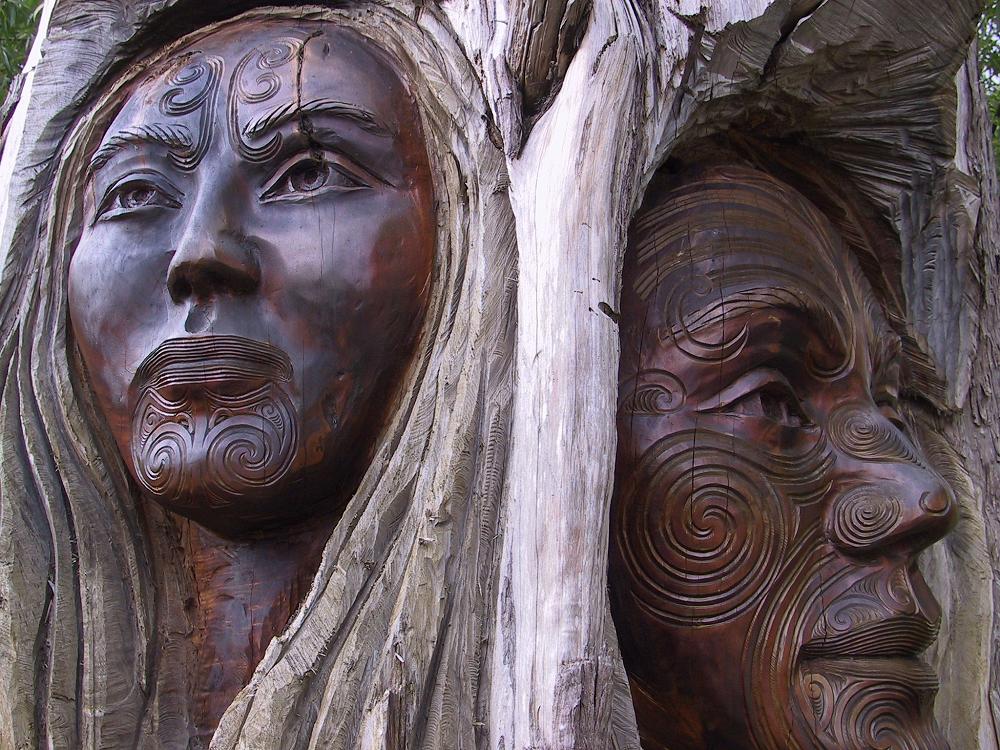
Atua, Whenua, Tangata – God, land and people
A Māori perspective on Pope Francis's encyclical Laudato Si’.
In the beginning was the Creator, for all things belong to him,
From him sprung forth the night,
The great night,
The long night,
The suspended night,
The growing night,
The moving night,
Dawn breaks to daylight, bursting forth to the world of light and understanding,
Behold the breath of life!
My perspective on Laudato Si’ is as an indigenous member of Aotearoa, one who continues to learn as much as I can about the lives and practices of my ancestors and to apply those teachings as a guide for myself. These are my own thoughts and interpretations of Māori theology which itself is a topic widely debated among all Māori. Some will agree with me, others will not.
Pope Francis’s encyclical acknowledges that nothing in this world works in isolation. He says:
“Nature cannot be regarded as something separate from ourselves or as a mere setting in which we live. We are part of nature, included in it and thus in constant interaction with it.”
My kōrero (presentation) began with a simple recitation of whakapapa (genealogy). Although whakapapa is often used to connect the speaker with those around him, I have used whakapapa here to describe the process of the beginning of the world - and thus of creation.
Whakapapa is a process of change, denoting a point of beginning and an end, from past to present and how we are all connected. Our identity is expressed through whakapapa, our deepest origins and a glimpse at a potential future.
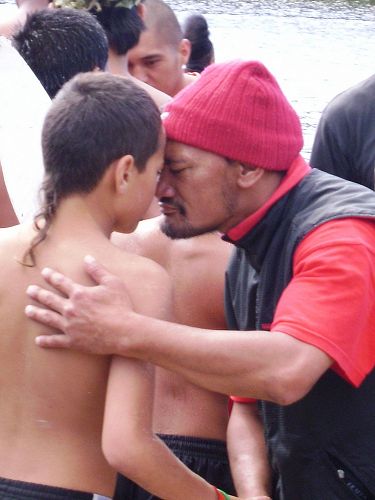
According to Māori theology, in the beginning there was nothing but darkness, Te Pō. Within Te Pō was the source of all life, te ira-Atua, the God element. Following the separation of Papatūānuku (Earth) and Ranging (Sky) by their children to create space for the light (te ao mārama), the physical world (te ao hurihuri) and its inhabitants, Tāne decided to create te ira-tangata (the human element). He did this by moulding the shape of a human woman out of sand and dirt known as Hineahuone (the woman born of sand). Together, they pressed noses and Tāne passed on his mauri (life force) over to the woman, creating the first human life.
Interrelationships of Divine, Earth and people
In this account of creation and in the biblical Genesis account, the earth is a creation of God and we are creations born of earth. It is by this whakapapa we are linked closely to God, the earth and all creation. To violate one aspect of this triangular relationship between God, earth and people is to further diminish each and every aspect of the whole.
Last year Taranaki kaumātua (elder), Henare Ngaia, told me and others from Caritas that in both Christian and Māori accounts of creation people were created last. This makes us the teina (younger sibling). All other creation, including the earth, is our tuakana (elder sibling). It is the job of the elder to provide for and protect us, while it is our role to reciprocate the relationship by showing respect towards our older siblings and listening to their words of guidance.
You could be wondering, how does one listen to an environment that does not speak verbally? Pope Francis’ words guide us:
“It is essential to show special care for indigenous communities and their cultural traditions. They are not merely one minority group among others, but should be the principal dialogue partners... For them, the land is not a commodity but rather a gift from God and from their ancestors who rest there, a sacred space with which they need to interact if they are to maintain their identity and values. When they remain on their land, they themselves care for it best.”
Within every culture, particularly indigenous cultures, the respect of our elders is regarded very highly. Our elders symbolise the greatest wells of wisdom we have direct access to. With this knowledge we are able to create a platform of understanding and add to it over the course of our lifetime. This enables us all to learn beyond our time restraints and connects us with the vast number of ancestors before us. And so it is appropriate that Pope Francis speaks of the importance of the “original culture” to determine what is needed to enhance and protect our environment, by using historical ancestral knowledge to move forward in sustainable ways.
In knowledge passed down to me through te reo Māori (the Māori language) the importance of seeking out this ancestral knowledge is also emphasised. Being a culture that places the elements of Atua, Whenua and Tangata - God, Earth and People - so highly, it is no surprise to find this perspective reflected in common terms in the language, specifically for the words past and future.
Learning from wisdom of ancestors
Te reo Māori, uses the same words for "past" and "future" as for "front" and "back". It may come as a surprise to some that unlike the English language, understandings of "going forward through time" differ from a Māori perspective of "looking towards the past". Mua, the Māori word for "front" is also the word used for the "past" (ngā rā o mua) and muri, the word for "back", is used to describe the future (ngā rā e whai muri nei). Reflecting on this and on Laudato Si’, it makes sense - we can draw on our past, what we know, as the future is still unknown to us. We literally have no eyes that can see into muri (our future).
I acknowledge the wisdom that Pope Francis and all our indigenous ancestors have imparted to us. On a personal note, it is great to see Pope Francis valuing Māori and other indigenous cultures.
It is true that all things do not work in isolation. The elements of God, Earth and People are interconnected in the world of the every day. In order for us all to move forward confidently it is imperative to draw on this knowledge. The ancient wisdom passed down over generations, locked away in the practices and beliefs of indigenous peoples, will need to be acknowledged for us to understand how to respect properly and look after our environment, our home.
Taneora Tunoho Ryall (Ngāti Raukawa) is Kaihāpai Māori at Caritas Aotearoa New Zealand, where he supports work across all the work of Caritas in areas of Māori relationships, and use of te reo Māori and tikanga Māori.
Gallery