
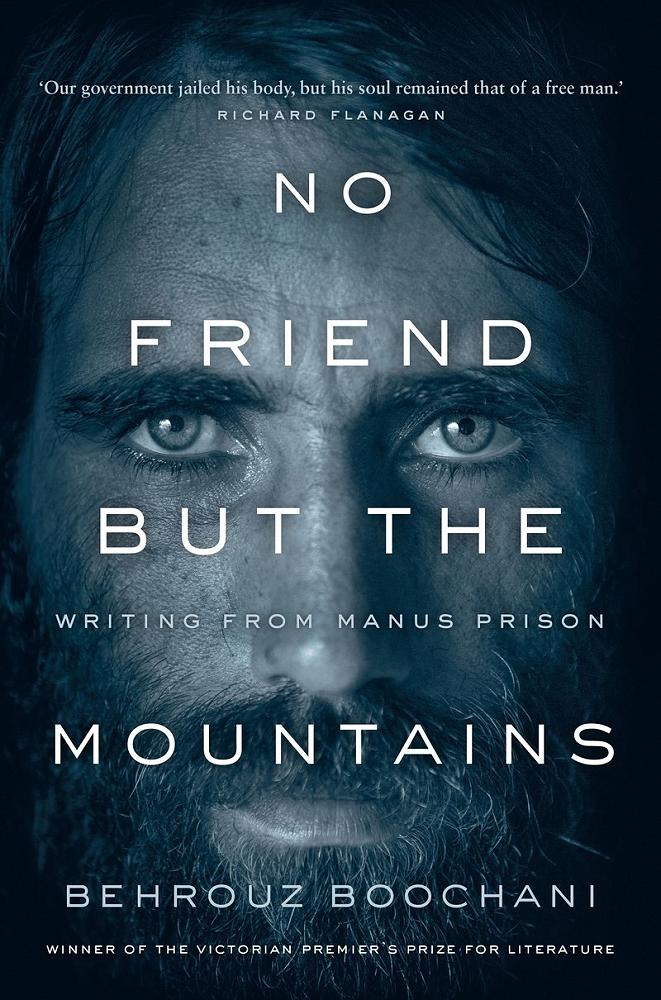
No Friend but the Mountains
by Behrouz Boochani. Published by Picador Pan Macmillan Australia, 2018. Reviewed by Susan Kane
There are times when something really hits us, and we say to ourselves “What on earth was that?" This book evokes such a reaction. You won’t enjoy it; it’s not a comfortable read. If you don’t want to be shaken up and forced to confront some disconcerting truths, it’s not for you. But if you can stay with Behrouz as he relentlessly details how misery piles upon misery in the hell-hole that is Manus, you can’t possibly emerge unscathed.
In the early part of No Friend but the Mountains, the ocean’s waves introduce Behrouz to an intimate relationship with death and fear, as he and his companions set out in a vain quest to seek refuge in Australia. In fact, the ocean is a menacing presence throughout, seen, for example, in the "manic waves" smashing the body of the island. He describes the people confined on Manus as "traumatised by the terrifying sound of waves ringing in their ears". As he develops his story of degradation and humiliation, it is the ocean which continues to separate him and his fellow prisoners from the freedom for which they had hoped.
In similar vein, I was conscious of being assailed by all sorts of waves as I read this book. As Behrouz described how conditions on Manus are designed to shatter the dignity of human beings, it was impossible not to be overcome by waves of revulsion. Sometimes the pettiness and harshness of the Australian officials (eg in refusing permission for a man to call his dying father) left me in utter disbelief. Waves have a way of upending us, tossing us about, and landing us in places not of our choosing. This book does those very things. Waves of astonishment, leading to new perceptions and understanding, can overwhelm the reader. Are these brutish, oppressive, merciless conditions actually being enforced, in our name, upon people who have committed no crime?
Behrouz takes us by the scruff of the neck, forcing us to confront the realities he so bluntly describes. The weight of sorrow expressed in the book can at times be almost suffocating. It is hard to comprehend that the people on Manus are being made examples in order to strike fear into others. One cannot avoid the inevitable questions. What has happened to our sense of fair play? Is it really the Australian way to set up a culture of systemic violence, turning people against one another and deliberately inciting violence? And what of the officers, who watch over people with a mixture of "contempt" and "barbarism". We learn that their approach to work is "based on being a bastard".
The book’s title, an invocation of an old Kurdish proverb, works to remind us that in this friendless universe, the only weapons the author has, with which to fight this tyranny, are his words. He wields them with considerable power and intensity. The poetry interweaving the text evokes a sense of the existential anguish of human beings deprived of hope. The book is a fitting testimony to the power of the human spirit to resist, and to name the evil which masquerades as legitimate government policy in today’s Australia.
Condensed Version
No Friend but the Mountains is not a comfortable read. If you can stay with Behrouz as he relentlessly details how misery piles upon misery in the hell-hole that is Manus, you can’t possibly emerge unscathed. Kurd journalist Behrouz and his companions set out in a vain quest to seek refuge in Australia but are interred on Manus Island. As Behrouz described how conditions on Manus are designed to shatter the dignity of human beings, it was impossible not to be overcome by waves of revulsion. Sometimes the pettiness and harshness of the Australian officials (eg, refusing permission for a man to call his dying father) left me in utter disbelief. The weight of sorrow expressed in the book can at times be almost suffocating.
The book’s title, an invocation of an old Kurdish proverb, remind us that in this friendless universe, the only weapons the author has to fight this tyranny, are his words. He wields them with considerable power and intensity. The poetry interweaving the text evokes a sense of the existential anguish of human beings deprived of hope. The book is a fitting testimony to the power of the human spirit to resist and to name the evil which masquerades as legitimate government policy in today’s Australia.
Tui Motu Magazine. Issue 244 December 2019: 31